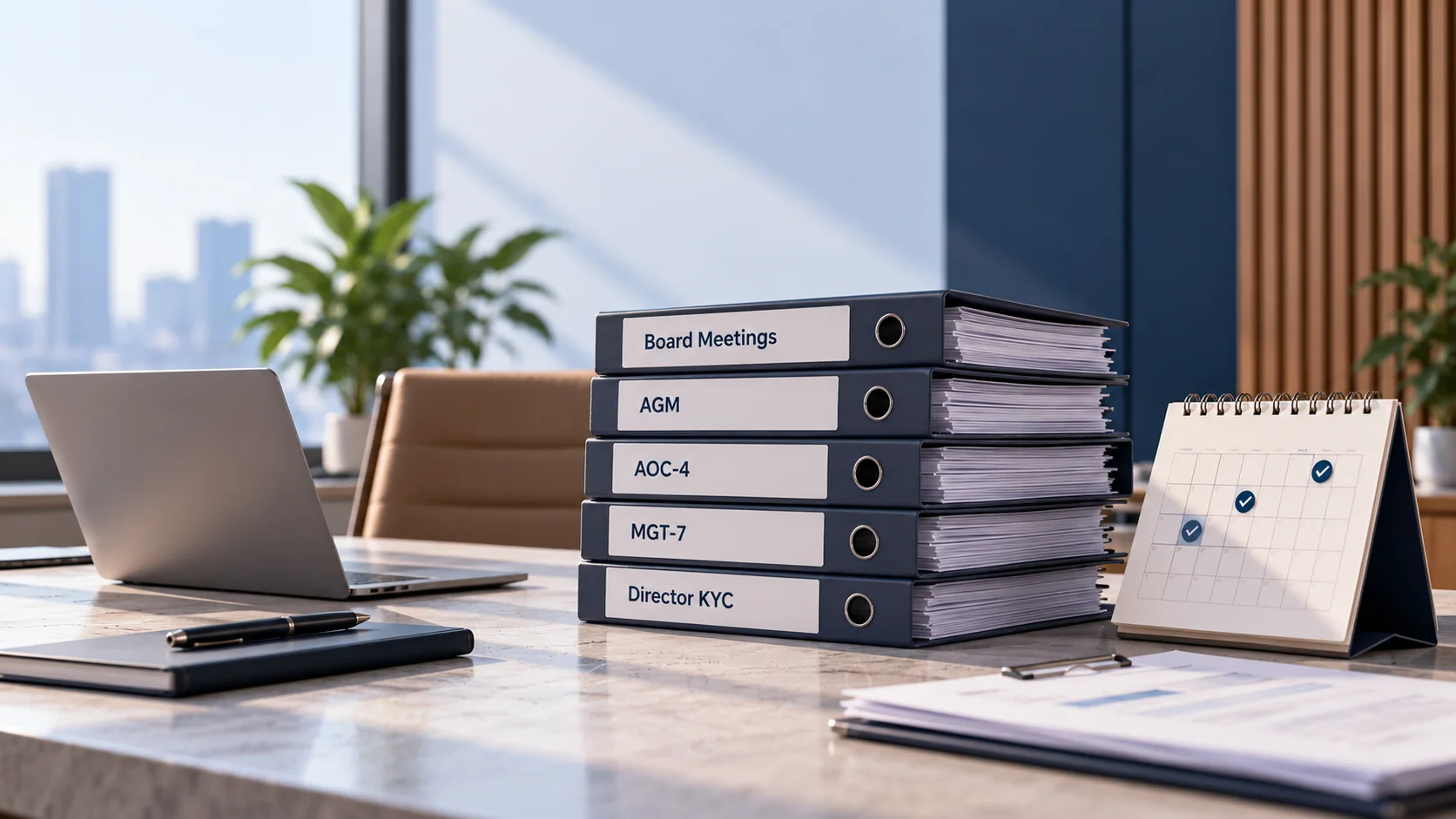
Form AOC-4 filing is the process through which every registered company in India submits its finalized financial statements to the Registrar of Companies each year, balance sheet, profit and loss account, supporting schedules, along with the auditor's and board's reports. It's one of the two central ROC annual filings, alongside Form MGT-7, and because it depends entirely on the company's finalized accounts, its accuracy and timeliness are only as good as the bookkeeping and financial statement preparation that feed into it. Livida prepares and files AOC-4 for India-based companies, often as a direct continuation of the accounting work we already do.
Key Takeaways
- Form AOC-4 filing submits a company's finalized financial statements, auditor's report and board's report to the Registrar of Companies.
- It can only be filed once accounts are finalized and adopted at the AGM, so bookkeeping quality drives the timeline.
- Some companies must file in XBRL format, and the right format needs to be confirmed each year.
- A late filing costs an escalating government fee, while an inaccurate one stays on the public record.
- Livida can prepare the statements and file AOC-4 from the same records.
Form AOC-4 Filing at a Glance
| Item | Detail |
|---|---|
| Who it suits | Every registered company in India |
| What we handle | Format check, form preparation, submission on the MCA portal |
| Typical documents | Adopted financial statements, auditor's report, board's report |
| What happens next | Filing within the AGM-linked window, then MGT-7 |
What Goes Into AOC-4
The form itself carries the company's full set of financial statements for the year, along with the auditor's report, the board's report, and, where applicable, details of subsidiaries or related party transactions. This is the filing that makes a company's financial position publicly accessible through the MCA portal, which is why the numbers need to genuinely reconcile, an AOC-4 filing that doesn't match a company's actual books, even if the mismatch is unintentional, creates a public record that can complicate later scrutiny, whether from lenders, investors, or tax authorities cross-referencing filings.
Why Bookkeeping Quality Determines Filing Timing
AOC-4 can only be filed once financial statements are finalized and formally adopted at the AGM, which means the filing deadline is really a downstream consequence of how smoothly the accounting and audit process went earlier in the year. A company that keeps its books current throughout the year, reconciled transactions, resolved discrepancies as they arise, tends to finalize its accounts without a scramble, while a company that compresses a year of bookkeeping into the weeks before its AGM often finds the AOC-4 deadline harder to meet cleanly. This is part of why Livida treats bookkeeping and AOC-4 filing as connected rather than separate services.
When XBRL Applies
Certain companies, generally larger companies or those meeting specific financial thresholds under the Companies Act, are required to file AOC-4 in XBRL format, a structured data format rather than the standard PDF-based form. Filing in the wrong format, or missing an XBRL requirement that applies to a company, can result in the filing being treated as non-compliant even if the underlying financial information is accurate. Livida checks applicability against current thresholds before preparing each year's filing.
Livida's Form AOC-4 Filing Process
For clients where we also handle bookkeeping, we work from the same financial records used to finalize the statements, which keeps the AOC-4 filing consistent with what the company's books actually show, rather than reconciling two separate versions of the numbers at filing time. We confirm whether XBRL applies, prepare the form with the finalized financial statements, auditor's report, and board's report, and file within the window set by the AGM date. For clients who handle their own bookkeeping or use a separate accountant, we coordinate closely to make sure the figures used for filing are the final, adopted set.
Why Getting This Right Matters Beyond the Deadline
AOC-4 is often the filing that outside parties look at first when assessing a company's financial credibility, since it's the public source for a company's actual financial statements. A late filing costs an escalating government fee, but an inaccurate one carries a longer tail of risk, since it's part of the record a bank, investor, or auditor may reference well after the filing window has closed. If your company's AOC-4 needs to be prepared and filed, Livida can handle this alongside your accounting so the numbers are consistent from the books through to the filing.
Five Steps in Form AOC-4 Filing
A clean Form AOC-4 filing usually follows this order:
- Keep books current and reconciled through the year.
- Finalize the financial statements and complete the audit.
- Hold the AGM and adopt the statements.
- Confirm whether the standard form or the XBRL version applies, then prepare the form.
- File on the MCA portal within the window set by the AGM date.
In the filings we handle, the most common delay is accounts that are not final when the AGM is scheduled. Our team asks for the audit sign-off date early, and we recommend fixing the AGM date only after that date is known.
Related ROC Filings
AOC-4 is one half of a company's core annual compliance. Livida also handles:
- Form MGT-7 Filing, the structural annual return that's due on its own separate timeline alongside AOC-4
- ROC Annual Filing, for businesses that want their full annual ROC compliance calendar managed together
Professional standards for preparing the financial statements and auditor's report that feed into AOC-4 are set out by bodies such as the Institute of Chartered Accountants of India (ICAI).
For the structural return that follows, see Form MGT-7 Filing. Companies that want the whole annual cycle managed can look at Annual Compliance for Private Limited Companies, DIR-3 KYC Filing and Statutory Audit Readiness Review. Our guide to annual ROC compliance for a private limited company explains how these filings fit together.
Conclusion
Form AOC-4 filing is a downstream result of good accounting. Current books, a settled audit and an adopted set of statements make the filing straightforward, accurate and on time. This page is general information, not professional advice, and rules, thresholds and due dates change, so confirm current requirements on the official portal or with a qualified professional before acting.
References
- Companies Act, 2013: copy of financial statement to be filed with Registrar, on India Code
- Ministry of Corporate Affairs: XBRL filing
Talk to Livida
To have your AOC-4 prepared and filed alongside your accounting, talk to our team. Use our India contact page, email info@livida.in or call +91 94860 33194.