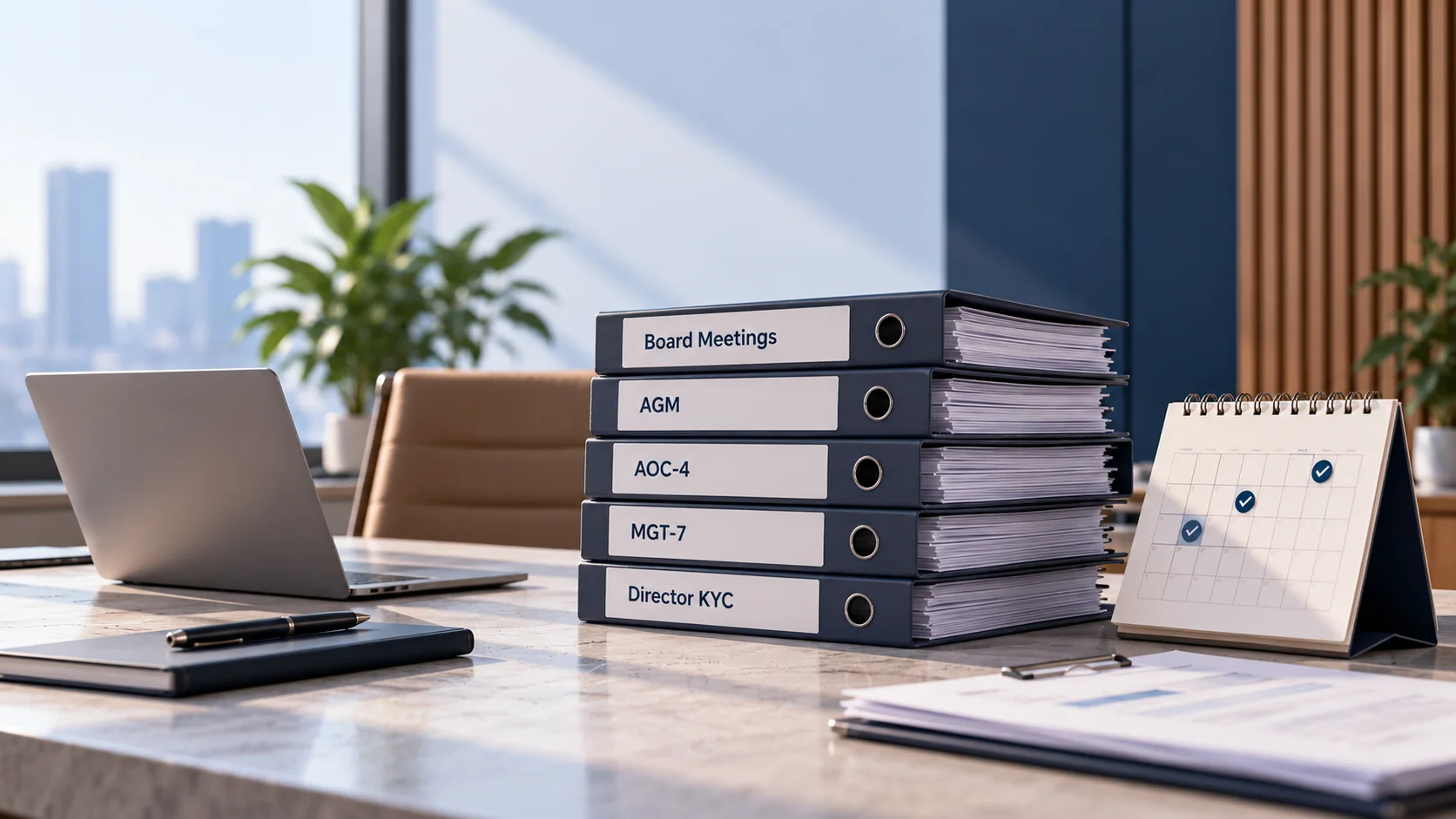
Annual ROC compliance private limited companies must plan for is not one filing, it is a year-round rhythm. Board meetings must be spaced out, accounts must be closed and audited, shareholders must meet, and two main forms must reach the Registrar of Companies within fixed days of the annual general meeting. Missing any link in that chain creates a default that grows with each passing day.
This annual ROC compliance private limited checklist walks a company through the whole year in plain order. It covers board meetings, the AGM, financial statements, the auditor, AOC-4, MGT-7 and MGT-7A, DIR-3 KYC, the income tax return and the statutory registers, followed by a compliance calendar and a plain account of what late filing can cost. It is general information based on the official sources listed in the References section, not professional advice, and rules and due dates change, so confirm current details on the MCA and Income Tax portals.

Annual ROC Compliance Private Limited: What It Covers
When people talk about annual ROC compliance, they usually mean the filings a company makes with the Registrar of Companies after its books close. In practice, those filings depend on events that happen earlier in the year: a board approves accounts, an auditor signs a report, and members adopt the statements at an AGM. So a sensible checklist starts with the meetings and ends with the filings.
The Companies Act, 2013 sets most of the obligations, the Companies Rules fix the forms and details, and the Income-tax Act adds the tax return. Three features of a company shape what applies to it:
- Whether it is a One Person Company, a small company or an ordinary private company
- Whether it has had any transactions, borrowings, deposits or foreign investment during the year
- Whether it has crossed thresholds that trigger extra duties such as secretarial audit or a CSR committee
In our experience, most private limited companies share the same core cycle, and the differences lie in the extras. That is why the checklist below begins with the core and then covers the add-ons.

Annual ROC Compliance Private Limited: The 9-Step Checklist
Work through these nine steps in order each year. The step numbers are a planning aid, not a legal sequence, although the filings really do depend on the meetings that come before them.
Step 1: Hold Board Meetings on Schedule
For annual ROC compliance private limited companies, board meetings come first. Section 173 requires the board to meet within thirty days of incorporation and then at least four times a year, with no more than 120 days between two consecutive meetings. Notice of a board meeting must be given at least seven days in advance in writing, unless urgent business calls for shorter notice with the safeguards the section describes. Directors can join by video conferencing.
One Person Companies, small companies and dormant companies are treated as compliant if they hold at least one meeting in each half of the calendar year with a gap of at least ninety days between the two. Whichever rule applies, the minutes must be written up and kept within thirty days of each meeting under section 118.
Step 2: Close the Books and Prepare Financial Statements
Section 128 requires a company to keep books of account on the accrual basis and double entry system, at its registered office or another place in India with notice to the Registrar. They can be kept in electronic mode. After year end, the accounts are finalised into financial statements that follow Schedule III and the accounting standards, as section 129 provides.
The board approves the financial statements under section 134 before they are signed and sent to the auditor, and the auditor's report is attached. A Board's report accompanies the statements and covers matters such as the number of board meetings and the directors' responsibility statement. The most common delay we see at this stage is incomplete bank reconciliations and unreconciled loans from directors, which stall the audit. Our statutory audit readiness review is built to catch those gaps before the auditor does.
Step 3: Appoint and Maintain the Statutory Auditor
The first auditor must be appointed by the board within thirty days of registration. If the board does not, the members appoint one within ninety days at an extraordinary general meeting. After that, section 139 requires the company to appoint an auditor at its first AGM, to hold office until the conclusion of the sixth AGM, subject to the auditor's written consent and eligibility certificate.
Once appointed, the company must inform the auditor and file a notice of appointment with the Registrar within fifteen days of the meeting at which the auditor is appointed. That filing is made in Form ADT-1. The Act treats reappointment as an appointment, so a fresh notice follows each appointment or reappointment made at a general meeting.
Step 4: Call and Hold the Annual General Meeting
Section 96 requires every company other than a One Person Company to hold an AGM each year, with no more than fifteen months between meetings. The AGM must be held within six months of the end of the financial year, and the first AGM within nine months of the close of the first financial year. If the first AGM is held on time, the company need not hold an AGM in the year of its incorporation.
A general meeting needs at least twenty-one clear days' notice under section 101, although a shorter notice is possible for an AGM with the consent of at least ninety-five per cent of members entitled to vote. The AGM typically takes up adoption of the accounts, the report of the Board and the auditors, and appointment or reappointment of directors and auditors. Our team prefers to circulate the notice and the annexed financial statements in a single pack, so that no document is missing when members sign.
Step 5: File Financial Statements in Form AOC-4
This is the first of the two main annual ROC compliance private limited filings. Section 137 requires a copy of the adopted financial statements, with the attached documents, to be filed with the Registrar within thirty days of the AGM, along with any additional fee. If the AGM is held on 30 September, the thirtieth day is 30 October. A One Person Company files within 180 days of the close of the financial year.
If the statements are not adopted at the AGM, the unadopted statements are still filed within thirty days and the Registrar records them as provisional. If no AGM is held at all, the statements are filed within thirty days of the last date by which the AGM should have been held, with a statement of reasons. Our Form AOC-4 filing service prepares the form from the signed accounts.
Step 6: File the Annual Return in Form MGT-7 or MGT-7A
Section 92 requires every company to file its annual return with the Registrar within sixty days of the AGM. The return covers the registered office, principal business activities, shareholding, directors and key managerial personnel, meetings held and their attendance, remuneration, and penalties imposed, among other matters. Where the company is a listed company or one with prescribed paid-up capital or turnover, a practising company secretary must certify it.
The Act also allows an abridged form of annual return for One Person Companies and small companies, which is why those companies file Form MGT-7A while others file Form MGT-7. A small company is defined in the Act by paid-up capital and turnover limits that the Central Government can raise up to a stated ceiling, so check the current limits before assuming that your company qualifies. Our Form MGT-7 filing service covers both forms.
Step 7: Complete Director KYC and Disclosures
Director KYC changed recently. According to a Ministry of Corporate Affairs press release dated 1 January 2026, the annual KYC under rule 12A of the Companies (Appointment and Qualification of Directors) Rules, 2014 was replaced by a simpler KYC intimation once in every three years, with effect from 31 March 2026. Directors who had completed their KYC before the change have their next filing due by 30 June 2028. The same form can be used to update a mobile number, email address or residential address.
Separate from KYC, section 184 requires each director to disclose their interests in other entities at the first board meeting in which they participate and at the first board meeting of every financial year, or after any change. Companies usually collect these disclosures, and a declaration that the director is not disqualified, at the first meeting of the year. Our DIR-3 KYC filing service helps directors keep their DIN active, and our add or remove director service handles board changes.
Step 8: File the Income Tax Return and Tax Audit Report
A company that does not claim exemption under section 11 files its income tax return in Form ITR-6, according to the Income Tax Department's guidance for domestic companies. Where the company is subject to a tax audit, the audit report in Forms 3CA to 3CD is due one month before the return due date. Companies with international or specified domestic transactions also file Form 3CEB.
For assessment year 2026-27, the Central Board of Direct Taxes announced on 28 September 2026 that the return due date for persons subject to audit, which was 31 October 2026, has been extended to 21 November 2026, and that the date for the audit report has moved from 30 September 2026 to 21 October 2026. A formal order was said to follow, so check the portal for the final position and for dates that differ for companies with certain cross-border transactions. Our income tax return filing service coordinates the return with the audited accounts.
Step 9: Maintain Registers, Minutes and Filings Through the Year
Statutory registers are not filed with the Registrar, but they must exist and be current. Section 88 requires registers of members, debenture holders and other security holders. Other provisions require a register of directors and key managerial personnel (section 170), a register of charges (section 85), a register of contracts in which directors are interested (section 189) and a record of loans and investments (section 186) where those apply.
Resolutions of the kind listed in section 117, such as those altering the articles, must be filed with the Registrar within thirty days of being passed. A new company with share capital must also file a declaration of commencement of business within 180 days of incorporation under section 10A. Our article on cloud document management and statutory records explains how to keep these records usable.
Annual ROC Compliance Private Limited Calendar (31 March)
The tables below line up the main items for a company with a financial year ending 31 March. They use the statutory periods verified in the Companies Act and the CBDT announcement above, and the example dates assume an AGM on 30 September. First, the items that run through the year.
| Item | Timing |
|---|---|
| Board meetings | Four a year, gap of 120 days or less |
| Director disclosures | First board meeting of the year |
| DIR-3 KYC | Every third year, by 30 June |
| Minutes | Within 30 days of each meeting |
| Resolutions needing filing | Within 30 days of passing |
Next, the filings that follow the AGM.
| Item | Timing | Example date |
|---|---|---|
| AGM notice | 21 clear days before the AGM | By 8 September |
| AGM | Within six months of year end | By 30 September |
| ADT-1 | 15 days after the appointing meeting | By 15 October |
| AOC-4 | 30 days after the AGM | By 30 October |
| MGT-7 or MGT-7A | 60 days after the AGM | By 29 November |
| Tax audit report and ITR-6 | Announced by the CBDT each year | See current notice |
Two cautions apply. First, annual ROC compliance private limited deadlines hang on the AGM date, so a late AGM pushes every later date forward and increases the risk of default. Second, a company with a different year end should shift the dates accordingly.
What Changes for OPCs and Small Companies
Annual ROC compliance private limited rules are lighter for some companies. The Companies Act gives lighter treatment to some companies. A One Person Company does not need to hold an AGM, files its financial statements within 180 days of the close of the financial year, and files an abridged annual return. OPCs, small companies and dormant companies can meet the board meeting requirement with one meeting in each half of the calendar year, at least ninety days apart. The annual return of a small company is signed by the company secretary or, where there is none, by a director.
These reliefs depend on meeting the legal definition. The Act defines a small company by reference to paid-up capital and turnover and excludes holding and subsidiary companies, Section 8 companies and companies governed by special Acts. Whether your company qualifies depends on current limits, so verify them each year. Our guide to private limited, LLP and OPC structures explains how the choice of structure affects the compliance load.
Other Filings and Event-Based Compliance
Beyond the annual ROC compliance private limited cycle, some obligations arise only when a company does something, or when it crosses a threshold. Examples include filings for deposits and loans, the half-yearly return for dues to micro and small enterprises, and the declaration of significant beneficial ownership. Companies that cross prescribed thresholds also face extra duties: a CSR committee applies when the Act's net worth, turnover or net profit limits are met, and secretarial audit and key managerial personnel requirements apply to prescribed classes.
Our recommendation is to run a short event review at every board meeting. Ask four questions: did we pass any resolution that must be filed, did a director, address or capital change, did we borrow or lend, and did we sign any contract with a related party. A yes to any of them probably means a form, and the time limit usually starts running from the event rather than from year end.
Annual ROC Compliance Private Limited: Cost of Late Filing
The Companies Act sets out the consequences in general terms, and the details are worth knowing because they grow with each day of delay.
- Additional fees. Forms filed late carry additional fees under the Companies Rules, on top of the normal fee.
- Penalties on the company and officers. For late financial statements (section 137) and a late annual return (section 92), the Act sets a base penalty plus a daily amount for continuing failure, up to a stated maximum for the company and a lower one for each officer in default.
- AGM default. Failure to hold an AGM can lead to a fine under section 99, with a further daily fine.
Two consequences reach the directors personally.
- Director disqualification. Under section 164(2), a person who is or has been a director of a company that has not filed financial statements or annual returns for three continuous financial years cannot be reappointed, or appointed elsewhere, for five years.
- KYC problems. A director who does not complete KYC risks having the DIN flagged, which can block filings.
The practical lesson is that a late filing is almost always cheaper than no filing. Because the maximum penalties are capped per default but multiply across forms and years, one missed AGM can quietly become several defaults. If your company is behind, the sensible step is to catch up in sequence, starting with the oldest year. Our ROC annual filing service can help, and the annual compliance service for private limited companies is built for companies that want the calendar managed.
Building a Routine That Prevents Defaults
Compliance goes wrong less from ignorance than from drift. To keep annual ROC compliance private limited work on track, a few habits help:
- Fix the AGM date at the start of the year and work backwards to the audit, accounts and notice dates.
- Book board meeting dates for the year in advance, so the 120-day gap never becomes a problem.
- Keep a single shared folder with signed minutes, resolutions, registers and approvals.
- Ask the auditor for a timetable at the start of the audit, not at the end.
- Review director KYC status, registered office details and signatory authority every quarter.
In the filings we handle, the most common delay is waiting for one signature or one missing document, such as a signed board resolution or a director's disclosure. Treat those as the critical path. If you are still at the incorporation stage, our guide on how to register a private limited company in India explains what to set up so that the first year's compliance starts cleanly.

Key Takeaways
- Annual ROC compliance private limited companies must handle runs on a cycle: board meetings, accounts, audit, AGM, AOC-4, MGT-7 or MGT-7A, KYC and tax return.
- AOC-4 is due within thirty days of the AGM, and the annual return within sixty days.
- The AGM falls within six months of year end, and the first within nine months of the first year end.
- Director KYC is now once in three years, with the next filing due by 30 June 2028 for directors who had completed it.
- Check the current notice for ITR-6 and tax audit dates.
- Late filing brings additional fees, daily penalties and a risk of director disqualification.
Talk to Livida
If you want help with annual ROC compliance private limited company filings, you can reach us through our contact page, by email at info@livida.in, or by phone at +91 94860 33194. We will review your calendar, filings and open defaults and explain the options. We do not guarantee outcomes that depend on regulators, and this article is general information rather than professional advice.
References
- Companies Act, 2013 (India Code)
- MCA replaces annual KYC with KYC once in three years (PIB, 1 January 2026)
- CBDT extends ITR due date for audit cases, AY 2026-27 (PIB, 28 September 2026)
- Domestic company return guidance, AY 2026-27 (Income Tax Department)
- Ministry of Corporate Affairs portal