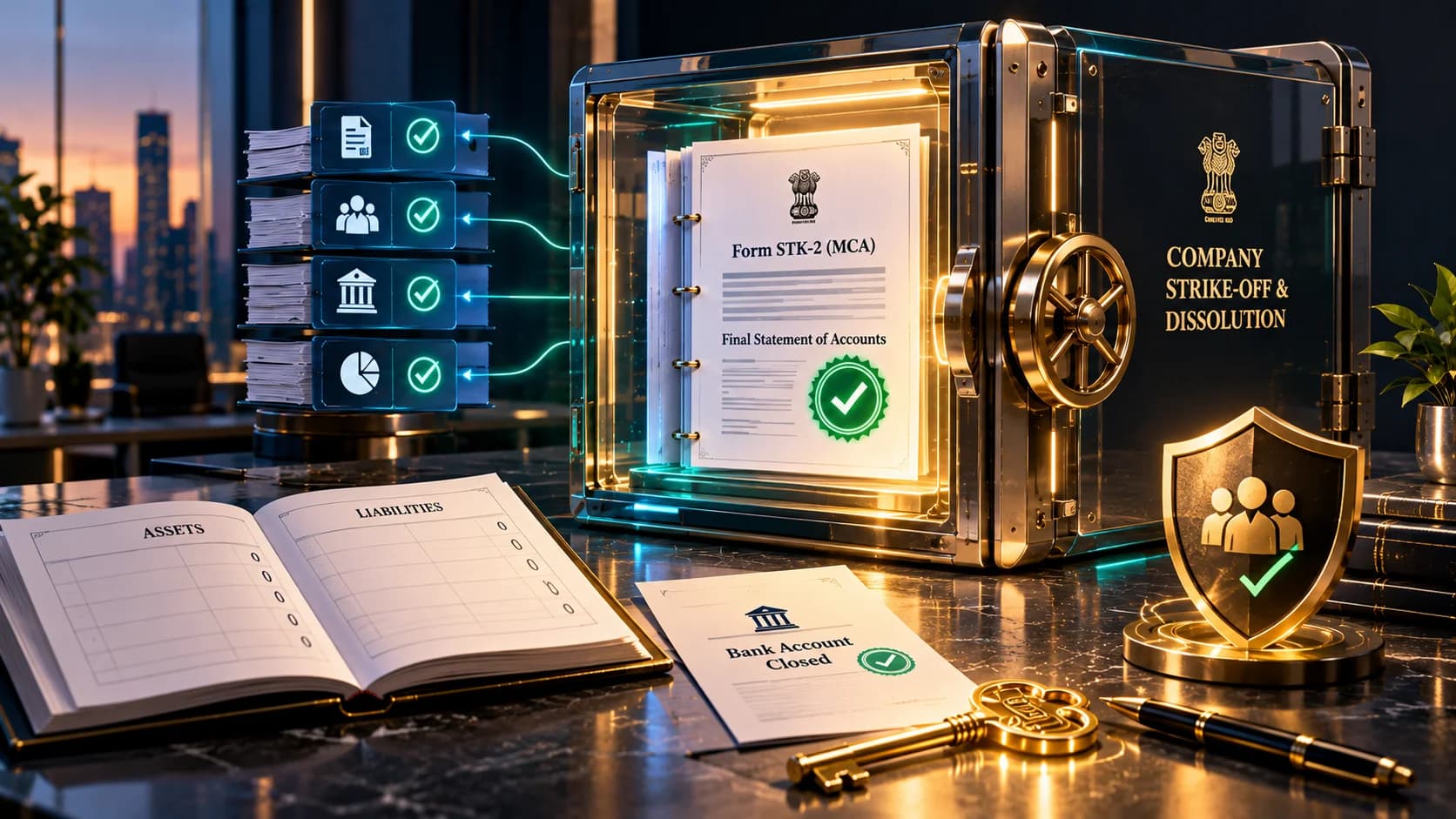
Not every company that stops operating needs a formal winding-up process. For a company that has genuinely gone inactive, with no significant assets or liabilities to settle, company strike-off India offers a simpler route to formally close the entity with the Registrar of Companies (ROC) rather than leaving it dormant and accumulating compliance obligations indefinitely. Livida's company strike-off assistance service is built for India-based companies in this situation, handling the filings and cleanup needed to close things out properly.
Key Takeaways
- Company strike-off India is a simplified closure route for inactive companies with no significant assets or liabilities.
- Pending annual returns and financial statements are usually the slowest part, so they come first.
- Companies with real assets, creditors or litigation generally need voluntary liquidation instead.
- A board resolution, shareholder approval and closed bank accounts are standard parts of the application.
- Livida's team assesses eligibility before anything is filed, which avoids rejections partway through.
When Company Strike-Off India Is the Right Route
Strike-off suits companies that either never commenced business after incorporation or have been inactive for a defined period without applying for dormant status, and that don't have pending litigation, significant liabilities, or ongoing regulatory matters that would require a more formal winding-up process. If a company has real assets to distribute or creditors to settle, strike-off generally isn't the appropriate route, and voluntary liquidation becomes the more suitable path instead. Getting this assessment right at the outset avoids filing an application that gets rejected partway through.
What the Process Involves
Before applying, any pending statutory filings, annual returns, financial statements, and income tax returns typically need to be addressed, since the ROC reviews a company's compliance history as part of the application. The company must also close its bank accounts, settle any outstanding liabilities, and obtain a board resolution and shareholder approval authorizing the strike-off application. Once filed, the ROC publishes a public notice inviting objections, and if none are raised within the notice period, the company's name is struck off the register and it ceases to exist as a legal entity.
A strike-off application generally requires:
- Pending annual returns and financial statements brought up to date
- Closed bank accounts and settled outstanding liabilities
- A board resolution and shareholder approval for the application
- A statement of accounts and supporting documentation
- No pending litigation or unresolved regulatory matters
If your company has assets or liabilities still to settle, voluntary liquidation is the more appropriate route rather than strike-off. Companies unsure whether to close or simply pause can also review our dormant company status service as an alternative.
Why Pending Filings Are the Most Common Holdup
Companies seeking strike-off have often been inactive for a while, which usually means a backlog of unfiled annual returns or financial statements. Sorting this out, rather than hoping it goes unnoticed, is part of a clean closure: an application filed with outstanding compliance gaps is more likely to face delays or rejection than one where the company's filing history is in order.
Livida's Process
We begin by assessing whether your company actually qualifies for strike-off or whether its situation calls for a different closure route. Where strike-off applies, we help bring pending filings up to date, prepare the board and shareholder resolutions, compile the required documentation including the statement of accounts, and manage the full application with the ROC through to final approval. Because Livida already supports India-based companies with annual filings, GST, and TDS compliance, we can also close out any final-year filings that need to be completed alongside the strike-off application itself.
Why This Is Worth Handling Carefully
An improperly filed strike-off application, or one filed without confirming eligibility, risks rejection, delay, or complications down the line if a liability surfaces after the company is struck off that wasn't properly addressed first. Closing a company cleanly protects the promoters from those loose ends resurfacing later, and clearing any outstanding ROC annual filing obligations beforehand, along with guidance from resources like the ICAI on closure documentation standards, helps the application go through without delay. If your company has gone inactive and you're ready to close it formally, Livida's team can assess eligibility and manage the strike-off process end to end.
Company Strike-Off India in 5 Steps
What is the order of work? Based on the filings we handle, this sequence keeps the application clean:
- Confirm the company qualifies for strike-off and not a different closure route.
- Bring pending annual returns, financial statements and income tax returns up to date.
- Close bank accounts, settle liabilities and prepare the statement of accounts.
- Pass the board resolution and obtain shareholder approval for the application.
- File with the Registrar, then track the public notice period through to the final strike-off.
Strike-Off at a Glance
| Item | What to know |
|---|---|
| Who it suits | Inactive companies with no significant assets or liabilities |
| What we handle | Eligibility check, backlog filings, resolutions, ROC application |
| Typical documents | Statement of accounts, resolutions, bank closure proof |
| What happens next | Public notice period, then removal from the register |
What Experience Shows
In the filings we handle, the most common delay is an unfiled annual return from an earlier year, not the strike-off application itself. Our team therefore reviews the full filing history first, and we recommend doing so before any resolutions are signed. To see what keeping a company active involves, read our guide to private limited company registration and the annual ROC compliance guide.
Talk to Livida
If your company has gone inactive and you want to know whether strike-off fits, get in touch through our contact page. You can also email info@livida.in or call +91 94860 33194, and we will review the company's position with you.
Conclusion
Company strike-off India works well when a company is truly inactive and its filings are in order. Check eligibility first, clear the backlog, and let the Registrar process a complete application. This page is general information, not professional advice, and rules change, so confirm current requirements on the official portals before acting.