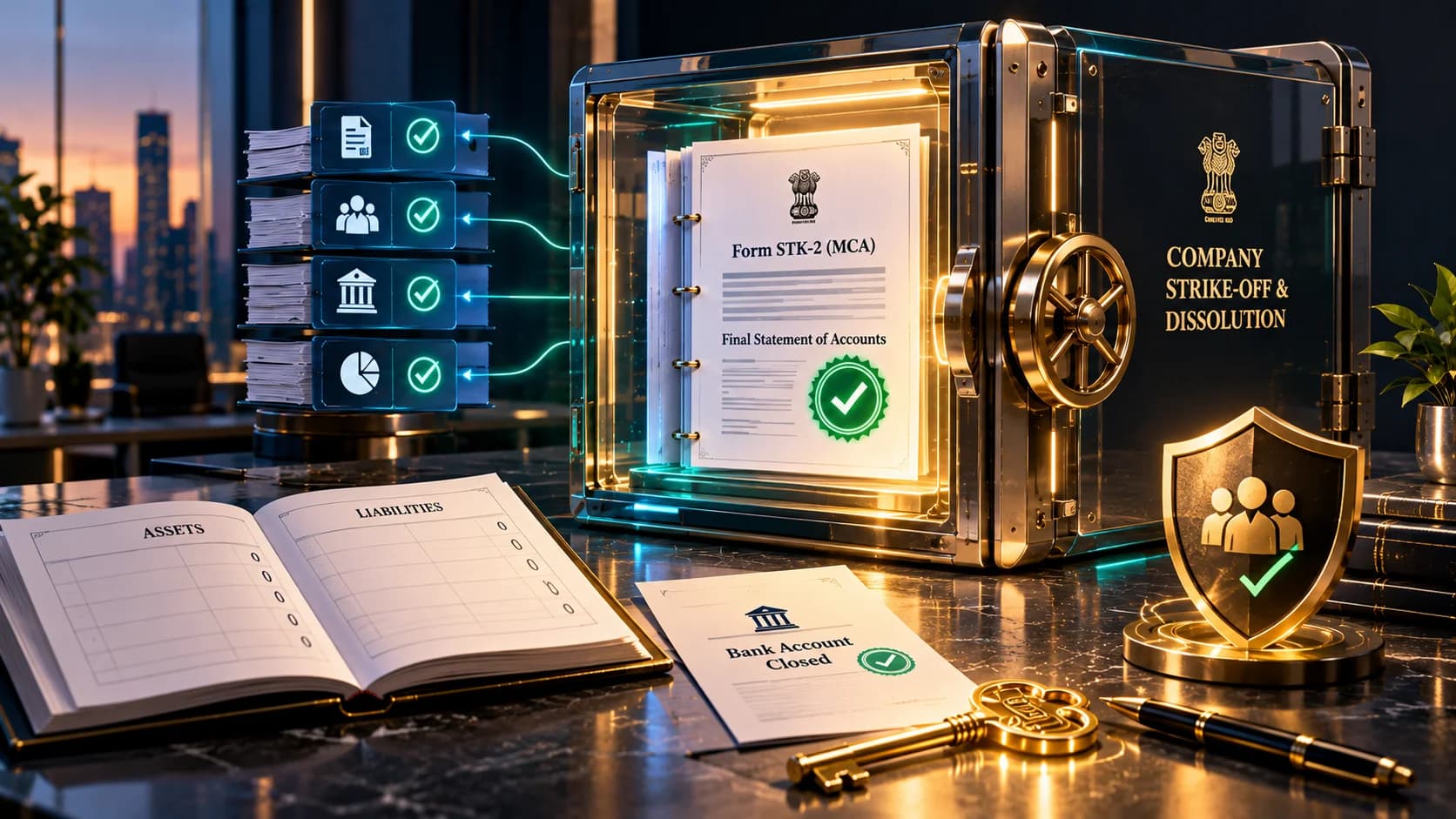
When a solvent company decides to close its operations, whether the business has run its course, the promoters are moving on, or a group is consolidating multiple entities into one, voluntary liquidation India is the formal route for winding it down properly. Unlike a simple strike-off, voluntary liquidation applies to companies that have real assets and liabilities to settle, and it follows a structured process under the Insolvency and Bankruptcy Code involving an appointed liquidator. Livida supports India-based companies through this process from the accounting and compliance side, working alongside the appointed insolvency professional.
Key Takeaways
- Voluntary liquidation India is the formal route for solvent companies that have real assets and liabilities to settle.
- It follows the Insolvency and Bankruptcy Code and needs a registered insolvency professional as liquidator.
- The declaration of solvency depends on accurate, reconciled books and audited financial statements.
- Companies with no meaningful assets or debts may find strike-off a simpler route.
- Livida supports the accounting, tax and compliance side alongside the appointed liquidator.
When Voluntary Liquidation India Applies
Voluntary liquidation India is meant for solvent companies, ones that can pay off their debts in full within a defined period, where the shareholders decide to formally wind up the business rather than continue running it or leave it dormant. This differs from company strike-off, which is reserved for inactive companies with no meaningful assets or liabilities, and from insolvency proceedings, which apply when a company cannot pay its debts. Confirming solvency accurately at the outset is a foundational step, since the entire process depends on the declaration of solvency holding up.
What the Process Involves
A typical voluntary liquidation India process runs through these stages:
- A declaration of solvency from the majority of directors, supported by audited financial statements and a statement of assets and liabilities.
- A shareholder resolution approving liquidation and appointing a liquidator.
- The liquidator, a registered insolvency professional, realizing the company's assets and settling claims from creditors.
- Distribution of any remaining surplus to shareholders.
- Filings and reports submitted to the regulatory authorities, culminating in an application for dissolution.
Companies that instead have no significant assets or liabilities to settle may find company strike-off or, for an LLP, LLP closure a simpler and more appropriate route.
Why Clean Books Matter From the Start
The declaration of solvency and the liquidator's entire process rest on an accurate picture of the company's financial position. If the underlying books are incomplete or the statement of assets and liabilities doesn't hold up to scrutiny, it can slow the process or create complications with creditors later. Companies that come into voluntary liquidation with well-maintained, reconciled accounts generally move through the process more smoothly than those that need to reconstruct records along the way.
Livida's Process
We work alongside the appointed liquidator to prepare and reconcile the financial statements and statement of assets and liabilities the process depends on, support the documentation needed for the solvency declaration, and help ensure final-year tax filings, GST closure, and other statutory obligations are addressed as part of the wind-down. Because Livida already handles bookkeeping, GST filing, and annual compliance for India-based clients, we're well positioned to bring accurate, up-to-date records into a liquidation process rather than starting from a gap.
Why This Isn't a Task to Handle Informally
Voluntary liquidation India is a regulated legal process with specific documentation, creditor notice, and reporting requirements, and errors or omissions can delay dissolution or create liability for directors if the solvency declaration doesn't hold up. Having accurate books and coordinated support alongside the liquidator makes a real difference to how smoothly the process runs. The audited financial statements this process depends on follow standards set by the Institute of Chartered Accountants of India. If your company is solvent and the shareholders have decided to wind it down, Livida can support the accounting and compliance side of that process from the outset.
Voluntary Liquidation at a Glance
| Item | What to know |
|---|---|
| Who it suits | Solvent companies winding up with assets and liabilities |
| What we handle | Books, solvency support, tax and GST closure, liquidator coordination |
| Typical documents | Declaration of solvency, audited accounts, asset and liability statement |
| What happens next | Liquidator realises assets, settles claims, applies for dissolution |
What Experience Shows
In the engagements we handle, the most common delay is an unreconciled ledger that has to be rebuilt after the liquidator is appointed. Our team therefore recommends cleaning the books before the solvency declaration is signed. To compare closure routes and structures, see our guide to private limited company registration and the annual ROC compliance guide. Related services include LLP closure, dormant company status and ROC annual filing.
Talk to Livida
If your company is solvent and the shareholders have decided to wind it up, contact us through our contact page, email info@livida.in or call +91 94860 33194.
Conclusion
Voluntary liquidation India works best when the company is genuinely solvent, the books are clean and the liquidator has what the process needs from day one. This page is general information, not professional advice, and rules change, so confirm current requirements on the official portals before acting.