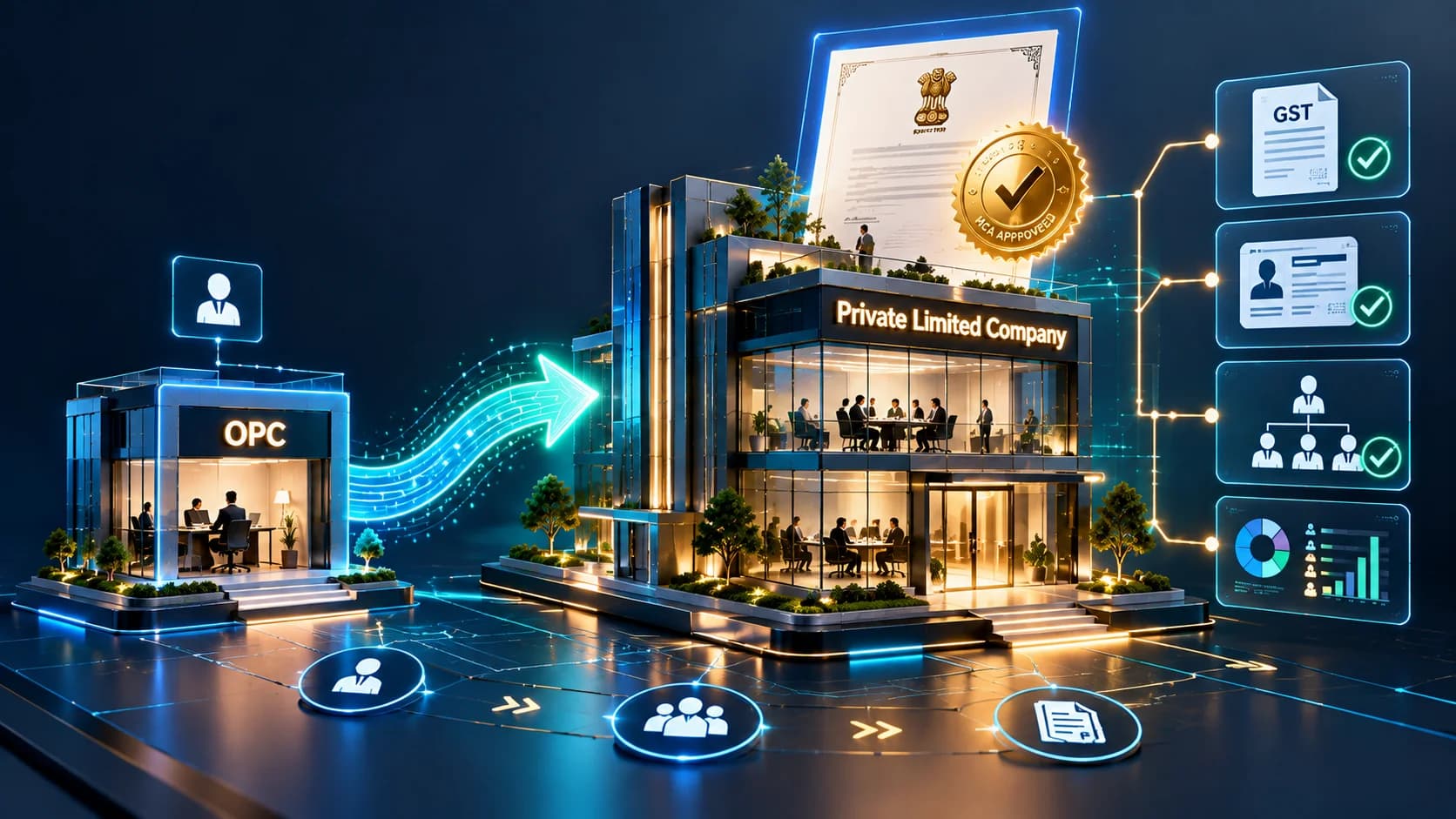
A One Person Company works well for a solo founder getting started, but it has structural limits: a single shareholder, restrictions on raising outside capital, and mandatory conversion once turnover or paid-up capital crosses prescribed thresholds. When an OPC outgrows that structure, converting it into a private limited company lets the business bring in co-founders or investors and operate under a framework built for growth. Livida's OPC to private limited conversion service handles this transition end to end, extending the same incorporation and compliance expertise we already apply to company registration in India.
Why Businesses Convert
Some conversions are mandatory, triggered automatically once an OPC's paid-up capital or average annual turnover crosses the limits set under the Companies Act. Others are voluntary: a founder decides to bring on a co-founder, take on institutional investment, or simply prefers the governance structure of a private limited company ahead of any mandatory trigger. Either way, the underlying filing process with the Ministry of Corporate Affairs (MCA) is broadly similar, though a voluntary conversion generally requires the company to have been incorporated for a minimum period before applying.
What the Conversion Process Involves
Conversion starts with a board resolution followed by a special resolution passed by the shareholder, along with obtaining a no-objection certificate from creditors where applicable. The company must then alter its Memorandum and Articles of Association to reflect the private limited structure, appoint at least the minimum number of directors and shareholders a private limited company requires, and file the conversion application with the Registrar of Companies along with supporting documents. Once approved, a fresh Certificate of Incorporation is issued reflecting the new company type.
Updating Statutory Records After Conversion
Conversion doesn't end with the MCA certificate. PAN details, GST registration, bank account records, and any licenses or registrations tied to the company need to be updated to reflect the change in structure and, where applicable, the new company name. Missing one of these updates can create mismatches that cause friction later, whether in a tax filing or a routine compliance check, so treating this as part of the conversion rather than an afterthought matters.
Livida's Process
We start by confirming whether your conversion is mandatory or voluntary and reviewing your current shareholding and capital structure against the requirements for a private limited company. From there, we prepare the board and shareholder resolutions, draft the updated Memorandum and Articles of Association, compile the supporting documentation, and manage the full MCA filing. Once the new Certificate of Incorporation is issued, we handle the follow-on updates to GST registration, PAN records, and bank details, and because Livida already supports India-based companies with bookkeeping, GST filing, TDS filing, and annual compliance, your newly converted private limited company can move straight into that same ongoing relationship.
Statutory records that typically need updating after conversion include:
- The fresh Certificate of Incorporation reflecting the new company type.
- GST registration details.
- PAN records where the company name has changed.
- Bank account records and mandates.
- Any licenses or registrations tied to the company's previous OPC structure.
The Institute of Chartered Accountants of India publishes guidance relevant to the compliance obligations a private limited company takes on that differ from an OPC. Companies that also need to bring in additional shareholders after conversion should review our Share Transfer Assistance service, and our OPC Registration service covers the structure this conversion is moving away from.
Why This Isn't Just a Form Filing
A conversion filing that's rushed or incomplete can leave a company with mismatched records across the MCA, GST, and banking systems, the kind of inconsistency that surfaces at the worst possible time, such as during due diligence for a funding round. Getting the resolutions, documentation, and follow-on updates right the first time avoids that. If your OPC has crossed a conversion threshold, or you're ready to bring in additional shareholders, Livida's incorporation team can manage the conversion and the compliance that follows it.
OPC to Private Limited Conversion in 5 Steps
Whatever triggers the move, the conversion follows the same broad sequence:
- Confirm whether the conversion is mandatory or voluntary, and review the current shareholding and capital structure.
- Pass the board resolution, then the shareholder's special resolution, and gather any creditor no-objection certificates that apply.
- Amend the Memorandum and Articles of Association and appoint the directors and shareholders a private limited company needs.
- File the conversion application with the Registrar of Companies and collect the new Certificate of Incorporation.
- Update PAN, GST, bank and licence records so every system shows the same company details.
For a wider view of how the two structures compare, see our guide to private limited vs LLP vs OPC in India. If you want the full picture of what a private limited company involves, read private limited company registration in India. Once converted, the company also takes on the yearly filings covered in our annual ROC compliance guide and our annual compliance for private limited companies service.
OPC to Private Limited Conversion at a Glance
| Item | Detail |
|---|---|
| Who it suits | Solo founders adding co-founders or investors, or OPCs that have crossed a mandatory limit |
| What we handle | Resolutions, MOA and AOA drafting, MCA filing, follow-on record updates |
| Typical documents | Identity and address proofs for new members and directors, existing incorporation papers |
| What happens next | New Certificate of Incorporation, then PAN, GST and bank updates |
What We See in Practice
In the filings we handle, the most common delay is not the MCA application itself but a missing piece on the shareholding side, such as an incoming member's documents arriving late. Our team therefore collects the identity, address and consent documents for every new member and director before the application is drafted. For any OPC to private limited conversion, we recommend checking GST and bank records on the same day the new certificate arrives, while the details are fresh.
Key Takeaways
- OPC to private limited conversion happens either because a prescribed limit is crossed or because the founder chooses it.
- The conversion needs resolutions, amended MOA and AOA, and an application to the Registrar of Companies.
- The converted company generally keeps its legal continuity, but PAN, GST, bank and licence records still need updating.
- Rushed or incomplete conversions leave mismatched records that surface during funding due diligence.
- Livida can carry the same company into bookkeeping, GST, TDS and annual compliance after conversion.
Conclusion
An OPC to private limited conversion is a structural change with real filing steps and a long tail of record updates. Handling both together keeps your company's identity consistent across the MCA, tax and banking systems, and leaves the business ready for new shareholders and growth.
References
This page is general information, not professional advice, and company law rules, forms and fees change, so confirm current requirements before you file.
Talk to Livida
If your OPC is ready to convert, reach out through our contact page, email info@livida.in or call +91 94860 33194.