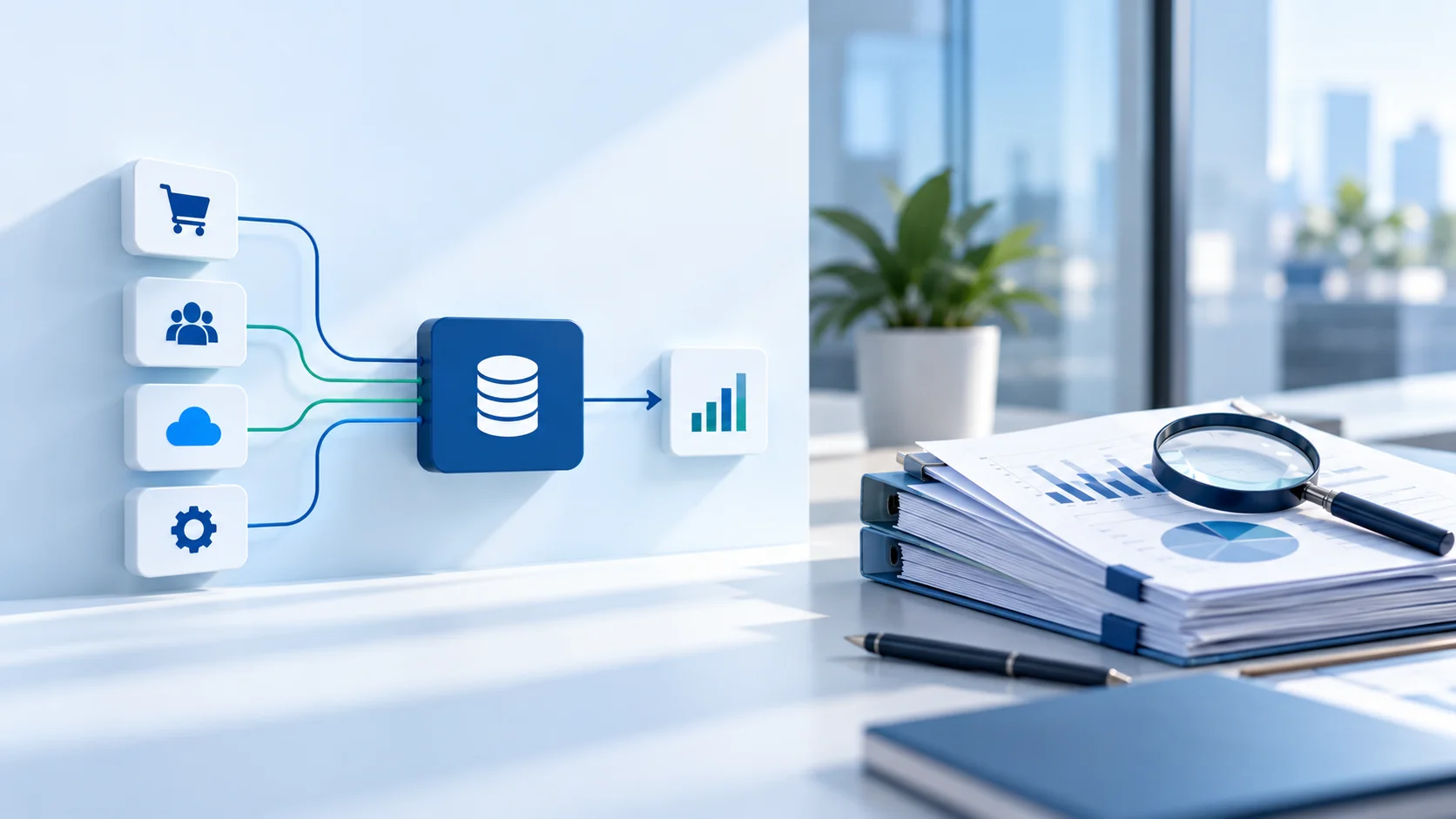
An API-connected accounting stack links your accounting software directly to the other systems your business runs on, such as payment processors, payroll, e-commerce platforms, and expense tools, so that financial data moves between them automatically. For a growing SME, this shift away from manual exports and spreadsheet re-entry is one of the more consequential changes in day-to-day finance operations over the past several years. Understanding what it actually does, and what it does not do, matters before deciding how much of your financial workflow to hand over to it. This trend is part of a broader shift covered in our overview of the API economy in financial services.

Key Takeaways
- An API-connected accounting stack moves data between your books and other tools automatically. It does not check whether the data is right.
- The biggest benefits are timeliness, fewer transcription errors and more consistent categorisation.
- Mapping each transaction type to the correct ledger account is the most important setup step.
- Connections can fail silently, so reconcile connected data to source systems on a regular schedule.
- Review access permissions as the stack grows, and keep a person responsible for oversight.
| Connection | What flows into the books | What to check |
|---|---|---|
| Payments | Settlements, fees, refunds | Fees posted separately from sales |
| Payroll | Wage, tax and benefit journals | Account mapping per pay component |
| E-commerce | Orders, returns, tax collected | Tax and revenue categories by region |
| Expenses | Approved claims | Approval rules match spending policy |

From Isolated Software to a Connected Ecosystem
For a long time, accounting software sat somewhat apart from the rest of a business's operational tools. A sales platform recorded orders, a payroll provider ran payslips, and a separate accounting package held the general ledger, with someone manually pulling reports from each system and keying totals into the books at the end of the month. This worked, but it created lag between when something happened in the business and when it showed up accurately in the financial records, and it left plenty of room for a transposed number or a missed transaction.
The cloud accounting ecosystem has changed this considerably. Most modern accounting platforms now expose an application programming interface, commonly called an API, that lets other software systems read from and write to the ledger directly. A payment processor can post a settlement straight into the accounting system as soon as funds clear. A payroll platform can send salary and tax journal entries the moment a pay run is processed. None of this requires a person to open a spreadsheet and copy numbers across.
Why This Trend Has Accelerated
Several forces have pushed accounting software integration forward. Cloud-based platforms are simply easier to connect than older desktop software, since they are already built around web-based data exchange. At the same time, businesses have adopted more specialized tools for each function of their operations, from inventory management to subscription billing, and each of those tools needs to reconcile with the books somehow. Rather than exporting and re-importing spreadsheets between every pair of systems, an API connection lets that reconciliation happen continuously and with less manual handling.
What an API-Connected Accounting Stack Actually Looks Like
In practice, a connected stack usually centers on the accounting platform as the system of record, with several other tools feeding data into it. A payment gateway sends transaction and fee detail. A payroll system sends wage, tax, and benefits journal entries. An e-commerce platform sends sales, refunds, and tax collected. A time-tracking or expense tool sends approved expense claims. Each of these connections replaces what used to be a manual monthly import with an ongoing, usually daily, flow of financial data connectivity between systems.
This is meaningfully different from simply having several pieces of software that each do their own job well. The value of the stack comes from how well the pieces talk to each other, not from any single tool in isolation. A business with excellent individual software but no integration between the pieces is still doing the reconciliation work by hand somewhere, even if it feels less obvious because it is spread across several small manual steps rather than one big monthly push.
Automated Financial Workflows in Everyday Operations
The practical effect of an API-connected accounting stack on daily operations is that a lot of routine data entry disappears. Bank feeds already do this for basic transactions, but a fuller stack extends the same principle to sales channels, payroll runs, and expense approvals. Automated financial workflows can route an approved expense claim straight into the correct ledger account, tag a sales transaction with the right revenue category, and flag a payment that does not match an expected pattern. None of this replaces judgment, but it does remove a large share of the repetitive keying that used to consume a bookkeeper's time.
For an SME with a lean finance function, this matters because it frees up limited hours for review and analysis rather than data entry. Instead of spending most of a week on reconciliation and manual posting, the time can go toward looking at cash flow trends, checking that categorization is correct, and preparing the reports that actually inform decisions.
The Real Benefits for Growing Businesses
The most immediate benefit of a well-built API-connected accounting stack is timeliness. Financial data connectivity that happens continuously means the books reflect what is actually happening in the business much closer to real time, rather than being reconstructed from memory and receipts weeks later. This matters most for businesses with tight cash flow, since a current, accurate picture of receivables and payables makes short-term decisions considerably easier to get right.
A second benefit of an API-connected accounting stack is reduced transcription risk. Every time a number is manually copied from one system to another, there is a chance of error: a missed decimal, a wrong column, a stale export. Removing that manual step does not eliminate errors, but it does remove one specific and common source of them. A third benefit is consistency. When sales data flows automatically from the same source every time, the categorization tends to be more consistent than when different people export and re-key it in slightly different ways each month.
Where the Benefit Is Overstated
It is worth being honest that some of the enthusiasm around connected accounting ecosystems overstates what automation alone delivers. Connecting two systems does not, by itself, guarantee that the data flowing between them is mapped correctly to your chart of accounts, or that unusual transactions are being handled sensibly. An integration that has never been checked can quietly misclassify a category of transactions for months before anyone notices, precisely because nobody is manually touching the data anymore and therefore nobody is looking at it closely.
This is the core tension of automation in finance: it is extremely good at doing the same thing correctly and quickly, over and over, but it is not good at noticing when the thing it is doing is subtly wrong. That noticing still requires a person who understands both the business and the accounting standards involved to periodically review what the connected systems are actually producing.
Building an Accounting Software Integration That Holds Up
A connected stack is only as good as the setup behind it. The first step is mapping: deciding precisely which account each type of transaction from each connected system should land in, and documenting that mapping so it can be checked later. Skipping this step, or letting a default mapping stand without review, is the single most common cause of automated financial workflows quietly producing bad numbers.
The second step is establishing a reconciliation cadence that does not disappear just because the connection is automated. Even a fully connected stack benefits from a monthly (or more frequent, depending on transaction volume) check that the totals flowing into the accounting system match the totals in the source systems. This is not a sign that the automation has failed; it is simply good financial control, the same principle behind any internal check in an accounting system reviews process, whether the data arrived by API or by hand.
Security and Access Considerations
Every additional connection in an API-connected accounting stack is also an additional point of access to your financial data. Reviewing which tools have write access to the ledger, rather than just read access, and periodically auditing which integrations are still active and actually in use, is a sensible practice as a stack grows. The NIST cybersecurity framework is a widely referenced resource for organizations thinking through access control and data governance principles, and its general guidance on managing digital risk applies just as well to a small connected finance stack as it does to a large enterprise system. You can find it on the NIST Cybersecurity Framework page.
Human Oversight in an API-Connected Accounting Stack
None of this changes the fundamental need for professional review of financial statements, especially once the numbers are used for tax filings, lender conversations, or investor reporting, a point developed further in our comparison of big data financial analysis against traditional methods. An API-connected accounting stack speeds up the movement of data, but it does not apply judgment to an unusual transaction, interpret a change in tax rules, or catch a mapping error that has been quietly misclassifying a vendor for three months. Those are still tasks for a qualified professional looking at the books with context.
This is where a general accounting service earns its keep even inside a highly automated environment. Reviewing the categorization coming out of connected systems, reconciling bank and payment data against the ledger, and preparing accurate financial statements from the resulting figures are exactly the kind of work that benefits from a human layer sitting on top of the automation rather than being replaced by it. A cash flow forecast is only useful if the data feeding it is correct, and checking that correctness is still a professional judgment call.
A Practical Way to Think About the Trade-off
A useful mental model is to treat the API-connected accounting stack as the plumbing and the accounting review as the water quality check. The plumbing moves data faster and with less manual effort, and that is a genuine improvement. But nobody would skip checking the water quality just because the pipes are new and shiny. The same logic applies to financial data: faster movement is valuable, but it raises rather than lowers the importance of periodic, professional review of what is actually flowing through the system.
Businesses that get the most value from a connected stack tend to be the ones that treat automation and oversight as complementary rather than as a trade-off between speed and accuracy. The automation removes the tedious, repetitive work; the oversight catches the exceptions and unusual cases that automation is not built to notice on its own.
Common Patterns Worth Knowing Before You Connect
Most API-connected accounting stacks fall into a handful of recognizable patterns, and knowing which one you are building helps you set expectations correctly:
-
The payments pattern: a processor sends settlement batches, fees, and refunds directly into the ledger. Usually the most reliable pattern, since the data is highly structured and the categories rarely change.
-
The payroll pattern: wage, tax, and benefits journal entries post automatically after each pay run. This tends to work well too, provided the initial account mapping for each pay component was set up correctly at the start.
-
The sales and inventory pattern: common in e-commerce and retail businesses, where orders, returns, discounts, shipping, and sales tax collected all need to land in different accounts depending on jurisdiction and product type. This has the most room for quiet misclassification.
-
Expense and procurement integration: connects approval workflows for spending directly to the books, speeding up expense tracking considerably, but still depends on someone checking that approval rules match the business's actual spending policy.
Matching the Pattern to Your Business
Not every business needs every pattern connected at once. A services business with few transactions and no inventory may get most of its value from connecting payments and payroll alone, while a product-based business selling across multiple channels has a much stronger case for investing in the sales and inventory integration despite its added complexity. Prioritizing the connections that touch your highest transaction volume first, rather than connecting everything available at once, tends to produce a cleaner rollout and makes it easier to review one integration thoroughly before adding the next.
Questions Worth Asking Before Adding a New Integration
Before adding another tool to your API-connected accounting stack, it helps to ask a short set of practical questions rather than assuming the connection will simply work as advertised. Does the new tool write directly to the ledger, or does it only export a report that still needs manual review before posting? Which specific accounts will the data land in, and has that mapping been checked against your actual chart of accounts rather than a generic default? Who is responsible for noticing if the connection stops working or starts sending unexpected figures, and how quickly would that be caught?
These questions matter because a broken or misconfigured integration often fails silently rather than with an obvious error message. A payment processor that stops sending settlement data because of an expired authorization token, for example, might simply leave a gap in the books that nobody notices until a monthly reconciliation catches the missing figures. Building a habit of checking connected data against source systems on a regular schedule, rather than assuming the pipes are always flowing correctly, is the practical safeguard against this kind of silent failure.
Vendor Selection for an API-Connected Accounting Stack
When evaluating which accounting platform to build a connected stack around, it is worth considering not just which tools it can connect to today, but how well-documented and stable those connections are likely to remain. A platform with a mature, well-supported API and a track record of maintaining its integrations tends to cause fewer surprises down the line than one with a newer, less battle-tested set of connections. This is a longer-term consideration than most businesses think about when first choosing accounting software, but it becomes increasingly relevant as the connected ecosystem around that software grows.

Getting the Balance Right as You Scale
As a business grows its API-connected accounting stack and adds more connected tools, the temptation is to assume that more automation means less need for review. In practice, the opposite is often closer to true: more connected systems mean more places where a mapping error, a duplicate transaction, or a misconfigured integration could introduce a problem, even if each individual connection is well-intentioned and generally reliable. Scaling a connected stack responsibly means scaling the review process alongside it, not assuming the automation has made review optional.
For an SME weighing how much of its financial workflow to connect, a reasonable approach is to expand automation gradually, checking the output of each new connection carefully for the first few reporting cycles before trusting it to run unattended. Pairing that gradual rollout with a bookkeeping and accounting review process that already understands how to reconcile figures across systems means the connected stack adds speed without adding risk. This is also a good moment to revisit your budgeting and cash flow planning, since more timely, connected data makes short-term cash forecasting noticeably more useful than it is when built on month-old figures.
It also helps to treat the rollout as a standing item in your regular accounting system reviews rather than a one-time project that is finished once the connections are switched on. A stack that was mapped correctly at launch can drift over time as new products are added, new payment methods are introduced, or a connected vendor changes its data format. Revisiting the mapping periodically, even briefly, catches this kind of drift before it accumulates into a larger cleanup project later.
Livida's general accounting, bookkeeping, and financial statement preparation services are built to sit exactly at that intersection, reviewing and reporting on the data your connected systems produce so that the automation genuinely saves time rather than quietly creating new problems. If your business is expanding its connected tools and wants a second set of eyes on the numbers coming out the other end, that is a conversation worth having.
5 Essential Checks for an API-Connected Accounting Stack
Before you trust an API-connected accounting stack to run unattended, work through these five checks:
- Document which ledger account each transaction type from each tool should land in.
- Confirm which connections can write to the ledger and which can only read from it.
- Reconcile connected totals to the source systems every month, or more often at high volume.
- Name the person who will notice if a connection stops working or sends unexpected figures.
- Review the mapping again whenever you add a product, a payment method or a new tool.
In our experience, the most common problem is a mapping that was set up once at launch and never revisited. We recommend putting a mapping review on the calendar each quarter.
Conclusion
An API-connected accounting stack gives a growing SME faster, cleaner data with less manual keying. It works best when it is paired with clear mapping, regular reconciliation and professional review. Speed and oversight are complementary, not competing.
Talk to Livida
If you would like a second set of eyes on the numbers coming out of your connected tools, our team is glad to help. Visit our contact page, email info@livida.in or call +91 94860 33194. You can also read about our bookkeeping service and payroll service, or see how open banking APIs compare with bank reconciliation.
This article is general information, not professional advice. Software, data and accounting rules change, so confirm the current position for your jurisdiction before acting.
References
- NIST Cybersecurity Framework, the official US government resource on managing digital and access risk.
- Digital Personal Data Protection Act, 2023 (MeitY, India), relevant where connected tools share personal data.
- Reserve Bank of India: Master Directions for Non-Banking Financial Company, Account Aggregator, the official rules for consent-based financial data sharing in India.