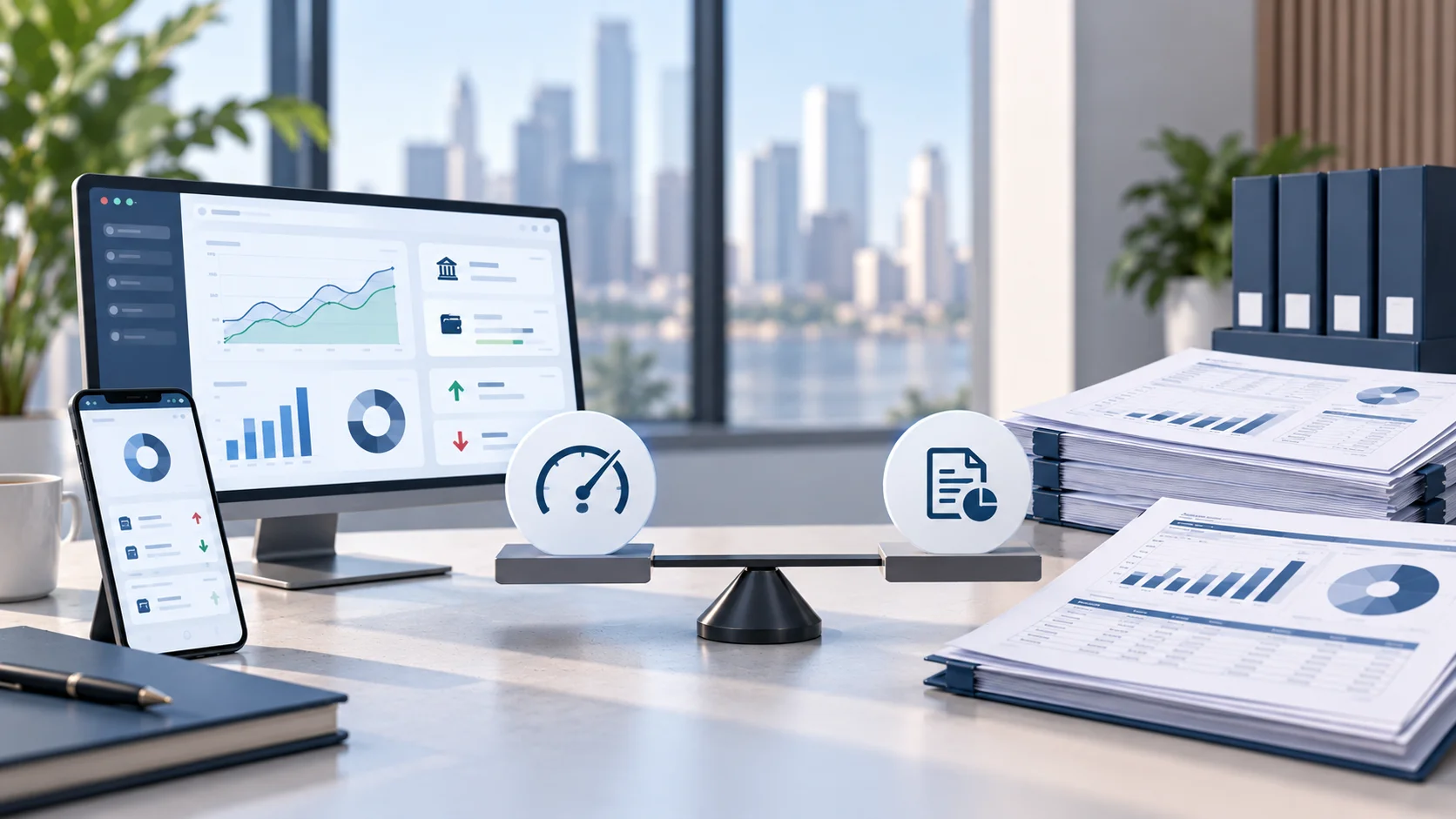
A real-time financial dashboard has become an increasingly common way for business owners to check their cash position without waiting for a monthly report, offering an always-on view of balances, receipts, and outgoing payments. Periodic cash management reporting, by contrast, delivers a more structured, reconciled summary on a set schedule, typically weekly or monthly. Both approaches aim to answer the same basic question, how much cash does the business actually have and where is it going, but they do so in very different ways, and understanding the trade-offs between them matters for any growing business trying to stay on top of its finances.

Key Takeaways
- A real-time financial dashboard gives instant cash flow visibility, but its figures are often not yet reconciled.
- Periodic cash management reporting is slower and more reliable, and it is what lenders, investors and auditors expect.
- Most growing businesses need both: frequent visibility and periodic depth.
- Both depend on accurate, current bookkeeping underneath.
- Treat any worrying dashboard signal as a prompt to investigate, not a final verdict.

What a Real-Time Financial Dashboard Actually Shows
A real-time financial dashboard typically connects directly to a business's bank accounts, credit cards, and accounting software, pulling in transaction data as it happens or with only a short delay. Instead of waiting for a report to be compiled, an owner or manager can open the dashboard at any point and see current balances, recent transactions, and often a rough categorization of spending by type. Many platforms also layer in visual elements like trend lines or spending breakdowns, making it easier to notice a shift at a glance rather than scanning rows of numbers.
The appeal is obvious: instead of finding out about a cash shortfall three weeks after it started, a business owner can potentially see the warning signs the same day they appear. This kind of immediate cash flow visibility is particularly valuable for businesses with tight margins, seasonal revenue swings, or a history of cash surprises that only became apparent once it was too late to easily adjust.
The Trade-Off Behind the Speed
The speed of a real-time dashboard comes with a cost: the data displayed has often not yet been reconciled. A transaction might be miscategorized, a pending charge might not yet reflect its final amount, or a bank feed might be temporarily out of sync. This does not make the dashboard useless, but it does mean the numbers shown should be treated as a helpful early indicator rather than a finalized figure suitable for external reporting or major financial decisions.
What Periodic Cash Management Reporting Provides
Periodic cash management reporting takes a different approach, compiling a structured report on a set schedule after transactions have been reviewed and reconciled against bank statements. This typically includes a clear breakdown of cash inflows and outflows, an accurate ending cash position, and often a comparison against the prior period or a budget. Because the data has been checked and categorized properly, periodic financial reporting tends to be significantly more reliable than a live dashboard feed, even though it necessarily lags behind real time.
This kind of reporting is also what lenders, investors, and auditors generally expect to see, since a reconciled report demonstrates that someone has actually verified the figures rather than simply displaying whatever the raw bank feed happened to show. Businesses that need to present their financial position externally, whether for a loan application or a board meeting, still rely heavily on this more formal, periodic approach.
Why the Reconciliation Step Cannot Be Skipped
Reconciliation is the process of confirming that the transactions recorded in the accounting system match what actually happened in the bank account, catching errors like duplicate entries, missed transactions, or miscategorized expenses along the way. Skipping this step to rely purely on real-time figures means those errors can persist unnoticed, sometimes for months, quietly distorting the picture a business has of its own cash position. This is precisely the review work that sits behind Livida's cash management reporting and monthly bookkeeping services.
Where Each Fits: Dashboard vs. Periodic Reporting
Rather than treating a real-time financial dashboard and periodic cash management reporting as competing options, it is more useful to think about where each one adds the most value.
Day-to-Day Awareness
A dashboard is well suited to day-to-day awareness: checking whether a large payment has cleared, confirming that cash on hand covers an upcoming payroll run, or simply keeping a general sense of the business's financial pulse without waiting for a formal report. This kind of frequent, low-friction check is exactly what real-time tools do well, and it can meaningfully reduce the chance of an unpleasant surprise between formal reporting periods.
Formal Decisions and External Reporting
Periodic, reconciled reporting is better suited to decisions that carry more weight: applying for financing, presenting to investors, setting a budget for the next quarter, or closing the books for tax purposes. These situations call for numbers that have been checked and can be defended if questioned, which is exactly what a reconciled cash management report is designed to provide and a live dashboard, by its nature, is not.
Real-Time Financial Dashboard vs. Periodic Cash Management Reporting
| Real-Time Financial Dashboard | Periodic Cash Management Reporting | |
|---|---|---|
| Timing | Instant, continuously updated | Weekly or monthly, after reconciliation |
| Reliability | Early indicator, not yet reconciled | Checked, categorized, and defensible |
| Best for | Day-to-day awareness | Financing, board reporting, and compliance |
| Data source | Bank feeds and accounting software | The same records, reviewed and reconciled |
Frequency and Depth
A dashboard trades depth for frequency, showing a simplified view updated constantly. Periodic reporting trades frequency for depth, showing a fuller, more accurate picture less often. Most growing businesses genuinely need both: frequent visibility to catch issues early, and periodic depth to make sure the underlying numbers are actually correct.
Building Genuine Cash Flow Visibility Without Losing Accuracy
The businesses that get the most value out of real-time tools tend to treat cash flow visibility as a first layer of awareness, not a final answer. They check the dashboard regularly to catch anything unusual, but they still rely on a properly reconciled cash management report to confirm the actual position before making any significant decision. This layered approach captures the speed advantage of real-time tools without inheriting their accuracy limitations.
It also helps to be realistic about what a dashboard is actually built to do. Most financial reporting tools marketed around real-time visibility are designed for quick checks and general awareness, not for the kind of detailed variance analysis or compliance-ready reporting that a formal monthly close requires. Using the right tool for the right purpose, rather than expecting one dashboard to do everything, tends to produce far better outcomes than trying to force a single tool to cover both jobs.
Connecting Dashboards to Clean Underlying Data
A real-time financial dashboard is only as trustworthy as the data it pulls from. If the underlying bookkeeping is inconsistent, if transactions sit uncategorized for weeks, or if bank feeds are not properly maintained, the dashboard will simply display that disorder in a more visually appealing format. This is why businesses that invest in accurate, current bookkeeping tend to get far more value out of any dashboard they connect on top of it, since the speed of the tool only matters if what it is showing is actually correct.
Why Periodic Financial Reporting Still Anchors the Process
Even as real-time tools become more common, periodic financial reporting has not lost its importance, and for good reason. A monthly or quarterly cash management report forces a disciplined review of the period's activity, catching errors and unusual items that a quick glance at a dashboard would likely miss. It also creates a documented record that can be referenced later, compared against budgets, or presented to a bank or investor without needing further explanation.
This kind of structured reporting aligns with the broader financial reporting standards that businesses are generally expected to follow when preparing statements for external use. Consistent accounting frameworks, of the kind maintained by standards bodies such as the IFRS Foundation, exist precisely because periodic, reconciled reporting needs to be comparable across time and across organizations in a way that a live, unreconciled dashboard feed simply is not designed to be. More detail on these standards is available from the IFRS Foundation.
Cash Management Reporting as Part of a Broader Process
Cash management reporting does not exist in isolation; it typically connects to budgeting and cash flow planning, general accounting services, and the preparation of financial statements more broadly. A business that treats cash reporting as one part of a coordinated financial process, rather than a standalone task completed in isolation, tends to catch problems earlier and plan more effectively than one that only glances at a dashboard between annual reviews.
Choosing the Right Combination for Your Business
There is no universal answer to how much weight a business should place on real-time dashboards versus periodic reporting; it depends on transaction volume, cash flow tightness, and how the business plans to use the information. A business with thin margins and frequent cash swings likely benefits from checking a dashboard daily while still producing a reconciled monthly cash management report. A more stable business with predictable cash flow might check a dashboard less often and rely more heavily on the periodic report as its primary reference point.
What matters most is that whichever combination a business chooses, the underlying financial data supporting both the dashboard and the periodic report is accurate, current, and properly reconciled. A dashboard built on messy data creates a false sense of security, and a periodic report compiled from unreconciled figures is no more reliable just because it arrives less often. Good financial reporting tools help, but they are not a substitute for disciplined bookkeeping underneath them.
Common Mistakes Businesses Make With Real-Time Dashboards
One of the most common mistakes is treating a real-time financial dashboard as a finished answer rather than a starting point. Because the numbers update constantly and look polished, it is easy to forget that they may include pending transactions, temporary duplicates, or miscategorized entries that have not yet been cleaned up. A business owner who makes a hiring decision or approves a large purchase based purely on a dashboard balance, without checking it against a reconciled cash management report, can end up working from a figure that shifts once the reconciliation happens.
A second mistake with any real-time financial dashboard is connecting it to too many disconnected data sources without a clear plan for how they relate to each other. Pulling in a bank feed, a separate merchant processor, and a manual spreadsheet all into one dashboard can create the appearance of a single unified view while actually introducing more room for double-counting or gaps, particularly around the timing of when a sale is recorded versus when the cash actually lands in the account. Cash flow visibility only improves when the underlying connections are configured carefully, not simply by adding more sources.
Ignoring the Dashboard Entirely
The opposite mistake also happens: some businesses invest in a real-time financial dashboard and then rarely look at it, falling back on old habits of only checking their cash position once a month. This wastes the genuine advantage the tool offers. A dashboard is only useful if it becomes part of a regular routine, whether that is a quick daily glance or a more deliberate weekly check-in, rather than a feature that sits unused between formal reporting cycles.
Practical Steps for Getting the Combination Right
Businesses that successfully combine real-time visibility with reliable periodic reporting tend to follow a similar pattern. First, they make sure the foundational bookkeeping is accurate and current, since both the dashboard and the periodic report ultimately draw from the same underlying records. Second, they establish a clear rhythm: a quick, informal check of the dashboard on a frequent basis, paired with a fully reconciled cash management report produced on a fixed schedule, whether that is weekly, monthly, or tied to a specific planning cycle.
Third, they treat any concerning signal from the dashboard as a prompt to investigate rather than a final verdict. If a real-time balance looks unexpectedly low, the next step is to check whether that reflects a genuine cash flow issue or simply a timing artifact, such as a large invoice that has not yet cleared. This habit of verifying before reacting prevents businesses from making decisions based on numbers that later turn out to have been temporary or incomplete.
In the books we review, the most common reason a dashboard balance differs from the reconciled figure is a transaction that is pending, uncategorized or recorded on a different date. Our team treats that gap as the first thing to explain before a number is used for a decision.
Keeping Financial Reporting Tools Aligned With the General Ledger
It is worth periodically confirming that whatever financial reporting tools a business uses for its real-time dashboard remain properly connected to, and consistent with, the general ledger maintained through regular bookkeeping. Over time, integrations can break, categorization rules can drift, or a new payment processor can be added without being properly mapped into the existing chart of accounts. A quick periodic check, ideally as part of the same process that produces the formal cash management report, keeps the dashboard trustworthy rather than letting it slowly diverge from the books it is supposed to reflect.

The Standards Behind Reliable Cash Reporting
Even informal, real-time visibility tools benefit from being built on top of consistent accounting practices. Professional accounting bodies such as AICPA & CIMA publish guidance on financial reporting and management accounting that shapes how cash management reporting should be structured and reviewed, and that guidance remains just as relevant whether the resulting figures are viewed in a monthly PDF or a live dashboard. You can review their published resources at AICPA & CIMA.
Following recognized reporting practices is not simply a compliance exercise; it is what makes a cash management report genuinely comparable from one period to the next, and what allows a bank, investor, or auditor to trust the figures without needing to re-verify them from scratch. A dashboard can display numbers instantly, but only disciplined, standards-based reporting behind the scenes makes those numbers something a business can actually rely on when it matters most.
Periodic Financial Reporting as a Planning Anchor
Beyond its role in verifying cash positions, periodic financial reporting also anchors broader planning activities such as budgeting and cash flow forecasting. A monthly cash management report gives a business a clear, reconciled starting point from which to project the following months, something a constantly shifting real-time balance cannot provide on its own. This is one more reason growing businesses continue to invest in structured, periodic reporting even as real-time tools become more widely available and easier to set up.
What to Ask Before Adopting a New Dashboard Tool
Before adding any new real-time financial dashboard to an existing finance stack, it is worth asking a few practical questions: does the tool connect directly to the accounting system already in use, or does it require a separate, manually maintained data feed that could fall out of sync over time? Does it clearly label which figures are provisional versus reconciled, so users are not misled into treating a live balance as a finalized one? And does the team responsible for periodic cash management reporting have visibility into how the dashboard is configured, so the two views stay aligned rather than quietly drifting apart.
Answering these questions honestly before rolling out a new tool saves a lot of confusion later. A dashboard that looks impressive in a demo but cannot answer these basic questions is likely to create more work correcting misunderstandings than it saves in convenience, whereas one that is properly scoped and clearly labeled can genuinely improve how quickly a business notices and reacts to changes in its cash position.
A short checklist of four checks for evaluating your current setup:
- Does the dashboard clearly label provisional figures as provisional, rather than presenting them as final?
- How often is the underlying bookkeeping actually reconciled against bank statements?
- Is there a fixed schedule for producing the more formal, periodic cash management report?
- Does whoever produces that periodic report have visibility into how the dashboard is configured?
Related reading: financial close automation, AI budgeting tools vs. cash flow planning, Predictive Analytics vs. Traditional Cash Flow Planning and Open Banking APIs vs. Manual Bank Reconciliation look at similar speed-versus-accuracy tradeoffs elsewhere in cash management. Businesses wanting a broader financial oversight layer can also look at Livida's Virtual CFO Advisory service.
Bringing It Together
Real-time dashboards and periodic cash management reporting are not really competitors; they answer different questions on different timelines, and most growing businesses need both to manage cash effectively. A real-time financial dashboard offers immediate cash flow visibility for day-to-day awareness, while periodic, reconciled reporting provides the depth and accuracy needed for major decisions, financing conversations, and compliance purposes.
Livida's bookkeeping, cash management reporting, and general accounting services are built to keep the underlying numbers accurate, whether they are being checked on a live dashboard between formal reports or reviewed in a fully reconciled monthly statement. If your business is trying to get a clearer, more reliable view of its cash position, whichever tools you use to see it, it starts with making sure the figures underneath are ones you can actually trust.
Conclusion
A real-time financial dashboard and periodic cash management reporting answer different questions on different timelines. Use the dashboard for daily awareness, use the reconciled report for decisions that carry weight, and keep the bookkeeping underneath both accurate. This article is general information, not professional advice, and reporting standards and tax rules change, so confirm the position for your own business before acting.
Talk to Livida
To get a clearer view of your cash position, use our contact page, email info@livida.in, or call +91 94860 33194.
References
- IFRS Foundation: the body that develops IFRS accounting standards
- AICPA & CIMA: guidance on financial reporting and management accounting practice
- IRS recordkeeping guidance for businesses: the IRS on choosing a recordkeeping system that clearly shows income and expenses