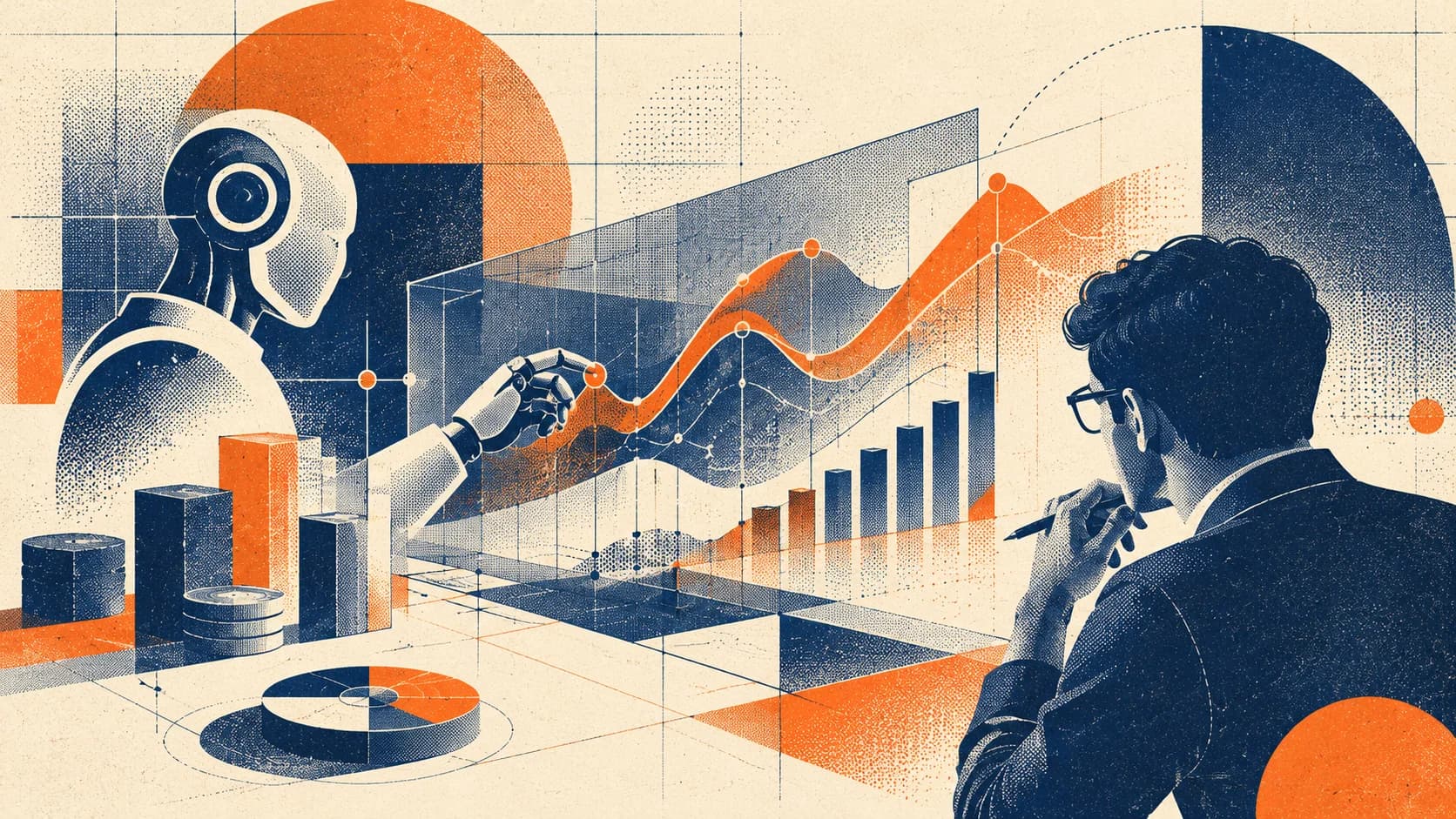
Predictive analytics cash flow tools have brought a level of forecasting sophistication to small and mid-sized businesses that used to require a dedicated financial analyst or an expensive enterprise software license. By analyzing historical transaction patterns, these tools can project future cash positions with a speed and apparent precision that traditional, manually built cash flow plans cannot easily match. The question growing businesses need to answer honestly is whether that speed and precision are actually reliable enough to plan around, or whether they still need the judgment that traditional cash flow planning brings to the table.

Key Takeaways
- Predictive analytics cash flow tools are strong on stable, recurring patterns and weak on change they have not seen before.
- A precise-looking number is an estimate, not a guarantee. Read it as a range.
- Traditional planning adds what the model cannot see, such as signed contracts and planned hires.
- The best results come from using analytics as an input to a planning process that people still own.
- Update assumptions as the business changes, and use an unwelcome forecast as a prompt to act.

What Predictive Analytics Cash Flow Tools Actually Do
Predictive analytics cash flow tools use statistical models, and increasingly machine learning, to analyze a business's historical transaction data and project how cash inflows and outflows are likely to behave in coming weeks or months. These models look for patterns: recurring revenue that arrives on a predictable schedule, seasonal fluctuations that repeat year over year, and expense patterns tied to specific times of month or specific business cycles. Based on these patterns, the tool generates a forecast that updates automatically as new transaction data comes in.
For businesses with stable, recurring cash flows, such as subscription-based revenue or predictable payroll and rent obligations, these tools can produce forecasts that are genuinely useful for short-term planning, often more current and less labor-intensive to maintain than a manually updated spreadsheet. The automation of what used to be a time-consuming manual exercise is a real and valuable improvement, particularly for businesses without a dedicated finance team to build and maintain forecasts by hand.
Where the Models Struggle
The accuracy of predictive analytics cash flow tools depends heavily on how much historical data is available and how stable the underlying business patterns are. A business that has recently changed its pricing, entered a new market, or experienced a one-time event like a large customer loss or a major new contract win presents exactly the kind of discontinuity that a model trained on historical patterns struggles to anticipate. The model will, by default, extrapolate from the past, and when the future genuinely differs from the past in ways the business itself understands but the model has no way to know about, the forecast can be meaningfully wrong.
Cash Flow Forecasting as a Discipline, Not Just an Output
Cash flow forecasting has always been more than producing a single projected number. It involves identifying which assumptions the forecast depends on, stress-testing those assumptions against different scenarios, and updating the forecast as new information becomes available, whether that is a delayed customer payment, an unexpected expense, or a shift in business strategy. Predictive analytics tools automate the mechanical production of a forecast based on historical patterns, but the discipline of identifying and questioning the assumptions behind that forecast is still fundamentally a human exercise.
This is where traditional cash flow planning, built with input from people who understand the business's current situation and near-term plans, continues to add value that a purely data-driven model cannot replicate. A person preparing a forecast can incorporate knowledge that has not yet shown up in the transaction history at all, such as a signed contract that has not yet generated any invoices, or a planned expense that has been budgeted but not yet incurred. A model working purely from historical transaction data has no visibility into either of these things.
Financial Analytics Tools and Budgeting: Related but Distinct
Financial analytics tools are often marketed as if they can generate a complete budget automatically, but budgeting is a broader exercise than forecasting cash flow from historical patterns. A budget incorporates strategic decisions about where the business wants to invest, what growth it is targeting, and what tradeoffs management is willing to make between different priorities. These are forward-looking, judgment-based decisions that historical transaction data cannot supply on its own, no matter how sophisticated the underlying analytics.
Livida's budgeting and cash flow planning service treats analytics as a useful input rather than a substitute for this planning process. Historical data and predictive trends inform the starting point for a budget or forecast, but the actual plan reflects a conversation about the business's goals, constraints, and near-term decisions, something no purely data-driven tool can generate without that human context.
Predictive Analytics vs. Traditional Cash Flow Planning: Side by Side
| Predictive Analytics Cash Flow Tools | Traditional Cash Flow Planning | |
|---|---|---|
| Speed | Generates a forecast quickly from historical data | Takes longer to build and update by hand |
| Reliability on stable patterns | Strong for recurring revenue and predictable costs | Also reliable, just slower to refresh |
| Reliability on change | Weak: extrapolates from a past that may no longer apply | Strong: incorporates known upcoming changes |
| Qualitative context | Cannot see a verbal commitment or unsigned lease | Can incorporate it directly |
Five essential checks are worth running before trusting a forecast, automated or not:
- Does the forecast account for a known upcoming change, such as a planned hire or a signed contract not yet invoiced?
- How much historical data is the model actually working from, and is the business's recent pattern still representative?
- Has anyone stress-tested the forecast against a realistic worst-case scenario?
- Is the forecast being treated as a range of outcomes, or as a single guaranteed number?
- Do the assumptions reflect current collection times, including how quickly customers actually pay?
The Danger of Trusting a Precise-Looking Number
One of the more subtle risks with predictive analytics cash flow tools is that their output often looks more precise than it actually is. A dashboard showing a projected cash balance of a specific figure three months from now conveys a sense of certainty that a manually built, more conservative range estimate does not. This precision is a byproduct of how the underlying statistical model works, not necessarily a reflection of how confident the projection should actually be, and business owners who are not familiar with how these models generate their output can easily mistake a point estimate for a guarantee.
The more useful way to interpret predictive analytics output is as a central estimate surrounded by a meaningful range of uncertainty, particularly for any projection extending more than a few weeks out. A professional reviewing a forecast can help translate an overly precise-looking number into a more honest range, and can explain which parts of the projection are relatively solid, such as recurring subscription revenue with a long history, versus which parts are much more speculative, such as a large new deal that has not yet closed. This kind of translation is exactly the value a knowledgeable person adds on top of a raw model output.
Scenario Planning as a Complement to Predictive Models
Traditional cash flow planning has long relied on scenario analysis, building a best case, a worst case, and a most likely case to help a business understand the range of outcomes it might face rather than anchoring on a single number. Predictive analytics tools can support this kind of scenario planning by quickly generating variations based on different assumptions, but deciding which scenarios are actually worth exploring, and how pessimistic a worst case should realistically be, still depends on judgment informed by the specific risks the business faces.
A business in a seasonal industry, for example, might need a worst-case scenario that accounts for a slower-than-usual peak season, while a business dependent on a small number of large customers might need a scenario that models the loss of its largest account. These are business-specific risks that a generic predictive model, trained primarily on the business's own transaction history, may not surface prominently on its own unless a person with knowledge of the business's customer concentration or industry cycle specifically asks the model to test for it.
How Predictive Tools Handle Growth and Change
Businesses growing quickly present a particular challenge for predictive analytics cash flow tools, because rapid growth by definition means the recent past is not necessarily a reliable guide to the near future. A model trained on a business's transaction history from a period of steady, modest growth may understate how quickly expenses will scale alongside a sudden increase in headcount or inventory, or may fail to anticipate a working capital squeeze that often accompanies fast revenue growth, where cash goes out to fund inventory or payroll well before the corresponding revenue comes in.
This is one of the more counterintuitive risks of relying too heavily on predictive analytics during a high-growth period: the tool can appear increasingly confident in its projections even as the business's actual situation becomes less predictable and more in need of careful, judgment-driven planning. Recognizing this dynamic, and knowing when to weight professional judgment more heavily than a model's output, is itself a skill that experienced financial professionals bring to a growing business's planning process.
The Role of Qualitative Information in a Good Forecast
A cash flow forecast is only as good as the information feeding into it, and a meaningful share of the information that actually matters to a growing business does not exist as historical transaction data at all. A verbal commitment from a customer, an informal understanding with a supplier about extended payment terms, a planned but not yet signed lease for new space, or an anticipated regulatory change affecting the business's industry are all qualitative pieces of information that shape a realistic forecast but that a predictive model working purely from past transactions has no way to incorporate.
Gathering this qualitative information requires an ongoing relationship with the people running the business, not just access to its accounting data. This is one of the clearest illustrations of why predictive analytics cash flow tools function best as an input to a broader planning conversation rather than as a standalone forecasting solution, and it is a large part of what a professional advisor brings to a cash flow planning engagement that a dashboard cannot replicate on its own.
How Cash Flow Management Software Fits Into the Picture
Cash flow management software provides the infrastructure for tracking, visualizing, and updating a cash flow forecast, often pulling in bank data automatically and presenting projections through a dashboard rather than a static spreadsheet. This is a genuine improvement in usability and timeliness compared to manually maintained forecasts, particularly for businesses that want visibility into their cash position without waiting for a monthly review cycle.
The software's value depends heavily on the quality of the assumptions built into it. A forecast that automatically extrapolates recent trends without incorporating known upcoming changes, such as a planned hire, a scheduled loan repayment, or a seasonal dip the business knows is coming, will produce a technically precise but practically misleading number. This is why most businesses that rely on cash flow management software still benefit from periodic professional review of the assumptions the software is working from, rather than trusting the automated output uncritically.
Where This Matters Most for Growing Businesses
The stakes around getting cash flow forecasting right tend to rise as a business grows, particularly during periods of expansion when cash is being deployed into inventory, hiring, or new markets faster than it is being replenished by revenue. A forecast that overstates future cash availability, whether because a predictive model extrapolated an unsustainable growth trend or because a manual forecast failed to account for a real risk, can lead a business to overcommit financially in ways that create serious problems if the actual cash flow falls short of the projection.
This is precisely the scenario where combining predictive analytics with professional judgment pays off. The analytics tool can process transaction history quickly and flag emerging trends the business might not have noticed on its own, while a professional reviewing that output brings the business context, industry experience, and healthy skepticism needed to stress-test the forecast before a business makes a significant commitment based on it. Neither element alone is as reliable as the combination.

Bringing Predictive Tools and Professional Planning Together
The realistic path forward for most growing businesses is not choosing between predictive analytics and traditional cash flow planning, but using the analytics as an input into a planning process still guided by professional judgment. This means letting the software handle the pattern recognition and the mechanical production of a baseline forecast, while a professional reviews the underlying assumptions, incorporates knowledge the model cannot see, and stress-tests the result against realistic alternative scenarios before it becomes the basis for a real financial decision.
Livida's budgeting and cash flow planning service is built around this combination, using whatever cash flow management software or financial analytics tools a client already relies on as a starting point, and applying professional review to make sure the resulting forecast actually reflects the business's current situation and near-term plans rather than just its recent transaction history. For businesses making decisions about hiring, expansion, or new investment, that combination of speed and judgment is what makes a forecast genuinely useful rather than just fast.
Connecting Forecasts to Real Decisions
A cash flow forecast only has value if it actually informs a decision, whether that is when to hire, how much inventory to order, or whether the business can afford to take on a new lease. Predictive analytics cash flow tools are good at producing a number, but connecting that number to a specific business decision requires understanding the tradeoffs involved and the consequences of being wrong in either direction. A model has no concept of what it means for a business to run out of cash at a critical moment, or what opportunities might be missed by being overly conservative with a forecast that understates realistic growth.
This is ultimately why cash flow forecasting works best as a conversation between reliable data and experienced judgment, rather than as a purely automated output handed to management without context. Livida's approach to budgeting and cash flow planning treats the forecast as a tool for supporting a specific decision the business is facing, not as an abstract exercise disconnected from what ownership actually needs to decide next. This grounding in real decisions is part of what separates a genuinely useful forecast from a technically accurate but practically unhelpful one.
Common Mistakes Businesses Make With Forecasting Tools
Businesses new to predictive analytics cash flow tools tend to make a few recurring mistakes. The first is treating the tool's output as a guarantee rather than an estimate, leading to overconfident financial commitments based on a projection that had meaningful uncertainty baked into it from the start. The second is failing to update the underlying assumptions as the business changes, so that a forecast that was reasonable six months ago continues to be treated as current even though the business's situation has shifted considerably since then.
A third common mistake is ignoring the forecast entirely once it produces an unwelcome result, rather than using an unfavorable projection as a prompt to investigate and address the underlying issue. A forecast showing a coming cash shortfall is most valuable precisely when it triggers a conversation about what to do differently, whether that means accelerating collections, delaying a planned expense, or arranging additional financing ahead of time. Businesses that treat forecasting as an ongoing discipline rather than a one-time exercise tend to catch and address these issues while there is still time to act.
Conclusion
Predictive analytics cash flow tools have made forecasting faster, more current, and more accessible to businesses that could not previously justify the cost of a dedicated financial analyst, and that is a meaningful and lasting improvement. What has not changed is the value of a professional who understands the business well enough to question a model's assumptions, incorporate information the model cannot see, and help ownership make sound decisions based on a forecast that has been properly stress-tested rather than simply trusted at face value.
In our experience, the most common gap in a forecast is a signed contract or planned hire that the model has never seen. We recommend adding known upcoming items by hand before relying on the output.
Related reading: Real-Time Financial Dashboards vs. Periodic Cash Management Reporting and Open Banking APIs vs. Manual Bank Reconciliation cover similar automation-and-judgment questions elsewhere in the finance function. Reference guidance from the AICPA & CIMA is a useful benchmark for how management accounting forecasts should be reviewed. Livida's bookkeeping service keeps the underlying records clean, which any forecast depends on. Businesses wanting a professional review of their own forecast can also look at Livida's Virtual CFO Advisory service.
Talk to Livida
If you would like a professional review of your cash flow forecast, our team is glad to help. Visit our contact page, email info@livida.in or call +91 94860 33194. Our accounting, bookkeeping and tax teams work with growing businesses in India and other regions, and can build a forecast around your actual plans.
This article is general information, not professional advice. Tax, compliance and lending rules change, so confirm the current position for your jurisdiction before acting.
References
- U.S. Small Business Administration: Manage your finances, the official guide to financial statements and cash flow projections for small businesses.
- Ministry of MSME, India: Samadhaan delayed payment FAQ, the official explanation of how delayed payments to micro and small enterprises are handled, which affects collection assumptions in a forecast.