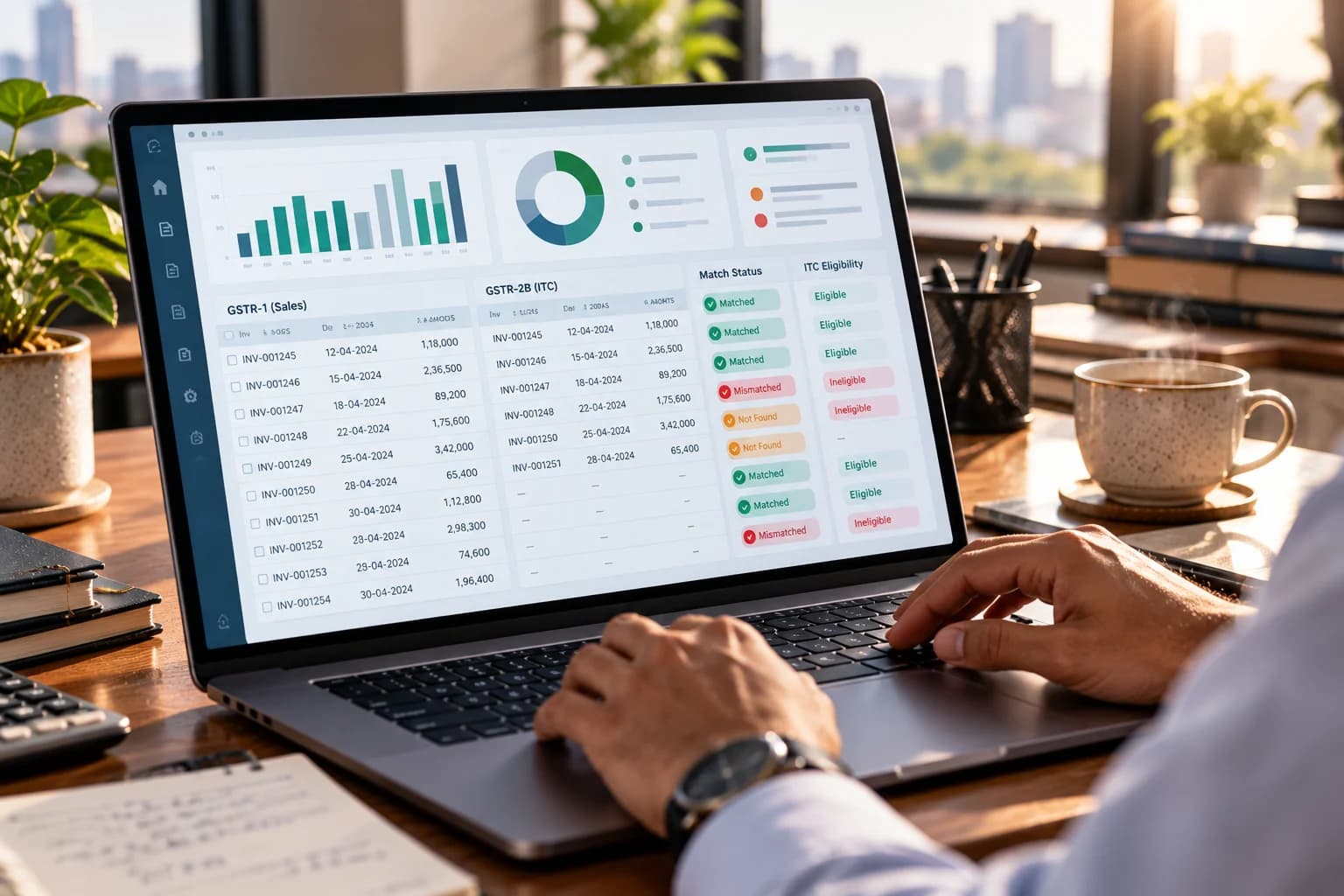
An AI tax filing chatbot can answer a routine question about a filing deadline or a general rate in seconds, which is a genuine convenience for a business owner trying to get oriented quickly, especially outside normal business hours when a professional advisor is not immediately reachable. The harder test comes when that same business needs to actually file a GST or TDS return correctly, where the classification of a specific transaction, an input credit reconciliation, or a threshold that applies only in certain circumstances determines whether the filing is right or wrong. That gap between answering a general question and completing a compliant filing is where AI tax filing chatbots and professional GST and TDS filing support genuinely diverge.

Key Takeaways
- An AI tax filing chatbot is useful for quick orientation, but it can answer confidently and still be wrong for your facts.
- Automated tax filing tools populate forms. They do not check that the classification behind the form is correct.
- GST and TDS filing depend on judgment about supplies, input credit, sections and thresholds.
- Errors fall on the business, not on the tool, so anything submitted to a government portal needs professional review.
- Think about data privacy before sharing invoices or customer details with a general-purpose chatbot.
This article is general information, not professional advice. GST and TDS rules, rates and thresholds change, so confirm the current position before filing.
| Dimension | AI tax filing chatbot | Professional GST and TDS filing support |
|---|---|---|
| Speed for general questions | Very fast, available anytime | Depends on advisor availability |
| Accuracy on business-specific facts | Risk of confident but wrong answers | Verified against actual transaction detail |
| Classification and reconciliation | Not equipped to perform these | Core part of the service |
| Accountability for the filing | None | Professional accountability for what is submitted |

What an AI Tax Filing Chatbot Is Actually Built to Do
AI tax filing chatbots are typically built on large language models trained on general tax information, sometimes supplemented with a narrower set of documents specific to a jurisdiction's tax code. They are designed to answer natural-language questions conversationally, which makes them far more approachable than searching through a dense tax manual or a government circular. For a straightforward question, such as a general filing deadline or the standard definition of a term, this works reasonably well and can save real time compared to manual research.
The limitation shows up as soon as a question depends on specific facts rather than general rules. Tax obligations frequently hinge on details like the nature of a supply, the location of the recipient, whether a threshold has been crossed for the year, or whether a particular payment falls under a specific TDS section. A chatbot answering in general terms, without full visibility into a business's actual transaction history and structure, can easily give an answer that is technically true in the abstract but wrong for the business asking the question.
The Confidence Problem in Practice
A particular risk with these tools is that they tend to answer confidently regardless of how well-supported the answer actually is. A chatbot rarely responds with genuine uncertainty or asks enough clarifying questions to properly scope an answer to a business's actual situation, the way a professional would before applying a specific rule to a real filing decision. This confident tone can lead a business owner to treat a chatbot's answer as more authoritative than it deserves, particularly on questions where the correct treatment depends on nuance the tool was never given enough context to evaluate properly.
Where Automated Tax Filing Tools Fit In
Automated tax filing tools, distinct from conversational chatbots, are software built specifically to populate filing forms based on data pulled from accounting records, run basic validation checks, and sometimes submit returns directly through a government portal's application programming interface. These tools reduce manual data entry and catch simple errors like a missing field or an obviously malformed number. They are a genuine improvement over manually retyping figures into a filing portal, and most professional GST filing services now use some version of this automation as part of their own workflow.
What these tools generally do not do is verify that the underlying classification feeding into the form is correct in the first place. If a transaction was recorded under the wrong GST rate, or a payment was never flagged as subject to TDS when it should have been, the automation will faithfully populate a filing based on that incorrect data, producing a return that is procedurally complete but substantively wrong. Automated tax filing tools are only as reliable as the classification and bookkeeping decisions that happen before the data ever reaches them.
Why GST Filing Involves More Than Data Entry
Classification Decisions That Shape the Filing
GST filing services exist because correctly filing a GST return depends on a series of classification decisions that are not always obvious from a transaction description alone. Whether a supply is taxable, exempt, or zero-rated, whether it falls under a reverse charge mechanism, and how input tax credit should be apportioned between taxable and exempt supplies all require judgment grounded in both the specific transaction and current regulatory guidance. Reference material published by tax authorities, such as the resources available through the GST portal, is a useful starting point, but applying that guidance correctly to a specific business's transactions is professional work.
Reconciliation as an Ongoing Discipline
GST compliance is not a once-a-period event either. Reconciling input tax credit claimed against what suppliers have actually reported, tracking outstanding mismatches, and following up on discrepancies before they compound into a larger problem all require ongoing attention that a chatbot or a filing tool does not provide on its own. Livida's GST filing service is built around this kind of continuous reconciliation, not just the mechanical act of submitting a return on the due date.
TDS Filing Compliance and Its Own Set of Judgment Calls
TDS filing compliance carries a parallel set of complexities. Determining whether a payment is subject to tax deduction at source, at what rate, and under which section requires understanding the nature of the payment and the recipient's status, not just running a calculation against a lookup table. Payments to contractors, professionals, and various categories of vendors can each fall under different provisions, and thresholds that trigger deduction obligations change periodically, which means a rule that applied correctly last year may not apply the same way this year.
Beyond correctly deducting and depositing TDS, quarterly returns need accurate deductee details, correct challan matching, and timely correction of any mismatches flagged by the tax department's systems. Getting any of these steps wrong can trigger notices, interest, or penalties that take considerably more time and cost to resolve than the filing itself would have taken to get right the first time. This is precisely the layer of ongoing diligence that Livida's TDS filing service is designed to provide, working alongside GST filing and year-end accounting as part of a business's broader statutory compliance in India, where deadlines and documentation requirements are enforced strictly regardless of how the underlying calculation was performed.
The Real Cost of Getting a Filing Wrong
It is worth being concrete about what actually happens when a GST or TDS filing goes wrong, because the abstract risk of "an error" understates how disruptive the consequences can be. A mismatched input tax credit claim can trigger a notice requiring a detailed reconciliation response within a fixed deadline, often demanding documentation that takes far longer to assemble under time pressure than it would have taken to prepare correctly the first time. A missed or incorrect TDS deduction can result in the deductor being held liable for the shortfall along with interest, on top of whatever penalty applies for the late or incorrect filing itself.
These consequences do not fall on the software vendor or the chatbot provider, no matter how confidently that tool phrased its original answer. They fall entirely on the business, which is precisely why relying on a tool's confident-sounding answer without professional verification is a false economy. The time and cost saved by skipping professional review on the front end is almost always smaller than the time and cost required to respond to a department notice, correct a return, or negotiate a penalty on the back end. Businesses that have been through this cycle once tend to prioritize professional oversight far more highly on their next filing cycle.
New Business Considerations: Incorporation Through Ongoing Compliance
For a newly incorporated business in India, GST and TDS compliance start from day one, often before the founders have fully internalized every applicable threshold and deadline. Getting company incorporation set up correctly, including registrations tied to GST and TDS obligations, establishes the foundation that everything downstream depends on. A misstep at this early stage, such as registering under the wrong category or missing an initial compliance requirement, can create friction that persists for years afterward.
This is one of the reasons Livida pairs company incorporation support with ongoing GST filing, TDS filing, accounts receivable, accounts payable, year-end accounting, and EPF and ESI compliance as a connected set of services rather than a menu of disconnected offerings. A closer look at where automated calculators specifically fall short on TDS work is covered in our companion piece on AI TDS calculators versus professional TDS filing services.
A practical rule of thumb for dividing work between a chatbot and a professional filing service:
- Use an AI tax filing chatbot for general orientation questions and quick definitions
- Use automated tax filing tools for data entry, form population, and basic validation
- Route anything that will actually be submitted to a government portal to a professional for review
- Route any classification decision specific to your business's facts to a professional
A business that gets professional guidance from incorporation onward tends to avoid the kind of foundational errors that are expensive and time-consuming to unwind later, compared to a business that adopts a patchwork of automated tools and general chatbot guidance without a professional reviewing how the pieces fit together.
Tax Compliance Software: A Supporting Layer, Not a Solution
Tax compliance software generally sits between a basic chatbot and a full professional service, offering more structured data handling and validation than a conversational tool while still stopping short of the judgment and accountability a filing service provides. These platforms are genuinely useful for organizing transaction data, tracking filing calendars, and flagging obvious inconsistencies before a return is submitted, and adopting one is usually a sensible step for any business trying to reduce the manual burden of routine compliance work. Many professional GST and TDS filing services incorporate this kind of software into their own process rather than treating it as a competing alternative.
The practical risk shows up when a business treats tax compliance software as sufficient on its own, without a professional reviewing the classifications and judgment calls the software is not equipped to make. Growing businesses in particular tend to encounter transactions that fall outside the software's default assumptions, whether that is an inter-state supply with unusual documentation, a related-party transaction requiring careful treatment, or a contractor payment that crosses a TDS threshold partway through the year. These situations are exactly where automation needs a professional layer on top of it.
Data Privacy Considerations With AI Tax Tools
There is another practical concern worth raising before relying heavily on an AI tax filing chatbot: what happens to the financial information shared with it. Many of these tools are built on general-purpose language models hosted by third parties, and depending on the platform's terms, conversations and any uploaded documents may be stored, used to improve the underlying model, or retained longer than a business might expect for sensitive financial data. Businesses experimenting with these tools should read the privacy terms carefully before sharing actual transaction details, invoice numbers, or identifying information about customers and vendors.
A professional GST or TDS filing service, by contrast, operates under clear confidentiality expectations and, in most cases, defined professional obligations around client data. This is not a reason to avoid AI tools altogether, since many are genuinely useful for general questions that do not involve sensitive specifics, but it is a reason to be deliberate about what information gets shared with a general-purpose chatbot versus what stays within a professional engagement with clear accountability for confidentiality.
Keeping Pace With Frequently Changing Rules
GST rates, thresholds, and procedural requirements have changed multiple times since the tax was introduced in India in 2017, and TDS thresholds and sections are similarly subject to periodic revision through annual budget announcements and subsequent notifications. A chatbot trained on a fixed snapshot of information can lag behind these changes, sometimes by months, unless its underlying data is actively and frequently updated, and even actively maintained tools can occasionally apply an outdated rate or threshold if a change has not yet been incorporated.
Professional GST filing services and TDS filing compliance support are structured specifically to track these changes as part of ongoing practice, rather than treating rule updates as an occasional maintenance task. This is a meaningful practical advantage for a growing business that cannot reasonably track every regulatory notification itself while also running day-to-day operations. Staying current is not a one-time effort but a continuous discipline, and it is one of the clearer places where professional support outperforms a static or infrequently updated automated tool.
How the Two Approaches Complement Each Other
The realistic path for most growing businesses combines both layers rather than choosing one over the other. An AI tax filing chatbot or a basic automated tool is useful for quick orientation and routine data handling, reducing the time spent on repetitive administrative work. A professional GST and TDS filing service then applies the classification judgment, reconciliation discipline, and accountability that keeps the business protected from the kind of quiet errors that a confident-sounding but unverified answer can introduce into a statutory filing.
This combination also scales more sensibly as a business grows. A business relying purely on chatbot guidance and self-filing may manage adequately while its transactions are simple, but the risk of an uncaught misclassification grows with transaction volume and complexity, exactly the trajectory most successful growing businesses follow. Layering professional GST filing services and TDS filing compliance support on top of whatever automated tools a business already uses tends to catch problems while they are still small and inexpensive to correct.

What to Watch For as These Tools Improve
AI tax filing chatbots and automated tax filing tools will keep improving, and it is reasonable to expect them to handle an increasing share of routine, well-defined questions and data entry over time. What is less likely to change is the need for professional accountability on anything that touches an actual government filing, since the consequences of an incorrect GST or TDS return, penalties, interest, and department scrutiny, fall on the business regardless of what tool produced the error. A chatbot cannot be held accountable for a wrong answer in any way that matters to a tax authority.
Conclusion
An AI tax filing chatbot is a good starting point and a poor final check. Use it for orientation, use tools for data entry, and keep a professional responsible for what reaches the tax portal.
What We See in Practice
In the filings we handle, the most common delay is a mismatch between the books and what a tool has pre-filled. Our team usually traces it to a wrong classification made earlier, not to the filing step itself.
We recommend that businesses keep a short log of the questions they asked a chatbot and the answers they relied on. An AI tax filing chatbot can then be checked quickly against the facts before anything is submitted.
Bringing It Together
AI tax filing chatbots and automated tax filing tools are useful additions to a business's compliance toolkit, particularly for quick orientation and reducing repetitive data entry. They are not a substitute for the professional judgment that correct GST filing and TDS filing compliance require, particularly around classification decisions, reconciliation, and accountability for what actually gets submitted to the tax department. Businesses that treat these tools as a starting point rather than a finish line tend to get the speed benefit without taking on unnecessary compliance risk.
Livida's GST filing and TDS filing services are built to provide exactly that professional layer, working alongside whatever tools a business already uses to handle its day-to-day data, while making sure the filings that actually reach the tax department are accurate, properly reconciled, and defensible if questioned.
For business owners who are unsure where the line should sit between what a chatbot or automated tool can safely handle and what needs professional review, a useful rule of thumb is to treat anything that will actually be submitted to a government portal, or that hinges on a judgment call specific to the business's facts, as requiring professional sign-off. General education and quick orientation can reasonably come from a chatbot. The filing itself, and the classification decisions behind it, should not rest on an automated tool's confidence alone. Getting that distinction right from the outset tends to save far more time than it costs, particularly as a growing business's transaction volume and complexity increase year over year.
References
Official portals for GST and TDS rules and filings:
- GST portal, Government of India
- Income Tax Department e-Filing portal
- Income Tax Department: TDS and TCS services available to deductors
Talk to Livida
If you want a professional to review your GST and TDS filings before they are submitted, our team is ready to help. Visit the contact page, email info@livida.in or call +91 94860 33194. You may also like our guides on AI bookkeeping software vs managed bookkeeping and GST e-invoicing portal vs manual GST filing.