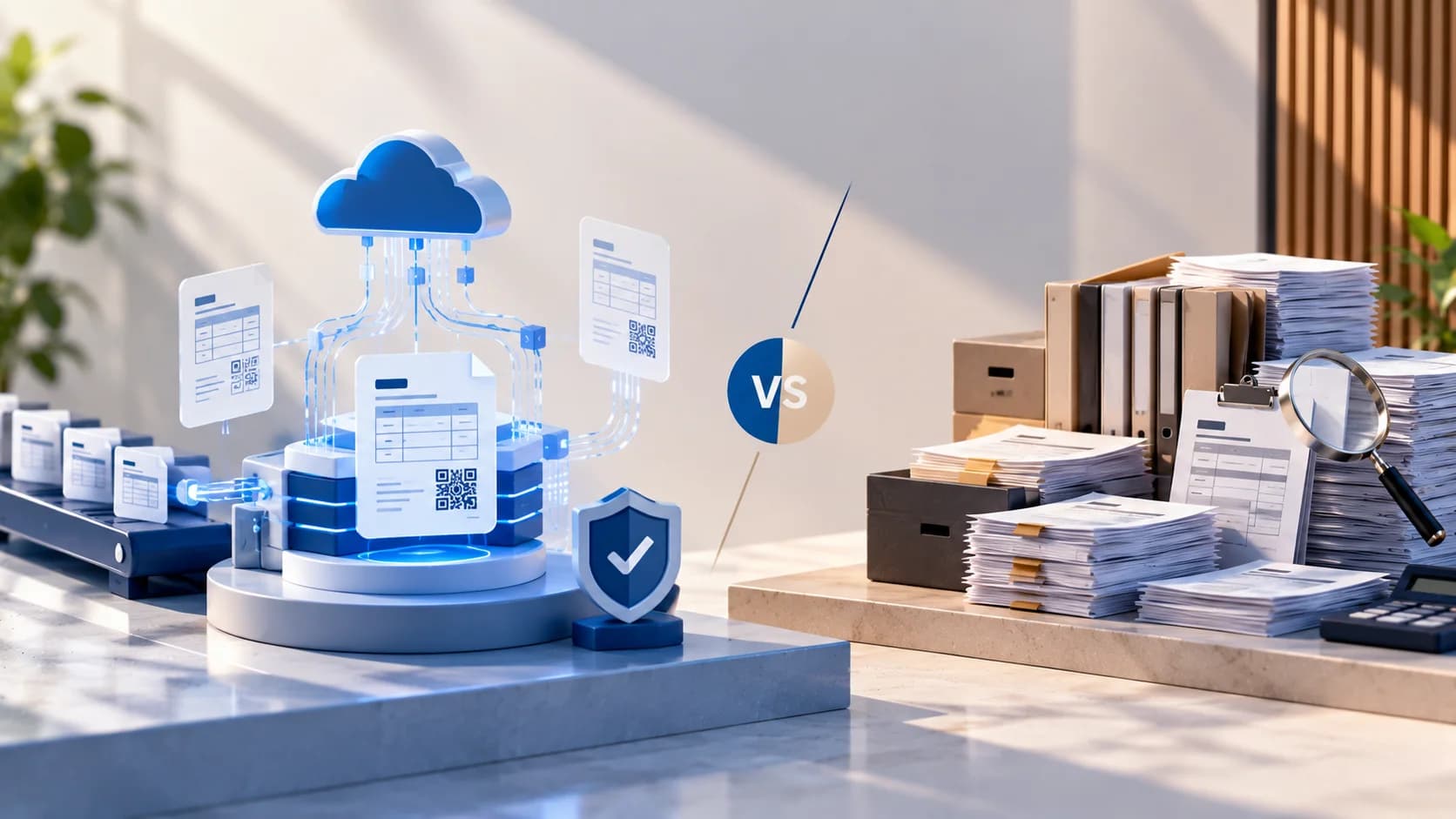
TDS filing software has become a standard part of how Indian businesses manage tax deducted at source, automating rate lookups, generating challans, and preparing the structured files needed for quarterly returns. For finance teams juggling payments to employees, vendors, contractors, and professionals across multiple sections of the Income Tax Act, this kind of automation genuinely reduces manual arithmetic. The open question for many businesses is whether that automation is sufficient on its own, or whether professional TDS filing support remains necessary to make sure deductions, deposits, and returns are actually correct rather than merely calculated quickly.

This article is general information, not professional advice. TDS rules, rates and due dates change, so check the current position with the Income Tax Department or a qualified professional.
Key Takeaways
- TDS filing software is fast at rate lookups, challans and return files.
- It cannot decide which section applies. It uses whatever category you select.
- Lower deduction certificates, treaty benefits and mixed payments need human judgment.
- Reconcile deducted, deposited and reported amounts before every quarterly return.
- A named owner for exceptions prevents small errors from repeating all year.
| Dimension | TDS filing software | Professional TDS filing services |
|---|---|---|
| Rate and section lookup | Fast once correctly configured | Verified against the specific payment's facts |
| Handling lower deduction certificates | Applies whatever is entered, no independent check | Tracked, validated, and applied correctly |
| Reconciliation across deduction, deposit, and reporting | Not performed automatically | Core part of the service |
| Response to a department notice | Software provides raw data only | Professional review and documentation |

Understanding What TDS Requires From a Business
Tax Deducted at Source applies to a wide range of payments, including salaries, rent, professional and technical fees, contractor payments, interest, and commission, each governed by a different section of the Income Tax Act with its own rate, threshold, and exemption rules. A business making these payments is required to deduct tax at the applicable rate at the time of payment or credit, whichever is earlier, deposit the deducted amount with the government within prescribed timelines, and report the details in quarterly TDS returns such as Form 24Q for salaries and Form 26Q for other payments.
Why the Responsibility Falls on the Payer
The structure of TDS places the compliance burden on the person making the payment rather than the person receiving it, on the logic that tax is easier to collect at the source of income than after it has been paid out. This means a business's finance team needs to correctly identify which section applies to each payment, apply the right rate, and keep accurate records, all before the recipient ever sees the net amount. Mistakes at this stage affect the deductor. They also affect the recipient's ability to claim credit for tax already deducted.
How TDS Filing Software Actually Works
Most TDS filing software operates by letting a user tag a payment to a particular section and category, after which the software applies the associated rate, calculates the tax to be deducted, and helps generate the challan for depositing that amount. At quarter-end, the software compiles all recorded transactions into the structured file format required for the relevant return, checks for basic formatting errors, and facilitates submission through the tax department's filing utility or portal.
Built-In Validations and Their Limits
These tools typically validate structural details, such as whether a PAN is in the correct format, whether challan details match the amounts reported, and whether mandatory fields have been completed. What they generally cannot validate is whether the section applied to a particular payment was the correct one in the first place, whether a payment should have been exempted or subjected to a lower rate under a specific certificate, or whether a payment was miscategorized due to how a vendor or transaction was set up in the accounting system feeding the software.
PAN Verification and Its Importance
Because TDS rates increase significantly when a recipient's PAN is invalid or not provided, software tools generally check PAN validity against a defined format and, where integrated with government systems, can verify PAN status. A PAN that appears formally valid but is linked to inconsistent name records, or a recipient who provides a PAN that does not match other records held by the deductor, can still create downstream problems that the software's formatting check will not catch.
Where Automation Genuinely Helps
For a business processing a high volume of routine, well-categorized payments, such as regular monthly salaries or recurring rent payments to a known set of vendors, TDS filing software meaningfully reduces the manual effort of calculating deductions and preparing quarterly returns. It also reduces arithmetic and formatting errors that used to be common when returns were prepared through manual spreadsheets, and it generally speeds up the process of generating and tracking challans across a large number of transactions.
Consistency Across Repeated Transactions
Once a payment category has been correctly configured in the software, it applies consistently to every later transaction of that type. The same payment is no longer treated differently from one month to the next. This is a genuine improvement over manual processes. There, different staff members might apply slightly different judgment to similar transactions.
Where Professional TDS Filing Support Remains Necessary
The judgment calls that TDS filing software cannot make on its own are exactly where professional support adds the most value. Determining which section applies to an unusual or borderline payment, deciding how to treat a payment covered by a lower deduction certificate, handling payments to non-residents that may be affected by a tax treaty, and managing the reconciliation between what was deducted, what was deposited, and what was reported in the return, all require someone with a working understanding of current TDS rules rather than reliance on default software settings.
Classifying Ambiguous or Mixed Payments
Many real-world payments do not fall neatly into a single TDS category. A contract that combines a service fee with a reimbursement of expenses, or a payment that could reasonably be classified under more than one section depending on the substance of the arrangement, requires a judgment call about which treatment is correct. Software will apply whatever category a user selects without questioning it, which means an incorrect initial classification can be repeated consistently across every future payment under that contract until someone reviews it.
Managing Lower Deduction Certificates and Exemptions
When a recipient holds a valid lower deduction certificate, the deductor is required to apply the specific reduced rate stated in that certificate rather than the standard rate for the relevant section. Tracking the validity period, threshold, and correct rate specified in each certificate, and making sure the software is updated promptly when a certificate is issued, renewed, or expires, is an ongoing administrative task that benefits from dedicated oversight rather than being left to whichever staff member happens to notice a certificate has arrived.
Reconciliation Across Deduction, Deposit, and Reporting
A correct TDS filing depends on three things lining up: the amount actually deducted from each payment, the amount deposited through the appropriate challan, and the amount reported in the quarterly return. Discrepancies between these can arise from timing differences, incorrect challan tagging, or data entry errors, and identifying and resolving these mismatches before a return is filed is a reconciliation task that requires someone actively reviewing the numbers rather than assuming the software's output is automatically consistent.
TDS on Payments to Non-Residents
Payments made to non-resident recipients, whether for services, royalties, interest, or other categories, are governed by a different section of the Income Tax Act and can also be affected by a Double Taxation Avoidance Agreement between India and the recipient's country of residence. Determining whether a treaty rate applies, and what documentation, such as a Tax Residency Certificate and Form 10F, needs to be collected from the recipient before a reduced rate can be applied, is a layer of complexity that standard TDS filing software is not designed to resolve independently.
Documentation Requirements for Treaty Benefits
Even where a treaty benefit clearly applies, the deductor typically needs to hold specific supporting documents from the recipient before applying a reduced rate, and the absence of this documentation can mean the standard, higher rate applies regardless of what the treaty itself technically permits. Businesses that make cross-border payments without a structured process for collecting and retaining this documentation risk either over-deducting, which frustrates the recipient, or under-deducting, which creates liability for the deductor. This is an area where the software will apply whatever rate it is told to, without independently confirming the underlying documentation actually supports that rate.
Payroll-Related TDS Complexities
TDS on salaries, filed through Form 24Q, involves its own layer of complexity beyond a flat percentage deduction, since it depends on an employee's declared investments, exemptions such as house rent allowance, and their choice between the old and new tax regimes. Software can calculate projected annual tax liability and divide it across remaining pay periods once employee declarations are entered, but it cannot verify that the declarations themselves are genuine or supported by valid documentation, which remains a compliance responsibility of the employer.
Handling Mid-Year Changes in Employee Circumstances
An employee who changes their declared investments, receives a salary revision, or joins partway through the financial year introduces recalculation complexity that automated payroll and TDS software handles well only if it is configured correctly for that specific scenario. Errors in mid-year recalculation can result in either a shortfall that surfaces as a large deduction near year-end, or an over-deduction that creates unnecessary friction with employees, both of which are more easily avoided with periodic professional review of the payroll TDS setup rather than relying solely on default automated recalculation.
Interest and Penalties for Non-Compliance
Late deposit of deducted tax, late filing of a quarterly return, and short deduction each carry their own interest and fee consequences under the Income Tax Act, and these can accumulate quickly across a large number of transactions or a long delay. Because TDS software generally does not proactively calculate or warn about interest exposure on a late deposit until after the fact, businesses that do not have someone actively monitoring deposit deadlines can find themselves facing avoidable interest charges that a timely process would have prevented entirely.
The Compounding Effect of Repeated Small Errors
TDS obligations recur every month and every quarter. A small process gap, such as consistently depositing tax a few days late, therefore compounds across a financial year. The cumulative interest cost becomes meaningful. Identifying and correcting small process inefficiencies early, which is typically the result of periodic professional review rather than software monitoring on its own, tends to save more over a year than most businesses initially expect.
Common Pitfalls in Automated TDS Processes
A recurring issue is businesses assuming that a return must be correct because software generated it without a formatting error. Structural validation and substantive accuracy are different things. A return can pass every format check the software performs while still containing an incorrect section classification, an outdated rate, or a missed deduction on a payment the software was never told to track.
Overlooking Payments Outside the Standard Payroll or Vendor Cycle
One-off payments, such as a one-time professional fee, a settlement payment, or a payment to a non-resident for services rendered, are more likely to be missed entirely if a business relies purely on software configured around recurring payroll and vendor cycles. These irregular payments often carry their own specific TDS treatment and are exactly the kind of transaction that benefits from being flagged for professional review rather than processed through default categories, or missed altogether.
Delayed Updates to Changing Rates and Thresholds
TDS rates and thresholds are periodically revised, and software needs to be updated to reflect these changes. A business relying on a tool that has not been updated, or on internal configuration that was set once and never revisited, risks continuing to apply outdated rates well after a change has taken effect, creating a shortfall that accumulates across every affected payment until it is identified.
5 Mistakes to Avoid With TDS Filing Software
In our experience, the same few mistakes account for most avoidable TDS corrections:
- Assuming a clean format check means the return is correct.
- Setting a payment category once and never reviewing it.
- Forgetting to update the software when a lower deduction certificate arrives or expires.
- Skipping the deducted, deposited and reported reconciliation before filing.
- Leaving one-off and non-resident payments outside the review process.
Building a Review Process Around Automated Tools
The most reliable approach for businesses using TDS filing software is not to abandon it, but to wrap it in a periodic review process that catches what the software cannot judge on its own. This typically means:
- A scheduled review of new or unusual vendor and payment types before they are processed at scale
- A periodic check of active lower deduction certificates and their expiry dates
- A reconciliation step before each quarterly filing that compares deducted, deposited, and reported amounts line by line
- A designated owner for exceptions, rather than leaving them to whoever notices the payment first
This process is closely related to how our comparison of AI tax filing chatbots against professional GST and TDS filing support frames the same divide between quick automation and professional accountability.
Setting Clear Ownership for Exceptions
A common gap in businesses that rely heavily on automation is the absence of a clear owner for exceptions, payments that do not fit neatly into an existing category, new vendors whose classification has not yet been confirmed, or certificates that are about to expire. Without a designated person responsible for flagging and resolving these exceptions before they are processed by default settings, they tend to be handled inconsistently, often by whichever staff member happens to notice the payment first, which is precisely the kind of variability that leads to compounding errors over time.

How Livida Supports TDS Filing in India
Livida's TDS filing service is designed around the understanding that software can handle calculation and form generation efficiently, but the classification decisions, exemption tracking, and reconciliation work still need experienced review. As part of its broader India-specific accounting services, Livida works alongside a business's existing payment and payroll processes to make sure TDS deductions are categorized correctly from the outset, certificates and exemptions are tracked and applied consistently, and quarterly returns reconcile cleanly against deposits before filing.
Integrating TDS With Broader Accounting and Payroll
TDS deductions on salaries connect directly to payroll processing. TDS on vendor payments connects to accounts payable. Livida's approach therefore treats TDS filing as part of a connected accounting process alongside business tax filing rather than an isolated quarterly task. This reduces the risk of the same classification error being repeated across the payroll cycle, the vendor payment cycle, and the TDS return itself. The same team reviews the underlying transactions and owns the resulting filing.
Reducing the Risk of Notices and Corrections
By reviewing classifications and reconciling figures before a return is filed, rather than after a mismatch triggers a notice from the tax department, Livida's approach aims to reduce the volume of correction statements a business needs to file and the administrative burden that comes with responding to department queries. Additional detail on TDS provisions and rates is available directly from the Income Tax Department at incometax.gov.in, which businesses can consult alongside professional advice when questions arise about a specific payment category.
Preparing for TDS Scrutiny and Department Queries
Even well-managed TDS processes occasionally attract a query or mismatch notice from the tax department. These are often triggered by a gap between what a deductor reported and what a recipient claimed on their own return. A prompt response needs clear supporting records. They should show how each deduction was calculated, deposited, and reported. That means organized documentation behind every filing, not only the software's summary export. Professional support at this stage often focuses less on the original calculation and more on reconstructing a clear, defensible narrative from the underlying records.
Why Documentation Habits Matter More Than the Software Choice
Two businesses using identical TDS filing software can have very different experiences responding to a department query, depending entirely on whether they kept organized supporting documentation, invoices, certificates, and payment records, alongside their software-generated returns. The software itself rarely stores enough context to fully explain an unusual transaction months later, which is why disciplined recordkeeping practices, maintained consistently rather than assembled reactively, remain a meaningfully different capability from the calculation and filing automation the software provides.
Bringing Software and Professional Review Together
TDS filing software has made the mechanical side of tax deduction at source considerably faster and less error-prone for routine, well-understood transactions. It has not removed the need for someone to make the classification decisions, track exemptions and certificates, and reconcile deduction against deposit and reporting before a return goes out. Businesses that treat these two layers as complementary, using software for efficiency and professional review for judgment, tend to avoid the accumulating errors that come from relying on either one alone. Businesses looking to review how their current TDS processes are structured are welcome to reach out to Livida to discuss where additional oversight might reduce their compliance risk.
Conclusion
TDS filing software handles calculation and form generation well. It does not handle classification, certificates or reconciliation. We recommend a quarterly review before each return is filed, with one named owner for every exception.
References
Official Indian government sources for TDS rules and filing:
- Income Tax Department e-filing portal, the official portal for returns, TDS statements and deductor services
- TRACES, the TDS reconciliation analysis and correction enabling system run by the tax authorities
- Income Tax Department, for current provisions, rates and notices
Talk to Livida
Our team is happy to look at how your TDS deductions, deposits and quarterly returns line up today. Reach us through our contact page, email info@livida.in, or call +91 94860 33194. You may also want to read about our income tax notice reply support and our guide to AI vs human judgment in accounting.