Filing an accurate business tax filing India return means more than transferring numbers from your books into a form. It requires applying the correct return format for your entity type, confirming whether a tax audit is required, reconciling income and expenses against what's already been reported through TDS and GST filings, and claiming the deductions and exemptions your business is actually entitled to. Livida prepares and files income tax returns for India-based companies, LLPs, partnership firms, and proprietorships as part of the broader accounting and compliance support we provide.
Getting the Basics Right
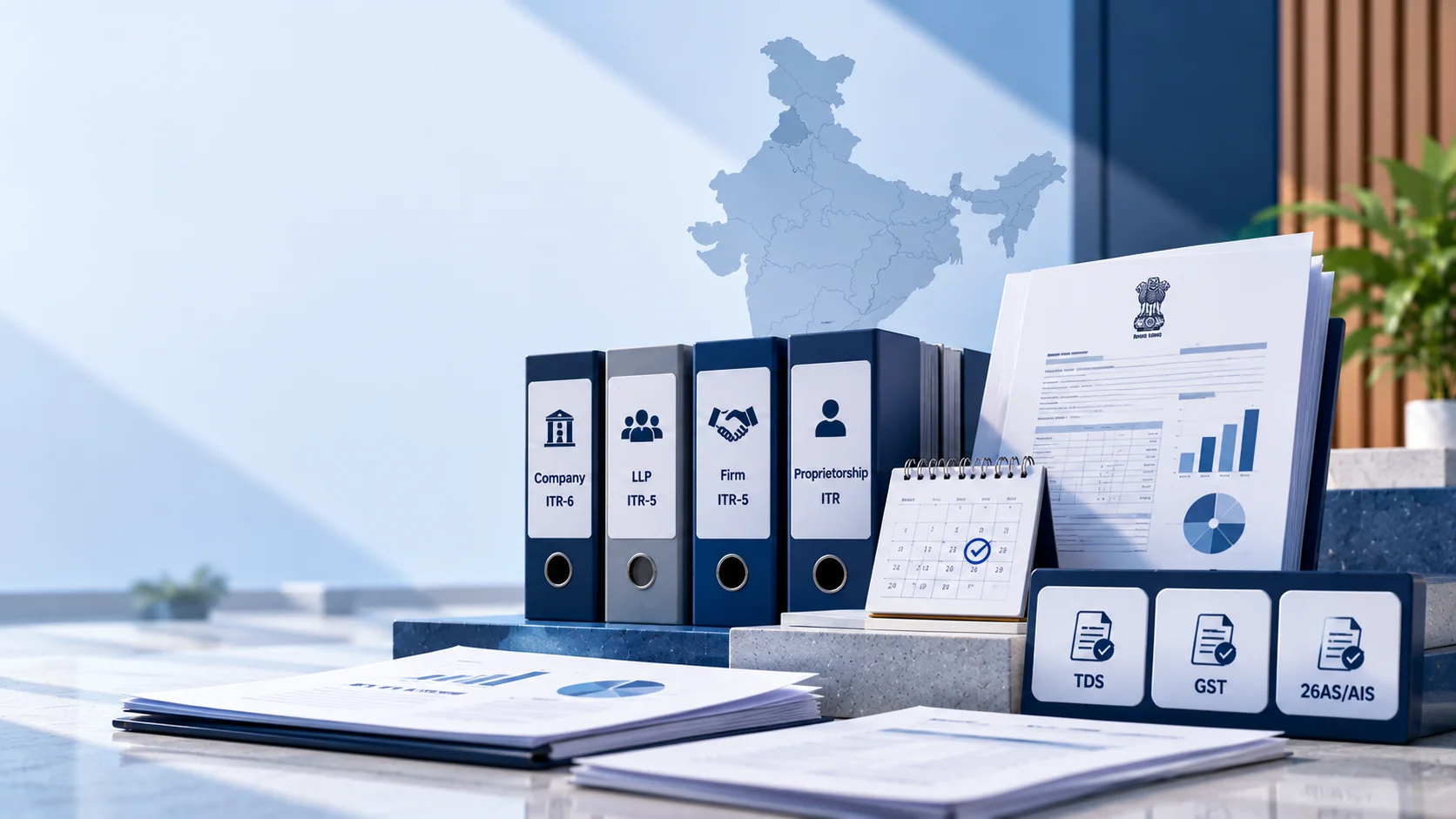
Different entity types file under different return forms, companies under ITR-6, LLPs and partnership firms under ITR-5, and proprietorships under the individual forms depending on income type, and each carries its own set of required schedules. Filing under the wrong form, or omitting a schedule your entity type is expected to complete, is one of the more common reasons a return comes back as defective and needs to be refiled or clarified. Getting the entity classification and applicable form right at the outset avoids that back-and-forth.
The return form that applies generally depends on entity type:
- Companies file under ITR-6
- LLPs and partnership firms file under ITR-5
- Proprietorships file under the applicable individual return forms based on income type
When a Tax Audit Applies
Businesses above the turnover threshold set under the Income Tax Act, or that don't qualify for presumptive taxation schemes, need their accounts audited before the return can be properly filed, with the audit report submitted alongside the return. This adds a step, and a deadline, ahead of the actual filing date, so the audit needs to be scheduled with enough lead time that it doesn't become the reason the return itself is filed late. Current thresholds and filing requirements are published by the Income Tax Department.
What Business Tax Filing India Involves
Beyond the return form itself, an accurate business tax filing India engagement means reconciling reported income against TDS credits reflected in Form 26AS and the Annual Information Statement, applying eligible deductions under the relevant sections of the Income Tax Act, computing depreciation correctly on business assets, and, where applicable, working out advance tax obligations for the following year. Each of these depends on the underlying bookkeeping being accurate and complete, which is why tax filing tends to go more smoothly when it's handled by the same team that maintains the books rather than as a once-a-year handoff to someone unfamiliar with them.
Livida's Process
We work from your books throughout the year rather than reconstructing them at filing time, reconciling income, expenses, and TDS credits, coordinating the tax audit where one applies, and confirming deductions and exemptions relevant to your business before preparing and filing the return. Where GST filing and TDS compliance are also handled by Livida, all three stay reconciled against the same set of books, which keeps the figures across your filings consistent rather than reconciled separately at the end of the year.
Our business tax filing India process runs in five steps:
- Confirm your entity type, the applicable return form and whether a tax audit applies.
- Reconcile income, expenses and TDS credits against your books, Form 26AS and the Annual Information Statement.
- Review deductions, exemptions and depreciation for the year.
- Prepare the return, check it against your GST and TDS filings, and share it with you for approval.
- File the return within the due date and keep the acknowledgement on record.
Why This Is Worth Getting Right Every Year
A late filing carries a statutory fee and can also mean forfeiting the ability to carry forward business losses to offset future profits, a cost that often exceeds the immediate penalty. Errors in deduction claims or income reconciliation, on the other hand, can trigger the kind of mismatch notice that then needs its own separate response. Filing accurately and on time, year after year, is less about any single filing and more about keeping your business's tax position clean and defensible over time. If your business tax return is coming up, Livida's India team can handle it alongside your existing bookkeeping and compliance work.
Business Tax Filing India at a Glance
| Item | Detail |
|---|---|
| Who it suits | Companies, LLPs, partnership firms and proprietorships |
| What we handle | Book reconciliation, return preparation and online filing |
| Typical documents | Books of account, Form 26AS, AIS, bank statements, TDS certificates |
| What happens next | We confirm your entity type, audit status and due date |
Key Takeaways
- The right return form depends on your entity type, and the wrong form is a common cause of defective return notices.
- A tax audit, where it applies, adds a step and a deadline ahead of the return itself.
- Reconciling income against Form 26AS, AIS and TDS credits before filing prevents most mismatch notices.
- Filing on time protects your ability to carry forward business losses.
- Returns that tie to your GST and TDS filings are easier to defend later.
What We See in Practice
In the filings we handle, the most common delay is books that have not been reconciled against Form 26AS and the AIS before the return is prepared. Our team therefore asks for these records early, and we recommend starting the reconciliation as soon as the financial year closes. If a mismatch notice does follow, our income tax notice reply service and our income tax return filing service work from the same records. For a wider view of where automation helps and where it does not, see AI tax chatbots vs GST and TDS filing.
Conclusion
Accurate business tax filing India work comes down to the right form, reconciled books and a calendar that includes any audit. Doing it the same careful way every year keeps your tax position clean and easy to defend. This page is general information, not professional advice, and tax rules, forms and due dates change, so confirm the current position before you file.
References
- Income Tax Department: filing your return
- Income Tax Department: income tax returns help
- Income Tax Department: e-Filing portal home
Talk to Livida
To discuss your return, use our India contact page, email info@livida.in or call +91 94860 33194.