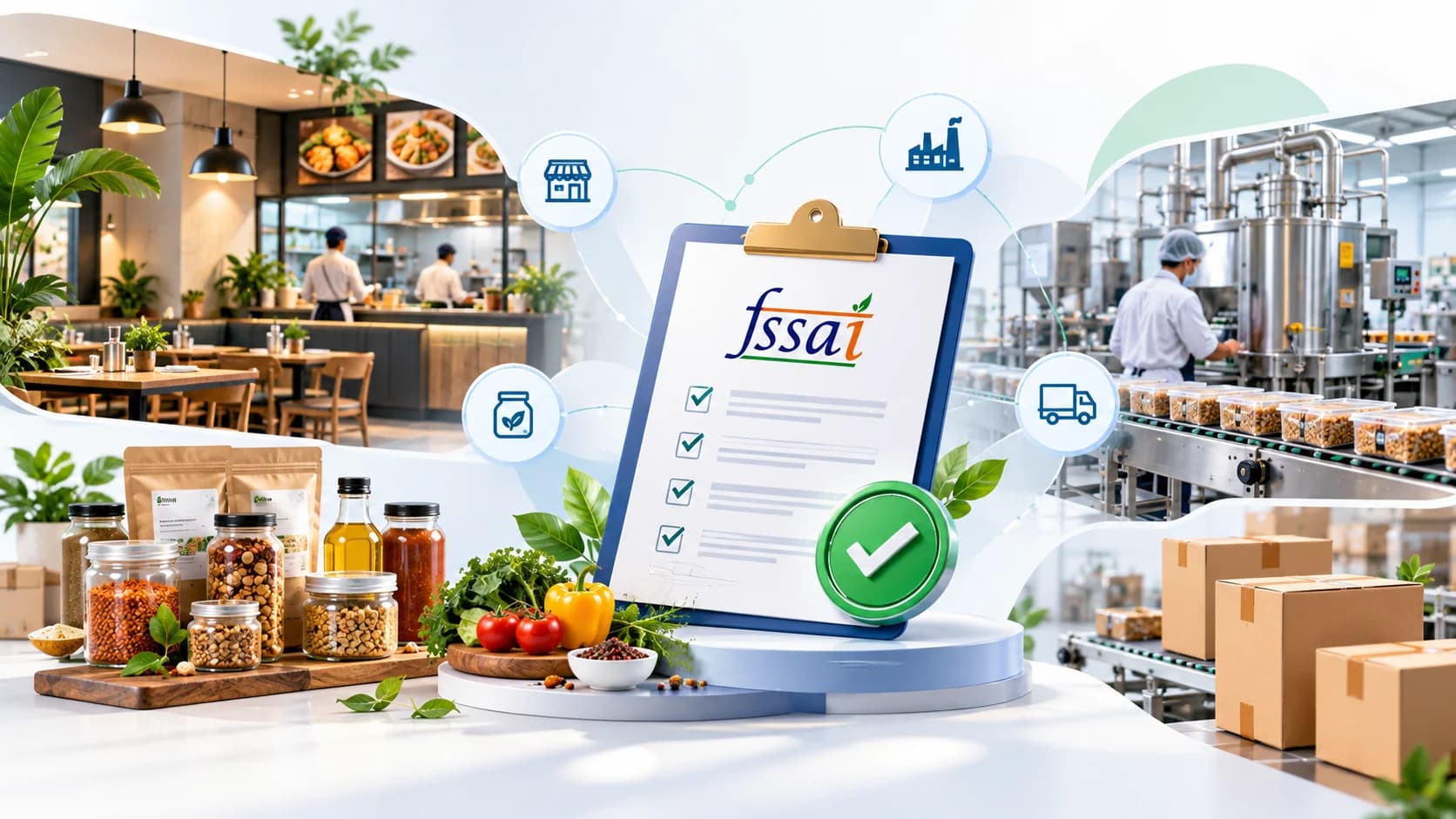
Any business in India that manufactures, processes, packages, stores, distributes, transports, or sells food, whether that's a restaurant, a packaged food brand, a cloud kitchen, or a home-based food business, needs to be registered with, or licensed by, the Food Safety and Standards Authority of India (FSSAI) before operating. Livida helps food businesses determine the correct FSSAI category for their scale of operation and handles the registration or license application and its ongoing renewal.
Key Takeaways
- FSSAI registration or a license is required before a food business operates, whatever its size.
- The right category, basic registration, state license, or central license, depends on scale and turnover.
- A growing business should recheck its category rather than assume the first filing still fits.
- Renewal dates need tracking so the business never operates on a lapsed registration.
Choosing the Right FSSAI Registration Category
FSSAI compliance isn't a single one-size-fits-all registration, it's structured across three tiers based primarily on the business's annual turnover and scale of operation. Basic registration applies to smaller food businesses below a defined turnover threshold. A state license applies to mid-sized businesses operating within a single state above that threshold. A central license applies to larger businesses, those operating across multiple states, and certain specific categories such as importers or large-scale manufacturers regardless of turnover. Applying under the wrong category, most commonly registering for basic registration when a business has actually grown past that threshold, is a common gap that surfaces during a compliance check.
Why Getting the Category Right Matters From the Start
Because the correct category depends on turnover and scale, a growing food business needs to reassess its FSSAI status periodically rather than assuming its original registration still applies as the business expands. Livida reviews a client's actual scale of operation before filing, and for existing clients, revisits this as part of ongoing compliance rather than leaving a category mismatch to be discovered later.
What the Application Involves
Documentation requirements differ by category. Basic registration generally requires identity and address proof for the business and its proprietors or partners along with proof of the business premises. State and central licenses require more detailed documentation, including a food safety management plan and details of the manufacturing, processing, or storage process involved, reflecting the higher scale of operation these categories cover. Livida confirms exactly what's needed for your specific category before submission, rather than applying a generic checklist across every business.
Livida's Process
We start by assessing your business's scale of operation and confirming whether basic registration, a state license, or a central license applies, then gather the required documentation and file the application with FSSAI. Once approved, we track your registration or license's validity period and reach out ahead of the renewal deadline so the business stays continuously compliant without gaps.
The five steps in practice:
- Assess your scale of operation and turnover.
- Confirm whether basic registration, a state license, or a central license applies.
- Gather the documents required for that category.
- File the application on the FSSAI portal.
- Track validity and file the renewal before expiry.
In the filings we handle, the most common issue is a business registered under a category it has since outgrown. Our team reviews scale first for that reason, and we recommend rechecking the category whenever turnover or locations change.
FSSAI Registration at a Glance
| Question | Short answer |
|---|---|
| Who it suits | Restaurants, cloud kitchens, packaged food brands, home food sellers |
| What we handle | Category check, documents, application, and renewal tracking |
| Typical documents | Identity and address proof, premises proof, and for licenses a food safety plan |
| What happens next | Operate with a valid number, plus tax and local licences |
Why FSSAI Registration Isn't Optional, Even for Small Operations
Operating a food business without valid FSSAI registration or a license is a violation under the Food Safety and Standards Act, and enforcement can range from penalties to closure of the business until compliance is restored, a disruption that's considerably more costly than getting registered correctly before opening. This applies regardless of how small the operation is, a home-based food seller is still expected to hold at least basic registration. If you're starting or already operating a food business in India and need to confirm your FSSAI status, Livida can assess your category and handle the filing.
Related Registrations for Food Businesses
FSSAI registration is rarely the only compliance requirement a food business needs to address at startup. Livida also supports:
- Trade License India, the local municipal license most food outlets need alongside FSSAI
- Udyam MSME Registration, which can unlock procurement and lending benefits for smaller food businesses
Most food businesses above the applicable turnover threshold also need to register separately under GST; current thresholds are published on the GST portal. Our GST registration service covers that step.
Conclusion
Correct FSSAI registration, in the right category and kept current, is a small cost compared with the disruption of a compliance gap. Getting the category and documents right at the start keeps the business free to focus on food, not paperwork.
References
- FSSAI licensing and registration, the regulator's page on licensing.
- FoSCoS, the FSSAI Food Safety Compliance System, where new licenses and registrations are applied for.
- National Portal of India, the single-window government portal listing central and state services.
This page is general information, not professional or legal advice, and rules change, so confirm current requirements before acting.
Talk to Livida
To confirm your category or start an application, contact Livida, email info@livida.in, or call +91 94860 33194.