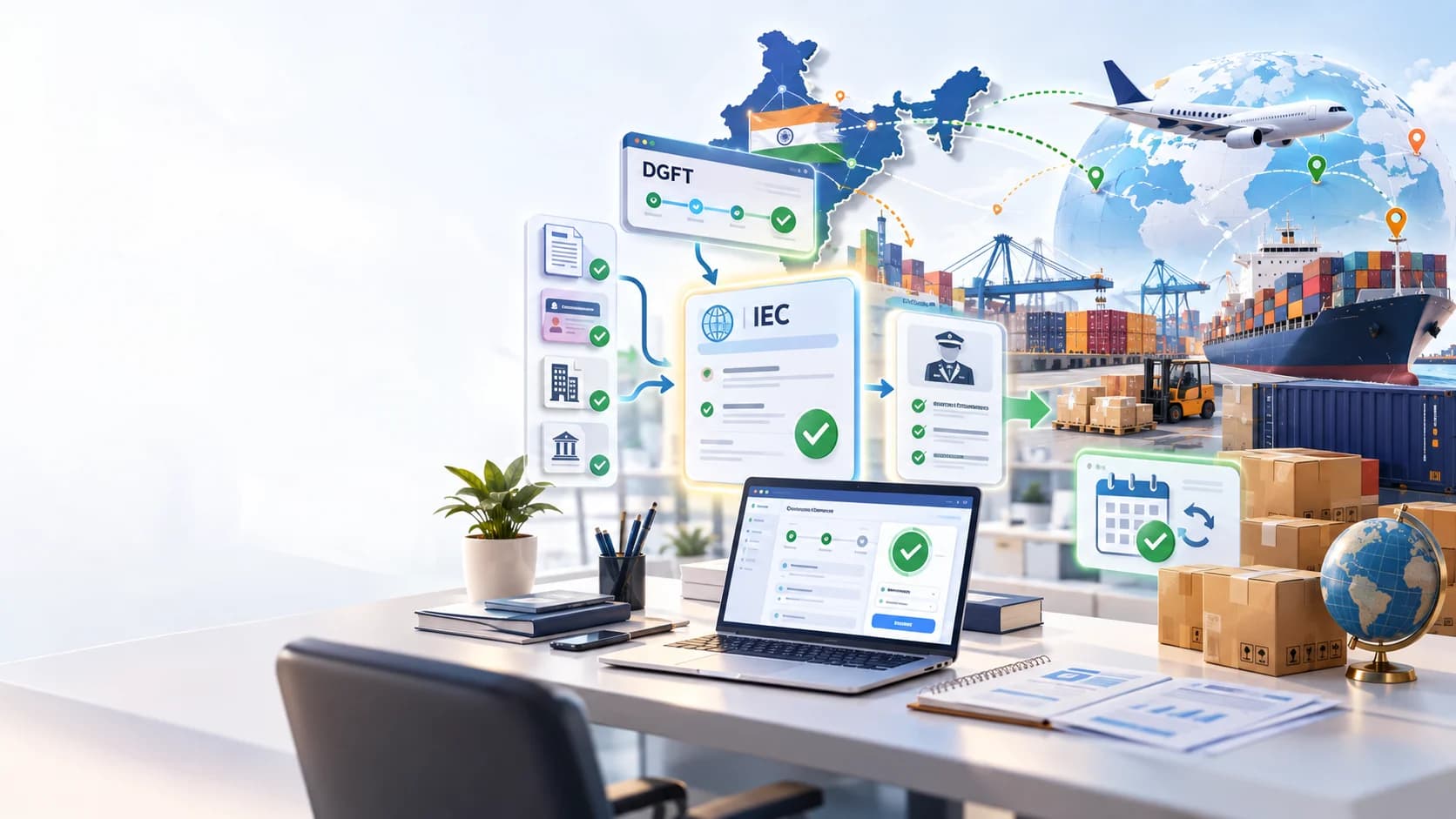
Any India-based business planning to import goods into the country or export goods out of it needs an Import Export Code (IEC) before that trade can legally proceed, since customs clearance and the banking transactions behind international trade both depend on a valid IEC being on file. Livida handles IEC registration with the Directorate General of Foreign Trade (DGFT) for clients setting up import or export operations.
Key Takeaways
- IEC registration India businesses complete with DGFT is a prerequisite for importing or exporting goods.
- One IEC, issued against the entity's PAN, generally covers all of that entity's trade.
- IEC details must be confirmed with DGFT every year, or the code can be deactivated.
- Coordinating the IEC with GST and outward payment filings keeps cross-border compliance consistent.
Why IEC Registration India Firms Need Comes First
Without a valid IEC, a shipment simply won't clear customs, and banks handling the foreign currency payments tied to an import or export transaction require the IEC to be in place before processing. This makes IEC registration one of the earliest steps a business needs to complete when planning to trade internationally, well before finalizing shipping arrangements or signing contracts with overseas suppliers or buyers, since discovering the requirement only once a shipment is ready to move creates avoidable delay.
One Code Per Business Entity
An IEC is issued against the business entity's PAN, and one IEC generally covers all of that entity's import and export activity, rather than needing a separate code per product line or per transaction. What matters is that the correct business entity, the one actually conducting the trade, holds the active IEC, which is a detail worth confirming clearly for businesses with multiple related entities or considering which entity should hold the registration.
What the Application Involves
An IEC application to DGFT requires the business's PAN, documentation establishing the business's constitution, incorporation documents for a company or LLP, a partnership deed for a firm, and proof of the business's address, along with the entity's bank account details, since the registration links to the business's banking information as part of DGFT's process. Livida gathers and prepares this documentation and files the application on the client's behalf.
Keeping the IEC Active
Unlike some registrations that simply expire and need periodic renewal, an IEC requires holders to confirm and update their details with DGFT annually during a specified window, even when there's no actual change to report. Missing this annual update results in the IEC being deactivated, which then needs to be reactivated before the business can use it again for any import or export transaction, creating an avoidable disruption for a business that's actively trading. Livida tracks this annual update requirement for clients so it doesn't get missed.
The five steps in practice:
- Confirm which business entity will conduct the trade.
- Collect the PAN, constitution documents, address proof, and bank details.
- Prepare and file the application on the DGFT portal.
- Download the IEC once issued and share it with banks and customs agents.
- Track the annual update so the code stays active.
In the IEC registration India applications we handle, the most common delay is a mismatch between the name or details on the PAN and the entity's other records. Our team checks that before filing.
IEC Registration India at a Glance
| Question | Short answer |
|---|---|
| Who it suits | Companies, LLPs, firms, and individuals importing or exporting goods |
| What we handle | Documents, DGFT application, and annual update tracking |
| Typical documents | PAN, constitution proof, address proof, bank details |
| What happens next | GST, LUT, and outward remittance tax filings |
Coordinating IEC With Your Broader Compliance
For businesses importing or exporting goods, IEC registration often sits alongside other related compliance needs, GST registration, export-related tax treatment, or Form 15CA/15CB filings for outward payments connected to imports. Because Livida already supports many India-based businesses across these areas, we coordinate IEC registration as part of a consistent overall setup rather than as an isolated filing disconnected from a business's other cross-border compliance. If your business is preparing to import or export, Livida can handle the IEC registration and coordinate it with your related compliance needs.
Related Cross-Border Compliance
IEC registration typically comes with other cross-border compliance needs. Livida also supports:
- GST LUT Filing, for exporters that want to invoice without upfront IGST payment
- Form 15CA 15CB Filing, for the tax documentation banks require on outward payments tied to import transactions
Outward remittance rules connected to import and export payments are administered by the Income Tax Department at incometax.gov.in. For GST on the sales side, see our GST Registration India service.
Conclusion
IEC registration India traders complete is a small step that every cross-border shipment depends on. Applying early, using the right entity, and keeping the annual update current avoids shipment and banking delays. Livida's accounting, tax, and compliance work keeps the rest of the setup consistent.
References
- Directorate General of Foreign Trade, the authority that issues the Import Export Code.
- DGFT FAQs on IEC profile management (PDF), the official guidance on applying for and managing an IEC.
- National Portal of India, the single-window government portal listing central and state services.
This page is general information, not professional or legal advice, and rules change, so confirm current requirements before acting.
Talk to Livida
For IEC registration India support, contact Livida, email info@livida.in, or call +91 94860 33194.