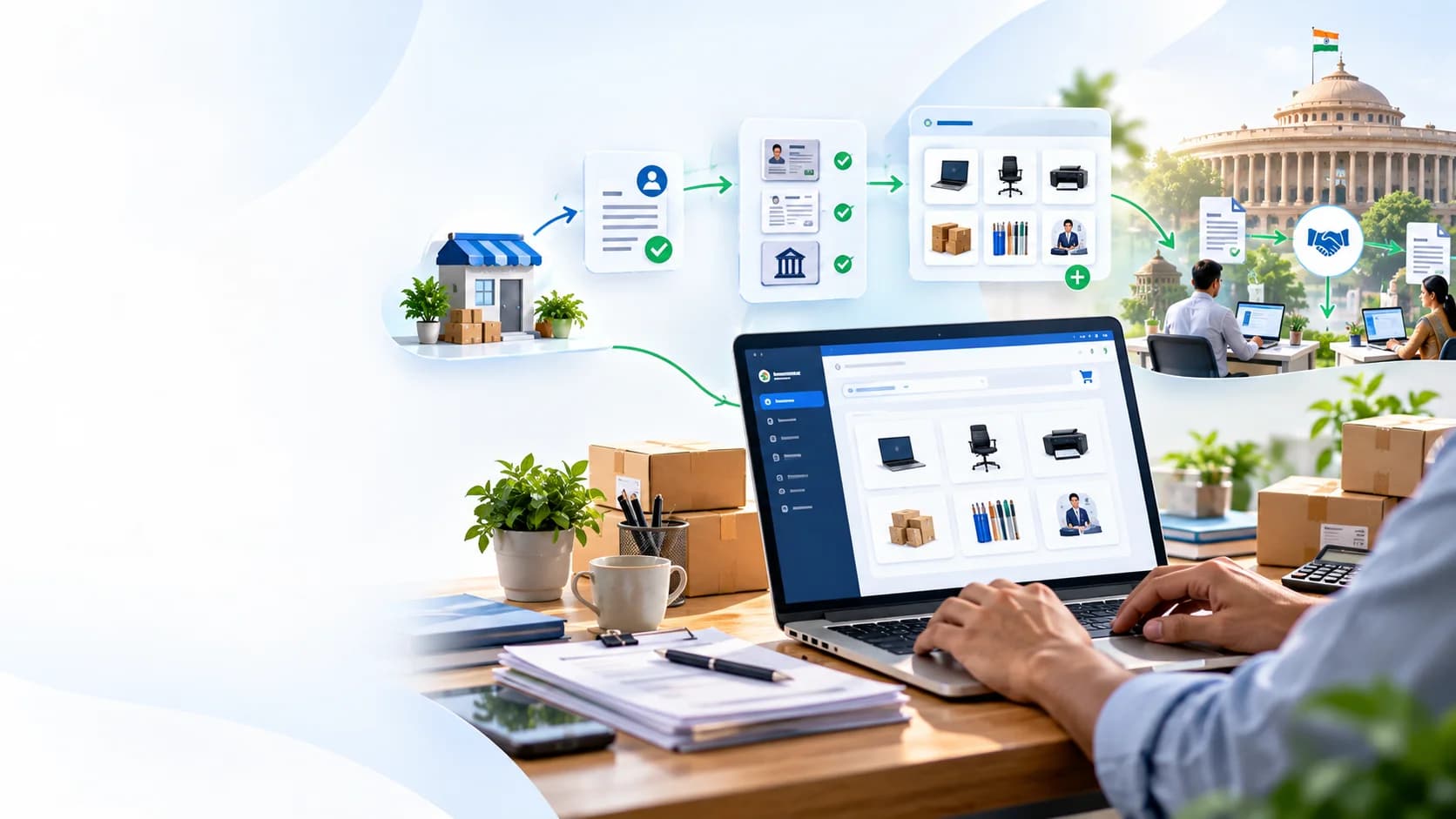
Registering as a Micro, Small, or Medium Enterprise under the Udyam MSME registration framework isn't a legal requirement for most businesses, but it's the gateway to a set of real, practical benefits that an unregistered business of the same size simply can't access, priority lending terms, protection against delayed payments, and, in some cases, preference in government procurement among them. Livida handles Udyam registration for India-based clients who qualify, as part of setting a business up to make use of the support available to it.
Key Takeaways
- Udyam registration is optional, but it is what activates MSME-specific benefits.
- Classification depends on investment in plant and machinery or equipment and on annual turnover, assessed together.
- Udyam is filed on top of the business's existing entity registration, not instead of it.
- The official portal describes registration as free and based on self-declaration, and Livida's role is an accurate assessment and filing.
Udyam MSME registration: How Classification Works
Classification as micro, small, or medium is based on two measures assessed together: the business's investment in plant and machinery or equipment, and its annual turnover. A business needs to fall within the applicable threshold for both measures to be classified in a given category, exceeding the limit on either one alone can push a business into the next category up. Because both thresholds matter jointly rather than independently, correctly assessing a business's classification takes a proper review of both figures rather than eyeballing one and assuming the other follows.
Why This Classification Matters Beyond a Label
MSME classification isn't just a descriptive label, it's the qualifying criterion for a defined set of benefits. Businesses often assume they'd naturally qualify for MSME support based on their size without realizing that registration is what actually activates access to it. An eligible business that never registers under Udyam simply doesn't receive the benefits it would otherwise be entitled to.
What Registration Unlocks
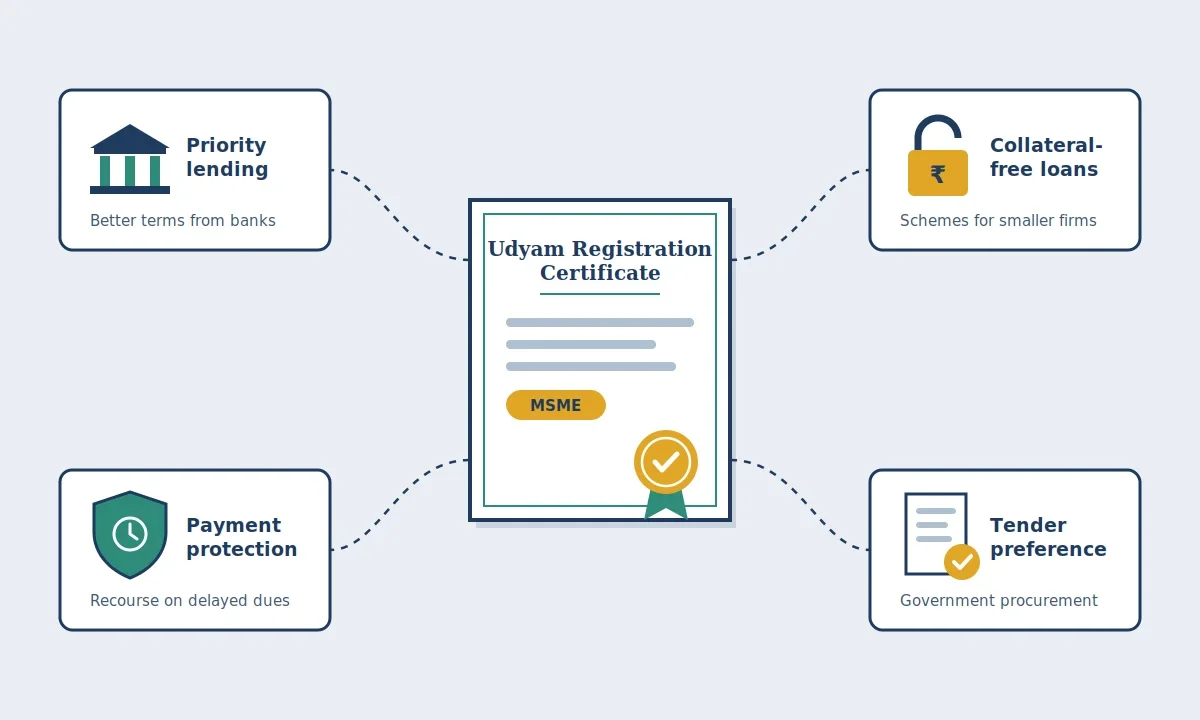
Udyam MSME registration typically unlocks:
- Priority sector lending from banks, often on more favorable terms than conventional business lending.
- Collateral-free loan schemes designed specifically for smaller businesses.
- Protection under the MSME Development Act against delayed payments from buyers, with a defined payment timeline and recourse.
- Preference in certain government tenders and procurement processes, including listing on the Government e-Marketplace.
Which benefits are most relevant depends on the nature of the business, which Livida reviews as part of the registration process. Businesses still finalizing their entity structure may also want to look at Startup India registration, which carries its own separate set of qualifying benefits.
Livida's Process
The Udyam MSME registration process comes down to five steps:
- Gather investment and turnover figures from the accounting records.
- Assess the correct micro, small or medium classification.
- Complete the online Udyam filing on the official portal.
- Check the certificate details against the business's records.
- Review the classification periodically as the business grows.
We assess a business's investment and turnover figures to determine its correct MSME classification, then complete the Udyam registration filing based on that assessment. This is separate from, and filed on top of, a business's underlying entity registration as a company, LLP, partnership, or proprietorship, which remains unaffected by Udyam registration itself. Once registered, we can periodically review the classification as part of ongoing compliance, since crossing an investment or turnover threshold can shift a business into a different MSME category over time.
Why This Is Worth Doing Even Though It's Optional
Because Udyam registration isn't legally required, some qualifying businesses simply never get around to it, and in doing so leave real benefits, better loan terms, payment protection, procurement access, unclaimed. Given how straightforward the registration itself is relative to the benefits it unlocks, it's one of the more clearly worthwhile optional registrations a qualifying small business can complete. The accounting records used to assess turnover and investment for classification follow the same bookkeeping standards referenced by bodies such as the Institute of Chartered Accountants of India. If your business is likely to qualify as an MSME and isn't yet Udyam registered, Livida can assess your classification and handle the registration.
Udyam MSME Registration at a Glance
| Question | Short answer |
|---|---|
| Who suits it | Micro, small and medium enterprises, whatever their entity type |
| What Livida handles | Classification assessment, online filing, later reviews |
| Typical inputs | Investment and turnover figures, entity details, identity details for the filing |
| What happens next | Udyam certificate issued, with classification reviewed as the business scales |
The Ministry of MSME's registration portal states that registration is free and paperless, so the value of working with a team is accuracy rather than access. In the filings we handle, the most common slip is a classification based on turnover alone, with investment left out. Our team checks both figures. Businesses also tend to pair this with trade license and ISO certification work, and the accounting side connects to GST registration.
Conclusion
Udyam MSME registration is a low-friction step with real practical benefits for a qualifying business, but only if the classification is right and kept current. Assess investment and turnover together, file on the official portal and revisit the classification as the business grows. This page is general information, not professional advice, and thresholds and schemes change, so confirm current details on the official portal.
References
Talk to Livida
To check your classification and register, use our contact page, email info@livida.in or call +91 94860 33194.