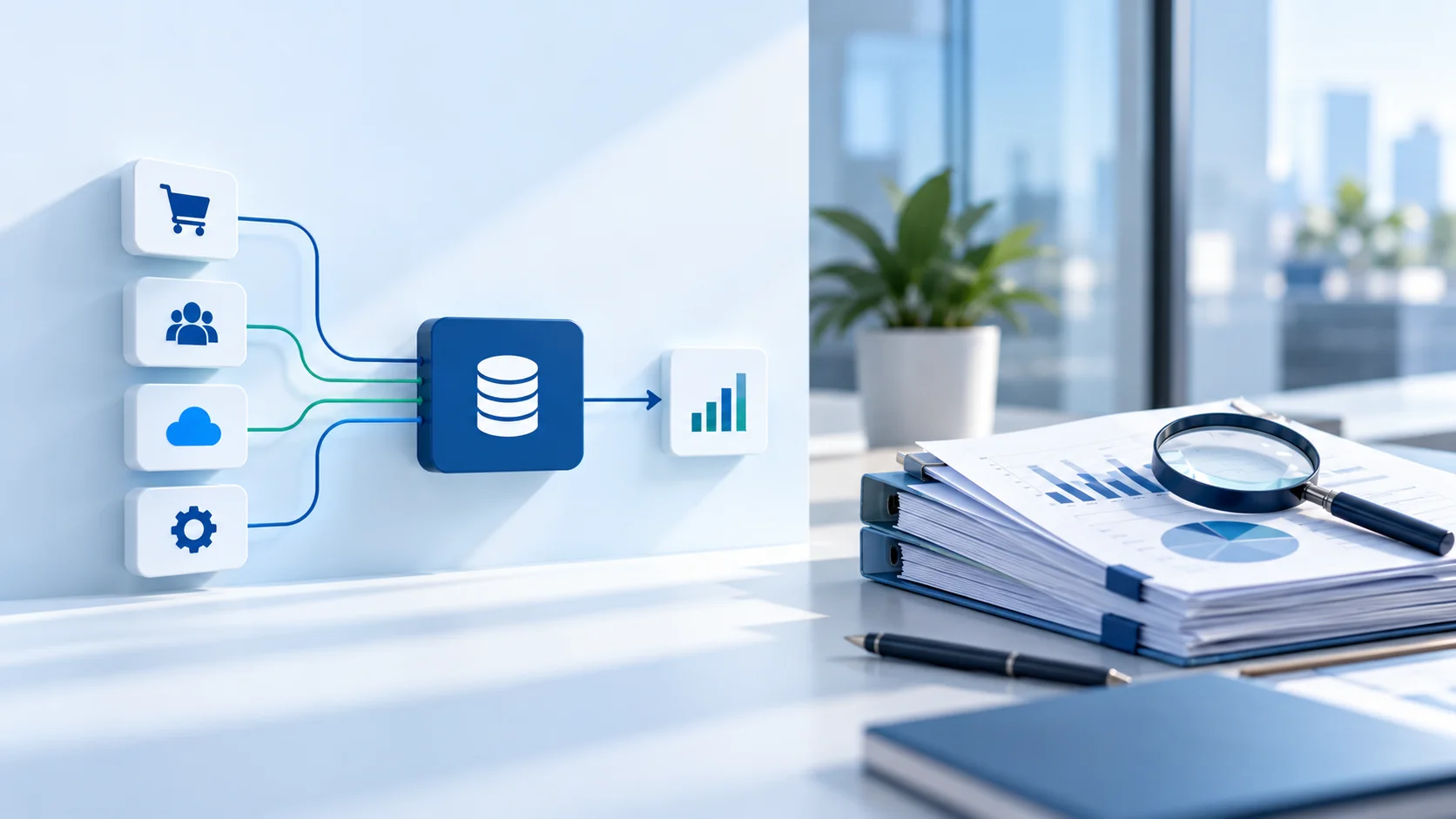
Businesses evaluating cloud ERP vs bookkeeping as two competing options are usually asking the wrong question, because the two serve fundamentally different purposes even though they both touch financial data. A cloud ERP platform is a system for organizing information across departments, inventory, and workflows, while bookkeeping is the discipline of making sure the financial data inside that system is accurate, reconciled, and properly reported. Understanding where one ends and the other begins helps a growing business avoid the costly mistake of assuming that adopting new software solves problems that only a qualified person can actually solve.

| Cloud ERP Platform | Professional Bookkeeping | |
|---|---|---|
| Role | Organizes and connects data across departments | Verifies, reconciles, and reports on that data |
| Judgment applied | None; processes whatever is entered | Professional review of accuracy and classification |
| Best at | Real-time visibility, automated posting | Catching misconfigurations, closing books correctly |
| Risk if used alone | Errors spread automatically across modules | Manual process without connected, real-time data |
Key Takeaways
- Cloud ERP vs bookkeeping is not a choice between two substitutes: the ERP organizes data, and bookkeeping makes sure it is right.
- An ERP processes whatever is entered, so a misconfiguration repeats across every connected module.
- Configuration needs revisiting as the business adds products, tax jurisdictions and sales channels.
- Reconciliation by a professional is the main safeguard against silent, compounding errors.
- Data migration and multi-entity reporting are the two moments where professional review pays off most.

What Cloud ERP Platforms Actually Do
Cloud ERP platforms bring together modules that used to live in separate systems: inventory management, sales orders, procurement, human resources, and financial accounting, all connected through a shared database accessible from anywhere with an internet connection. The appeal for a growing business is real. Instead of manually re-entering a sales order into an accounting system after it is created in a separate sales tool, an ERP platform can push that transaction through automatically, updating inventory levels, recognizing revenue, and posting to the general ledger in a single connected flow.
This connectivity is a genuine improvement over the fragmented, spreadsheet-and-standalone-software approach that many smaller businesses start with. It reduces the manual re-keying that introduces transcription errors, and it gives management a more current view of operations across departments rather than a monthly snapshot assembled after the fact. Cloud based accounting systems, whether standalone or part of a broader ERP suite, have made this kind of real-time visibility accessible to businesses that could never have justified the cost of legacy on-premises ERP software a decade ago.
The Limits of What an ERP Can Judge
What a cloud ERP platform cannot do is exercise judgment about whether the data flowing through it is being handled correctly in the first place. If a sales order is entered with the wrong revenue recognition timing, or an inventory adjustment is miscategorized, the ERP will faithfully process that error through every connected module, spreading it across departments rather than containing it. An ERP is only as reliable as the configuration and data entry behind it, and neither of those is something the software provides on its own. In the cloud ERP vs bookkeeping question, this is the key limit.
Why ERP Accounting Integration Needs a Professional Eye
ERP accounting integration is the specific process of connecting modules like sales, procurement, and payroll to the financial accounting layer so that transactions post automatically rather than requiring manual entry. Done well, this integration is one of the most valuable features of a modern ERP system. Done poorly, it becomes a source of systematic errors that are harder to catch than a single manual mistake, because the same misconfiguration repeats across every transaction that flows through that path.
A common example is a tax or revenue recognition rule that is configured incorrectly at setup and then applies quietly to every subsequent transaction for months before anyone notices the pattern in a reconciliation. Catching this kind of error requires someone who understands both the accounting principle involved and how to trace a discrepancy back through the ERP's transaction flow, which is squarely the work of a professional bookkeeper or accountant rather than something the software flags on its own.
Configuration Is Not a One-Time Event
Businesses also tend to underestimate how often ERP configuration needs revisiting. New product lines, new tax jurisdictions, changes in how revenue is recognized, and growth into new sales channels all require updates to how the ERP posts transactions. A configuration that was correct at implementation can become wrong months later simply because the business changed and nobody updated the underlying rules to match. Periodic review by someone with accounting expertise catches this kind of drift before it accumulates into a larger cleanup project.
Signs an ERP Setup Needs a Bookkeeping Check-Up
A business weighing cloud ERP vs bookkeeping should know the recognizable warning signs that an ERP environment has drifted away from accurate financial reporting. Reconciliations that used to close quickly start taking longer and turning up unexplained variances. Reports that different departments pull from the same ERP no longer agree with each other, suggesting that data is being classified inconsistently somewhere in the flow. Month-end close stretches longer each cycle rather than becoming more efficient as the system matures, which usually means someone is manually patching errors after the fact rather than the system generating clean data from the start.
Any one of these signs on its own might be a minor issue, but together they usually point to configuration drift, inconsistent data entry practices across departments, or a lack of regular reconciliation. A professional bookkeeping review at this stage, focused specifically on tracing discrepancies back to their source in the ERP, tends to be far less expensive than waiting until a lender, investor, or tax authority raises a question that forces the same investigation under pressure.
Five red flags worth watching for include:
- Reconciliations that used to close quickly now taking noticeably longer.
- Reports from different departments no longer agreeing with each other.
- Month-end close stretching longer each cycle instead of shortening.
- Unexplained variances appearing repeatedly in the same accounts.
- Manual patches or journal corrections becoming a routine part of close.
In the accounts we review, the most common ERP problem is a posting rule that was right at setup and then drifted as the business changed. Our team recommends a periodic check of how cloud ERP vs bookkeeping responsibilities are split, not only a check after something looks wrong.
This decision connects closely with our broader framework for choosing between software and managed services and our look at AI bookkeeping software versus managed bookkeeping.
Cost Considerations: License Fees vs. Professional Oversight
Cloud ERP platforms are usually priced by user seat, module, or transaction volume, and businesses budgeting for a new system often focus heavily on that license cost while treating the bookkeeping and reconciliation work as a secondary, almost optional line item. This ordering tends to be backward. The license fee buys access to a system; it does not buy assurance that the numbers inside that system are correct. Underinvesting in the oversight layer to save money on the visible line item often costs more later, whether through a compliance penalty, a restated financial statement, or a lender relationship damaged by numbers that did not hold up to scrutiny.
Cloud ERP vs bookkeeping is not really a budget trade-off. A more balanced way to budget is to treat the software license and the professional bookkeeping service as two parts of the same investment, each addressing a different risk. The software reduces the risk of manual re-entry errors and gives real-time visibility. The bookkeeping service reduces the risk of the underlying data being wrong, misclassified, or improperly reported. Cutting either one to save cost usually just shifts the risk somewhere less visible rather than removing it.
Multi-Entity and Multi-Currency Complexity
Businesses operating across more than one entity, region, or currency add a layer of complexity that neither an ERP platform nor a bookkeeping service can fully resolve alone. An ERP can technically support multiple currencies and entities, but the rules for translation, intercompany elimination, and consolidated reporting still require someone with the accounting expertise to configure and periodically verify them. A translation rate applied incorrectly, or an intercompany transaction that is not eliminated properly during consolidation, can materially distort the picture a consolidated financial statement presents to ownership or investors.
This is precisely the kind of scenario where Livida's consolidation of accounts and annual financial report preparation services, covered in more depth in our piece on consolidation software versus professional consolidation of accounts, intersect directly with whatever ERP platform a multi-entity business is using. The software provides the infrastructure to hold the data; the professional service ensures that data is combined and presented correctly once it needs to represent the business as a whole rather than as a set of disconnected entities.
What Professional Bookkeeping Services Add to an ERP Environment
Reconciliation as the Primary Safeguard
Professional bookkeeping services provide the reconciliation discipline that an ERP platform does not provide on its own. Reconciling bank accounts, credit cards, and intercompany balances against what the ERP shows is the primary way a business catches errors, whether those errors come from a misconfiguration, a duplicate entry, or a transaction that was never properly closed out. Livida's accounting system reviews are built around exactly this kind of ongoing check, treating the ERP's output as something to verify rather than something to trust automatically.
Turning Data Into Statements That Matter
An ERP can generate reports, but turning raw data into general and special purpose statutory accounts, annual financial statements, or a consolidation of accounts across multiple entities requires professional judgment about presentation, classification, and disclosure that goes beyond what a standard ERP report template provides. This is particularly true for consolidation, where intercompany eliminations and currency translation require decisions that a generic ERP module handles only partially without expert oversight.
Ongoing Financial Analysis
Beyond compliance-driven statements, professional bookkeeping services also provide financial analysis that interprets what the numbers in the ERP actually mean for the business, identifying trends, flagging concerning patterns in cash flow, and translating raw financial data into insight that supports decision-making. An ERP dashboard can show a number moving; a professional can explain why it is moving and what to do about it.
Cloud Based Accounting Systems Without a Full ERP
Not every growing business needs or wants a full ERP platform, and many operate perfectly well on a cloud based accounting system paired with point solutions for inventory or payroll.
This is a legitimate and often more cost-effective path for businesses that have not yet reached the operational complexity that justifies a full ERP implementation, and there is no inherent shame in staying on a simpler stack longer than a software vendor's sales pitch might suggest. This lighter setup still benefits from the same principle: the software organizes and stores data, while professional bookkeeping ensures that data is accurate, reconciled, and properly reported. The cloud ERP vs bookkeeping question applies here too. The scale of the technology changes the complexity of the review required, but it does not remove the need for the review itself.
Businesses sometimes assume that a simpler accounting system needs less oversight than a full ERP, but this is not always true. Simpler systems often have fewer built-in controls and validation checks, which can mean more manual judgment is required to catch errors that a more sophisticated ERP might flag automatically. The right amount of professional oversight depends more on transaction complexity and business risk than on which software category is in use.
The Migration Risk Businesses Underestimate
One of the highest-risk moments where cloud ERP vs bookkeeping meet is the data migration itself, when historical transactions, account balances, and configuration rules move from an old system into a new one. Migrations that go wrong tend to go wrong quietly, with balances that do not tie out, historical transactions mapped to the wrong account, or opening balances that are simply incorrect. These errors then flow forward into every subsequent report the business generates until someone catches the discrepancy during a reconciliation or an audit.
Having an experienced bookkeeping team involved during migration, reviewing the mapped chart of accounts and validating opening balances against the prior system, substantially reduces this risk. This is exactly the kind of transition support that pairs a business's chosen cloud ERP platform with the professional oversight it needs to actually deliver reliable numbers from day one, rather than requiring a cleanup project months down the road once the errors surface.
How This Plays Out for Growing Businesses
For a business in Singapore preparing consolidation of accounts and annual financial report preparation, or one in the United States managing accounts receivable and accounts payable across an ERP-connected sales and procurement flow, the cloud ERP vs bookkeeping pattern is the same: the ERP organizes the data, and professional bookkeeping makes sure that data is trustworthy enough to build statutory accounts, financial statements, and tax filings on top of. Standards guidance from organizations like the IFRS Foundation continues to shape how financial data should be presented, and applying that guidance correctly inside a specific ERP's chart of accounts is squarely professional work.
Regardless of which cloud ERP platform or accounting system a business chooses, the underlying question in cloud ERP vs bookkeeping is the same: who is verifying that what the system reports is actually correct, complete, and properly classified? Software answers "what does the data show." A professional answers "can this data be trusted, and what does it actually mean."

Training, Access Controls, and Everyday Discipline
A cloud ERP platform is only as reliable as the people entering data into it day to day, and businesses often underinvest in training relative to how much they spend on the software license itself. Staff who do not understand why a transaction needs to be coded a particular way will code it inconsistently, and that inconsistency compounds across every report generated from the system afterward. Establishing clear data entry standards, and revisiting them periodically as the business changes, is unglamorous work compared to selecting new software, but it has an outsized effect on whether the resulting numbers can actually be trusted.
Access controls matter for similar reasons in any cloud ERP vs bookkeeping setup. An ERP platform that allows too many people to post directly to sensitive accounts, or to alter historical entries without a review step, creates an environment where errors and, in rarer cases, deliberate manipulation can go undetected for longer than they should. Professional bookkeeping services often include a review of who has access to what within the client's system as part of a broader accounting system review, since access control is inseparable from data integrity in any connected financial platform.
Cloud ERP vs Bookkeeping: Choosing the Right Combination
The right combination of ERP investment and bookkeeping oversight depends on business size, transaction complexity, and how many departments and locations need to be connected through a shared system. A business considering a move to a cloud ERP platform should think about that decision alongside its bookkeeping process, not as a separate project, since the value of the new system depends heavily on the accuracy of what feeds into it and the quality of review applied to what comes out.
It is also worth revisiting this combination periodically rather than treating it as a one-time decision made at implementation. As a business adds product lines, enters new markets, or simply grows in transaction volume, both the ERP configuration and the level of bookkeeping oversight it needs will shift, and what was sufficient at one stage of growth can quietly become inadequate at the next without anyone noticing until a problem surfaces.
Bringing Technology and Expertise Together
Cloud ERP platforms have made it possible for growing businesses to connect operations and finance in ways that used to require enterprise-scale budgets, and that shift has been genuinely valuable. But an ERP is a system for organizing data, not a substitute for the judgment, reconciliation, and reporting expertise that professional bookkeeping services provide. The businesses that get the most value from an ERP investment are the ones that pair it with exactly that kind of oversight from the start.
On cloud ERP vs bookkeeping, Livida's general accounting and bookkeeping services are built to work within whatever cloud based accounting system or ERP platform a client already relies on, applying the reconciliation and review discipline that turns organized data into numbers a business can actually act on and report with confidence.
That combination matters most at the moments when it is tested the hardest: an audit, a financing round, a tax authority inquiry, or simply a board meeting where ownership expects a clear, defensible answer about the state of the business. A well-configured ERP makes it easier to produce an answer quickly. A professional bookkeeping service makes sure that answer is actually correct. Businesses that plan for both from the outset, rather than treating one as a later add-on to the other, tend to avoid the costly cleanup projects that so often follow a purely software-driven approach to growth.
Conclusion
Cloud ERP vs bookkeeping is a question of integration, not replacement. The ERP gives real-time visibility and automated posting, and professional bookkeeping gives reconciliation, review and accountable reporting. Planning for both from the start avoids the cleanup projects that follow a purely software-driven approach.
References
- IRS recordkeeping guidance: what business records to keep and how long to keep them.
- Ministry of Corporate Affairs, India: the official portal for company filings and incorporation services.
- Institute of Chartered Accountants of India: India's national professional accounting body.
- IFRS Foundation: the body behind IFRS Accounting Standards.
Talk to Livida
If you would like help reviewing how your ERP or cloud accounting system posts to the books, reach out through our contact page, email info@livida.in or call +91 94860 33194. You can also read about Virtual CFO advisory and statutory audit readiness review.
This article is general information, not professional advice, and accounting and reporting rules change. Please confirm your own position with a qualified professional before acting.