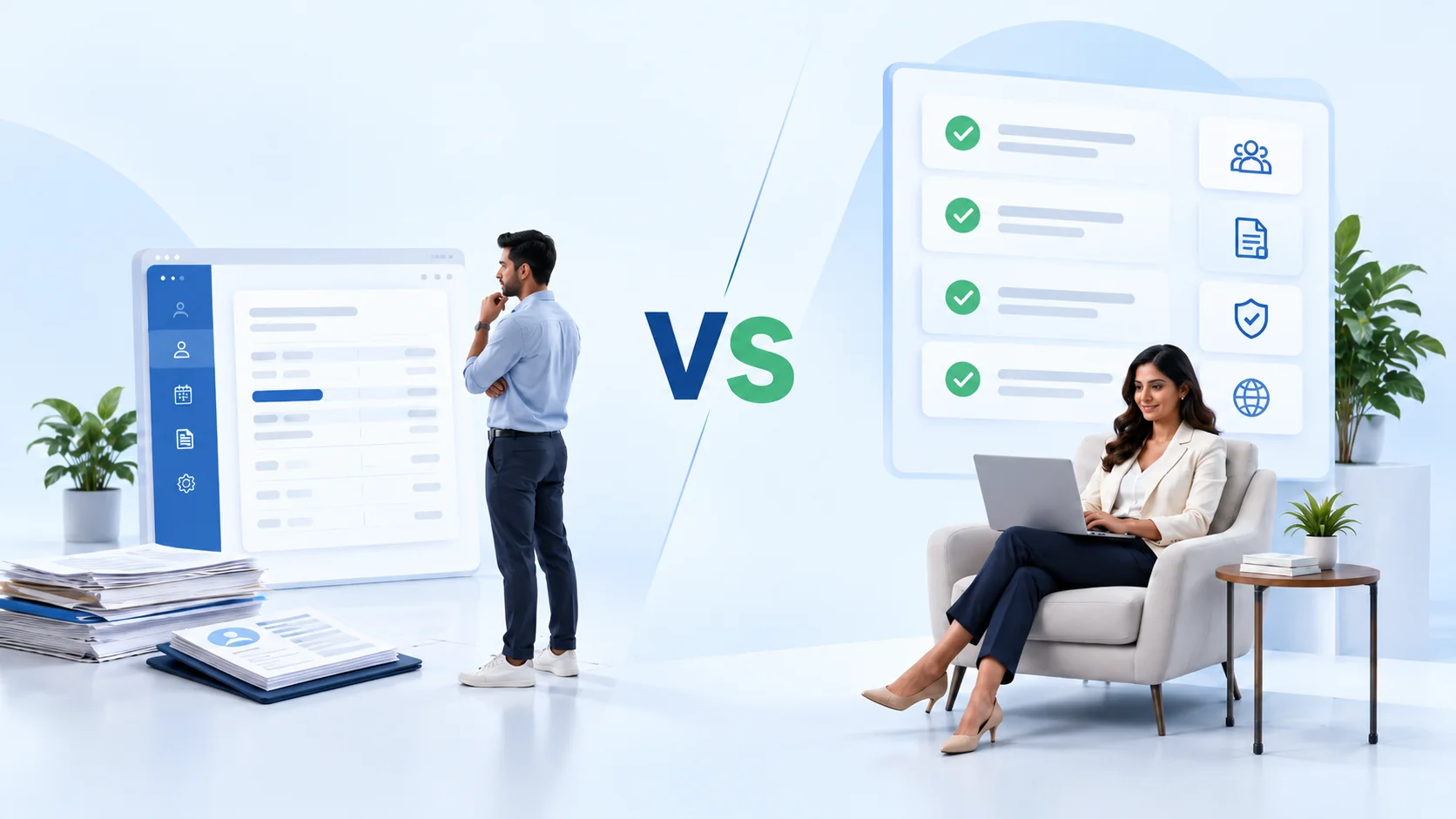
Payroll tax filing software sits inside nearly every cloud HR suite sold today, bundled alongside modules for recruitment, performance management, and benefits administration as part of an all-in-one platform pitch. For a business evaluating whether that bundled tax module is enough on its own, or whether specialized payroll tax filing support is still worth paying for separately, the honest answer depends heavily on how many jurisdictions the business operates in, how complex its compensation structures are, and how much risk it is willing to accept if a filing turns out to be wrong.
This piece looks at what these bundled modules actually do well, where they tend to fall short, and why many businesses still keep a specialized layer of human review in place even after adopting a full-featured cloud HR suite.

| Bundled Cloud HR Tax Module | Specialized Payroll Tax Filing Support | |
|---|---|---|
| Strength | Convenient, single-platform administration | Deep, jurisdiction-specific accuracy |
| Depth | One module among many | Sole focus of the provider |
| Multi-jurisdiction handling | Often strongest only in the vendor's home market | Built to track rules across jurisdictions |
| Review before submission | Automated, based on fixed configuration | Human review of inputs and exceptions |
Key Takeaways
- Payroll tax filing software inside a cloud HR suite works well for simple, single-jurisdiction payroll.
- Convenience is not the same as accuracy: the software calculates from whatever configuration it is given.
- Rules, rates and forms change, so someone must confirm each update was applied to your setup.
- A review step before submission is far cheaper than correcting a filing afterwards.
- Five questions to ask before relying on bundled software are listed near the end of this article.

What a Cloud HR Suite's Tax Module Typically Covers
Cloud HR suites have become the default choice for many mid-sized businesses precisely because they promise to consolidate a sprawling set of administrative functions into a single login and a single vendor relationship. Recruitment, onboarding, time and attendance, benefits enrollment, performance reviews, and payroll tax filing all sit under one roof, which is undeniably appealing from a procurement and IT-management perspective. The question this piece explores is whether that consolidation, convenient as it is, extends to the same level of depth and reliability in payroll tax filing that a business would get from a provider whose entire focus is statutory tax accuracy.
Most cloud HR suites treat payroll tax filing software as one module among many, built to calculate statutory withholdings based on configured tax tables, generate the standard forms a jurisdiction requires, and submit or prepare those forms for submission on a defined schedule. For a straightforward business operating in a single jurisdiction with a relatively uniform workforce, this functionality often works reliably enough for routine, month-to-month filing. The convenience of having payroll tax filing live inside the same platform used for onboarding, time tracking, and other HR functions is a genuine draw, particularly for smaller businesses trying to avoid managing several disconnected systems.
Where Bundled Modules Show Their Limits
The trouble tends to surface once a business's situation becomes less uniform. Employees working across multiple jurisdictions, compensation structures involving bonuses, allowances, or equity components with distinct tax treatment, and mid-year rule changes are all areas where a general-purpose HR suite's tax module, built to serve the widest possible customer base with configuration options rather than deep jurisdiction-specific expertise, can struggle to keep pace. The module still produces an output, a filing, a form, a submitted return, but the confidence that output deserves depends entirely on how well the underlying configuration matches the business's actual, sometimes idiosyncratic, situation.
The All-in-One Pitch Has a Trade-Off
There is an inherent trade-off in any all-in-one platform: breadth of functionality is usually achieved at some cost to depth in any single area.
A vendor building a suite that spans the entire employee lifecycle has to divide engineering and compliance resources across recruitment features, performance tools, benefits tracking, and payroll tax, among other modules. A vendor whose sole focus is payroll tax filing can dedicate its entire compliance team to tracking rule changes, testing edge cases, and refining accuracy in that one narrow domain. Neither approach is universally superior, but it is worth being clear-eyed about which trade-off a business is accepting when it chooses a bundled suite over a specialized filing provider.
Payroll Tax Filing Software Must Keep Up With Rule Changes
Payroll tax compliance is rarely static. Tax rates, withholding thresholds, and reporting requirements can change within a single fiscal year, sometimes more than once, and reputable software vendors do push updates to reflect these changes. The gap that matters is the one between a rule changing and a specific business's configuration being verified as correctly updated. Vendors update the platform; someone still needs to confirm the update was applied correctly to the business's specific setup, particularly where a business has customized settings, added exceptions, or operates in a jurisdiction the vendor supports less thoroughly than its home market.
Statutory Payroll Filing Deadlines Don't Move
Regardless of how a filing is prepared, statutory payroll filing deadlines are fixed by the regulator, not by the software vendor. Missing a deadline, or filing on time with incorrect data, both carry real consequences: interest charges, penalties, and in some cases increased scrutiny of an employer's broader compliance history. A cloud HR suite can automate the timing of a filing, submitting on schedule without manual intervention, but automating the timing does not guarantee the content being submitted is accurate. These are two separate problems, and solving one does not solve the other.
How Businesses Discover the Gap
Most businesses don't discover the limits of a bundled tax module through careful upfront evaluation; they discover it after an error has already occurred, often when a jurisdiction sends a notice about a discrepancy or an employee flags an incorrect withholding on their payslip. By that point, the cost of the error, in penalties, corrected filings, and staff time spent investigating, has already been incurred. This pattern is common enough that it is worth treating as a predictable risk to plan around rather than an unlucky exception, particularly for any business whose payroll situation is even modestly more complex than the simplest, single-jurisdiction case the software was primarily built to handle well.
Why Specialized Support Still Adds Value
Specialized payroll tax filing support, whether from a dedicated payroll team within a business or an outsourced accounting partner, brings a level of scrutiny that a general-purpose HR suite's payroll tax filing software was not designed to provide on its own. This includes reviewing a sample of calculated withholdings against current statutory rates before a filing is submitted, confirming that recent rule changes have actually been reflected correctly in the platform's configuration, and handling the exceptions, a retroactive salary correction, a departing employee's final tax reconciliation, a compensation structure the software wasn't built to model precisely, that inevitably arise in any real payroll operation.
The Case for Human Review Before Submission
A filing that has already been submitted to a tax authority is considerably harder to correct than one caught and fixed before submission. Building in a review step, even a lightweight one, before a filing goes out reduces the number of corrections a business has to manage after the fact, each of which typically requires its own paperwork, explanation, and sometimes penalty negotiation. Livida's payroll tax filing service is built around this principle: statutory filings are reviewed by people who track regulatory changes as part of their role, not solely generated and submitted by software running on a fixed configuration.
In the payroll filings we handle, the most common delay is a configuration that was correct at setup but never updated after a rule change. Our team therefore recommends a short pre-submission check on every cycle, not only when something looks wrong.
What Good Review Actually Looks Like
Effective review of payroll tax filings is not a matter of re-running the same calculation the software already performed. It involves checking whether the inputs feeding that calculation, employee classification, jurisdiction assignment, compensation component treatment, are themselves correct, and whether recent regulatory changes have been reflected in the platform's configuration. This is a fundamentally different kind of check than the software itself performs, since the software assumes its configuration is correct and calculates accordingly; a human reviewer questions whether that assumption still holds. Building this review into a standing monthly or quarterly routine, rather than only investigating after a problem surfaces, is what separates businesses with a clean filing record from those managing frequent corrections.
Cloud HR Suites and Multi-Jurisdiction Complexity
A cloud HR suite's payroll tax filing software is typically strongest in the jurisdiction where the vendor itself is based and headquartered, since that is where the vendor's own compliance team has the deepest expertise and the largest customer base pushing for accuracy. Businesses operating across multiple countries or states often find that the same platform's tax module performs noticeably less reliably outside its home jurisdiction, sometimes requiring manual workarounds or supplementary tools to handle filings the core module wasn't built to support natively.
This unevenness is rarely advertised clearly during the sales process, and it tends to surface only once a business has already committed to the platform and started relying on it for filings in a jurisdiction it handles less well.
Reference Points Worth Knowing
Employers filing in the United States, for example, can review current federal withholding and reporting guidance directly from the IRS, which publishes updated forms and thresholds each year. Payroll tax filing software vendors build their configurations around this same guidance, but the responsibility for confirming a specific filing matches current requirements ultimately still rests with the employer, not the vendor.
Vendor Lock-In and Switching Costs
Once a business has built its entire HR and payroll data around a single cloud suite, migrating away from that vendor, even just the tax filing module, becomes a substantial undertaking involving historical data migration, employee retraining, and a period of parallel running to confirm the new setup is accurate.
This switching cost tends to make businesses more tolerant of a suite's tax filing shortcomings than they would otherwise be, since the perceived hassle of switching outweighs the frustration of occasional filing errors, at least until an error becomes expensive enough to force the issue. Businesses evaluating a cloud HR suite upfront are better served by stress-testing its payroll tax filing software specifically, rather than assuming that a well-regarded platform for recruitment and onboarding is equally strong in the narrower, higher-stakes domain of statutory filing.
Negotiating Better Terms Around Tax Accuracy
Businesses that do commit to a cloud HR suite for payroll tax filing can still improve their position by negotiating specific service terms around accuracy and support responsiveness, rather than accepting the vendor's standard terms by default. Asking for a defined service-level commitment on how quickly configuration issues are addressed, or for documented evidence of how promptly the vendor updates tax tables after a regulatory change, gives a business more leverage if problems do arise later. Vendors serious about supporting statutory compliance are usually willing to discuss these terms; vendors reluctant to commit to anything specific are signaling something worth noting before signing a multi-year contract.
Payroll Tax Accuracy Depends on More Than Software Quality
Payroll tax accuracy is often treated as purely a function of software quality, as though choosing a better-reviewed platform guarantees correct filings. In practice, accuracy depends just as much on how well the platform was configured for a specific business's actual circumstances, how promptly configuration is updated when rules change, and how carefully outputs are reviewed before submission. Two businesses using the identical software platform can have very different filing accuracy records purely based on how much human oversight each has layered on top of the automation.
Common Sources of Filing Errors
The most frequent sources of errors in payroll tax filing software output are rarely dramatic bugs. They tend to be smaller, more mundane issues: a new hire's tax status not configured correctly at onboarding, a mid-year rate change applied a pay period late, a compensation component classified under the wrong tax treatment, or a jurisdiction change following an employee relocation not reflected promptly in the system. Each of these is individually minor but collectively responsible for a large share of the filing corrections businesses end up managing after the fact.
Statutory Payroll Filing Records and Audit Readiness
Beyond the accuracy of the filing itself, businesses need to maintain clear records showing how each filing was calculated and what supporting documentation justifies the figures submitted.
This matters most during an audit or a regulatory inquiry, when a business may need to reconstruct, sometimes for a period going back several years, exactly how a particular withholding or contribution amount was determined. Cloud HR suites generally retain this data, but organizing it into a form that clearly answers an auditor's specific questions often takes someone familiar with both the platform's reporting tools and the standards the relevant tax authority expects to see. Treating audit readiness as a continuous practice, rather than a scramble triggered by an actual audit notice, saves considerable stress and staff time when a review does eventually happen.
Building a Sensible Process
For most growing businesses, the more sensible approach isn't choosing exclusively between a cloud HR suite and specialized payroll tax filing support, but layering the two together deliberately. The HR suite handles the broader employee lifecycle, onboarding, time tracking, benefits administration, while payroll tax filing itself is either handled by a specialized module with regular human review, or handed off entirely to a payroll partner experienced in the relevant jurisdictions. This layered approach preserves the convenience of a unified HR platform for day-to-day administration while ensuring the narrower, higher-stakes function of statutory tax filing gets the scrutiny it needs.
Setting Realistic Expectations With Internal Stakeholders
Finance leaders adopting a cloud HR suite often face internal pressure to present the new platform as a complete solution that removes the need for further payroll spend, particularly after a significant licensing cost has already been approved. Resisting that pressure, and being honest with leadership about where the platform's tax filing capability genuinely ends and where continued human oversight is still warranted, is a harder conversation in the short term but a considerably easier one than explaining a preventable penalty notice months later. Framing specialized payroll tax support as a complement to the software investment, rather than an admission that the investment was insufficient, tends to make this conversation easier to have internally.
Questions to Ask Before Relying Solely on Bundled Software
Before a business decides its cloud HR suite's payroll tax filing software is sufficient without additional support, it is worth asking how frequently the vendor updates tax configurations, whether a person can be reached quickly if a filing looks incorrect, and how the vendor's liability terms address an error that results in a penalty. If those answers are unsatisfying, that is a signal the business may be carrying more filing risk than it realizes.
Five essential questions worth asking before relying solely on bundled software:
- How frequently does the vendor update tax tables after a rule change?
- Can a knowledgeable person be reached quickly if a filing looks wrong?
- What do the vendor's liability terms say about an error causing a penalty?
- How strong is the module's support outside the vendor's home jurisdiction?
- Is there a documented review step before a filing is submitted?
Related reading: earned wage access versus traditional payroll and multi-country payroll platforms versus local expertise look at adjacent trade-offs between payroll technology and human oversight.

Payroll Tax Filing Software: Bringing It Together
Payroll tax filing software bundled into a cloud HR suite genuinely simplifies the mechanics of statutory filing for many businesses, particularly those operating in a single, well-supported jurisdiction with straightforward compensation structures. For businesses with more complexity, multiple jurisdictions, varied compensation, frequent exceptions, specialized human review remains a meaningful safeguard against the kind of quiet configuration drift that automated systems don't flag on their own. Combining both gives a business the efficiency of automation with the accountability that only a knowledgeable reviewer can provide.
The pace of feature releases across cloud HR suites is unlikely to slow, and payroll tax modules will keep getting more capable with each release cycle. That trajectory is genuinely good news for businesses, but it does not remove the underlying principle: a statutory filing is only as accurate as the configuration and inputs behind it, and confirming that accuracy still benefits from a person who understands both the platform and the regulatory landscape reviewing the output before it is submitted. Businesses that build this review into their process from the start tend to spend far less time correcting filings after the fact than those who assume the software's speed is a proxy for correctness.
Businesses running payroll across multiple systems may also find our comparison of API-based payroll versus EPF/ESI compliance useful for thinking through similar integration trade-offs. If you would like a second set of eyes on how your current payroll tax filing process is holding up, Livida's team can review your setup and point out where additional oversight would help.
Conclusion
Payroll tax filing software is a useful engine, not a guarantee. Bundled modules suit simple, single-jurisdiction payroll, while multi-jurisdiction or exception-heavy payroll benefits from a person who checks inputs and recent rule changes before anything is submitted. Layering the two keeps day-to-day administration convenient and keeps statutory filings accountable.
References
- IRS employment taxes: federal employment tax deposit and reporting guidance for US employers.
- IRS recordkeeping guidance: what records to keep and for how long.
- Employees' Provident Fund Organisation: India's provident fund regulator under the Ministry of Labour and Employment.
Talk to Livida
If you would like a second opinion on your payroll tax filing software setup, reach out through our contact page, email info@livida.in or call +91 94860 33194. For India payroll compliance you can also read about PF return filing, ESI return filing and TDS return filing.
This article is general information, not professional advice, and payroll tax rules, rates and forms change. Please confirm your own position with a qualified professional or the relevant authority before acting.