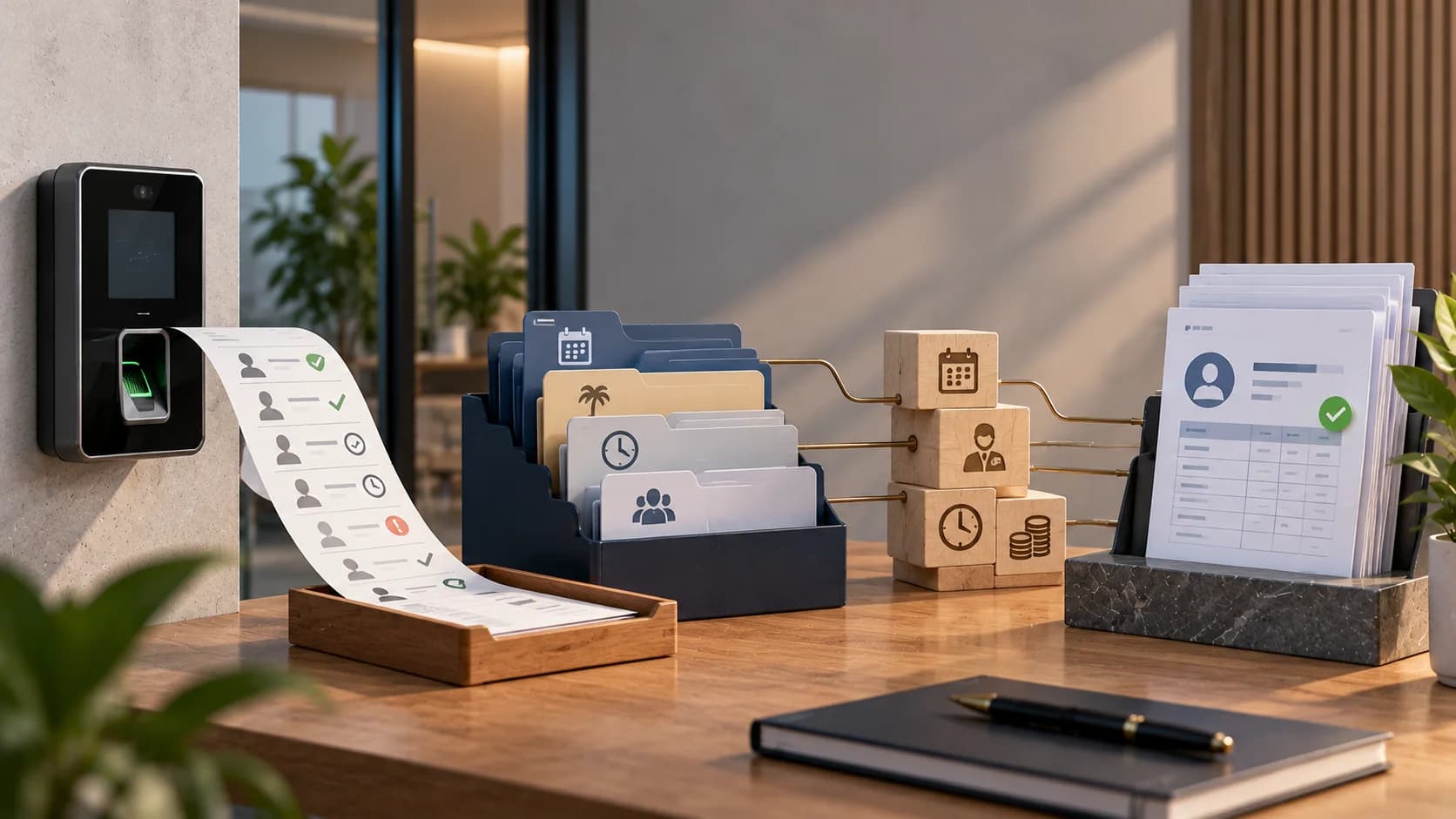
Biometric attendance payroll systems have become common across industries with hourly or shift-based workforces, replacing manual timesheets and card-based systems with fingerprint, facial recognition, or other biometric clock-in methods. The technology solves a genuine problem: it makes it far harder for one employee to clock in on behalf of another and produces a more objective record of when someone actually arrived and left. What it does not automatically solve is the harder, more judgment-dependent work of turning that raw attendance data into an accurate payslip, which still depends on how well attendance is reconciled against leave records, overtime rules, and statutory pay requirements before payroll is finalized.

Key Takeaways
- Biometric attendance payroll systems prove who clocked in, but they do not apply pay rules, leave records or overtime policy.
- Missed punches, overtime rules and leave mismatches are where payslip errors most often start.
- Reconciliation works best as a standing step in every pay cycle, not a one-off check.
- Employees need a clear way to dispute a recorded punch before pay is finalised.
- Treat fingerprint and face data with the same care as financial payroll data.
| Dimension | Biometric attendance technology alone | Technology plus dedicated reconciliation |
|---|---|---|
| Identity verification | Strong, hard to share or fake | Same strength, unchanged |
| Missed punches and exceptions | Left as gaps in the record | Investigated and corrected before payroll runs |
| Overtime and leave reconciliation | Not performed by the device | Actively reconciled each pay cycle |
| Employee disputes | No clear resolution path by default | Documented process for review and correction |
This piece looks closely at what biometric attendance technology reliably solves, where the connection between raw attendance data and an accurate payslip tends to break down, and why leave and attendance reconciliation deserves to be treated as a dedicated, ongoing part of payroll rather than an assumed byproduct of good hardware. This complements our related comparison of API-based payroll software against EPF and ESI compliance management, which looks at a different part of the same payroll accuracy chain.
What Biometric Attendance Technology Actually Captures
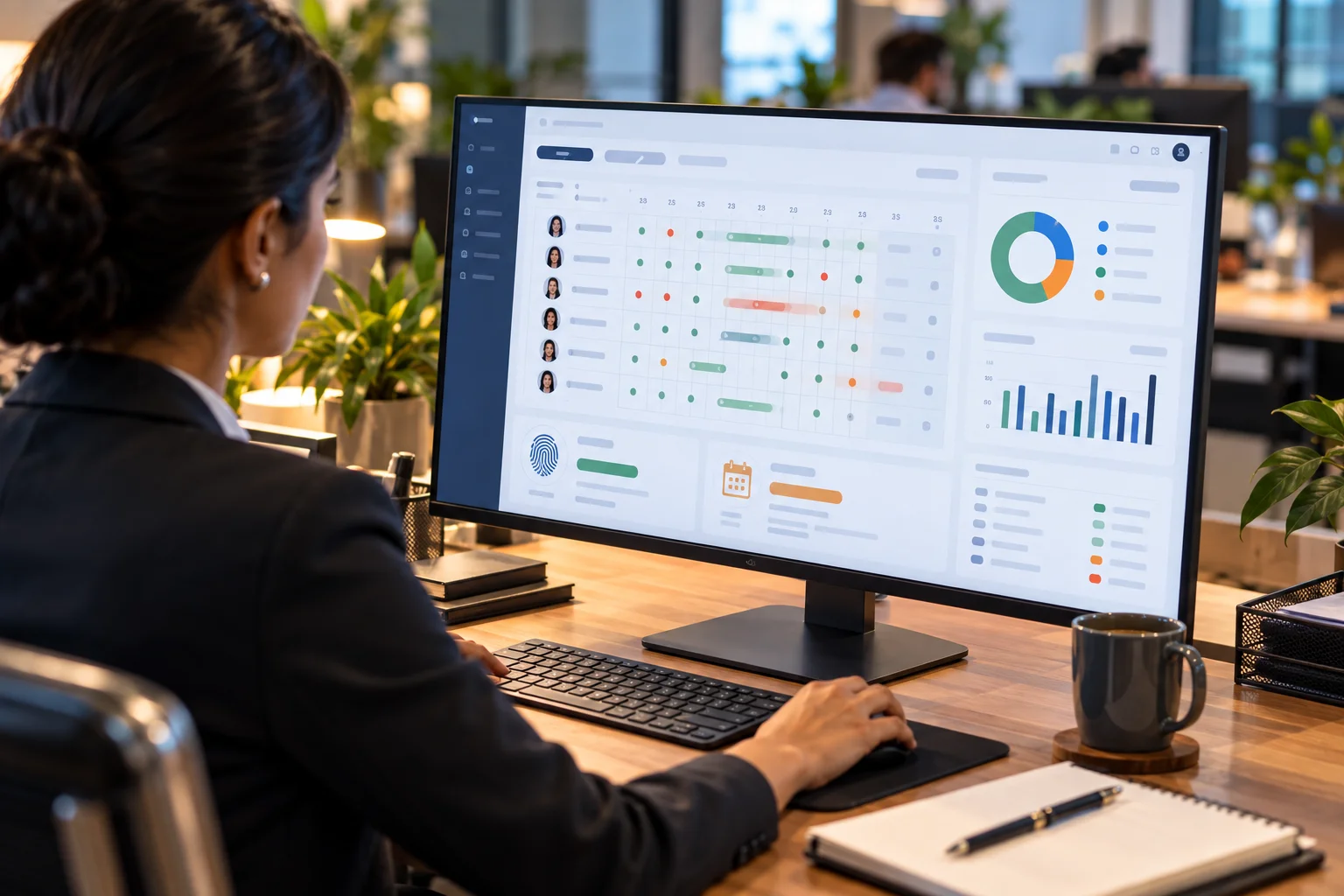
At its core, a biometric attendance system captures a timestamp tied to a verified individual, using a fingerprint scan, facial recognition, or another biometric marker to confirm identity at the point of clock-in and clock-out. This is a meaningful improvement over systems that rely on a card, badge, or PIN, all of which can be shared, borrowed, or used by someone other than the intended employee. For businesses concerned about buddy punching, where one employee clocks in for an absent colleague, biometric verification directly addresses that specific problem in a way manual or card-based systems cannot.
Time and Attendance Technology Has Limits Too
Time and attendance technology, biometric or otherwise, is still fundamentally a data capture tool. It records when someone was physically present at a device, but it does not, on its own, understand the context around that presence: whether a late arrival was pre-approved, whether a missed punch reflects a genuine absence or a device malfunction, or whether a particular shift qualifies for a special pay rate under a specific policy. These are all interpretive questions that raw attendance data cannot answer by itself, no matter how precisely the underlying biometric capture technology performs.
Adoption Has Grown Across Shift-Based Industries
Retail, manufacturing, healthcare, hospitality, and logistics have all seen growing adoption of biometric attendance systems over the past several years, driven partly by falling hardware costs and partly by a genuine desire to tighten up time tracking across large, distributed, shift-based workforces. In these environments, even small inaccuracies in time tracking, whether from buddy punching or simple manual entry errors, can add up to a meaningful cost across hundreds or thousands of shifts each month, which makes the upfront investment in biometric hardware relatively easy to justify on paper.
The harder question, addressed less often in vendor pitches, is what happens to that captured data once it leaves the device and needs to be turned into an accurate payslip.
Where Biometric Attendance Payroll Accuracy Breaks Down
Biometric attendance payroll accuracy depends on far more than accurate attendance capture. It depends on correctly applying overtime rules to the hours captured, correctly reconciling attendance against approved leave so an employee isn't marked both present and on leave for the same period, and correctly handling the exceptions that inevitably arise: a device outage, a forgotten clock-out, a legitimate reason for an unusual pattern that needs to be reviewed rather than penalized automatically. A biometric system that captures data perfectly can still feed into a payroll process that produces an inaccurate payslip if the reconciliation step between raw attendance data and final pay calculation is weak or inconsistent.
Missed Punches Are More Common Than Expected
Even reliable biometric systems experience missed punches with some regularity: a device offline during a shift change, an employee working from a location without device access, or a genuine oversight during a busy period. Each missed punch creates a gap in the attendance record that someone needs to investigate and correct before payroll is finalized, typically by cross-referencing manager approval, other access logs, or the employee's own account of what happened. A business without a clear, consistent process for resolving these gaps risks either underpaying employees for hours genuinely worked or overpaying based on an assumption that fills the gap incorrectly.
Overtime Rules Are Rarely Simple
Overtime calculation is one of the more common places where accurate attendance data still produces an inaccurate payslip. Overtime eligibility often depends on factors beyond raw hours worked in a day or week, such as whether a shift crosses into a public holiday, whether an employee has already exceeded a monthly cap on overtime hours, or whether a specific role is exempt from overtime rules entirely under local regulations. A biometric system captures the hours accurately, but applying the correct overtime rule to those hours requires configuration that reflects current, jurisdiction-specific rules, and that configuration needs periodic review as regulations or internal policies change, not a one-time setup treated as permanent.
Attendance Reconciliation as a Distinct Discipline
Attendance reconciliation, the process of cross-checking biometric clock data against leave records, shift schedules, and manager approvals before payroll is calculated, deserves to be treated as its own distinct discipline rather than an automatic byproduct of having good attendance technology in place. This reconciliation catches situations where an employee's leave request was approved after they had already been marked absent by the system, where a public holiday needs to override a scheduled shift, or where a shift swap between two employees needs to be reflected correctly in both individuals' records rather than just one.
Communicating Attendance Policy Clearly to Employees
A meaningful share of attendance disputes originate not from a technology failure but from an employee not fully understanding how a policy applies to their situation, such as how a grace period for late arrival works, or how a missed punch should be reported and by when. Clear, accessible communication of these policies, ideally reinforced during onboarding and revisited periodically rather than mentioned once and forgotten, reduces the volume of disputes that reach payroll as unresolved discrepancies. This is a low-cost, high-value practice that many businesses underinvest in relative to the technology itself.
Why Reconciliation Errors Are Costly to Ignore
An attendance reconciliation error that goes unnoticed doesn't just affect a single payslip; it can compound over multiple pay periods if the underlying discrepancy isn't identified and corrected at its source. An employee consistently shorted a few hours of overtime pay each period because of a recurring reconciliation gap accumulates a meaningful shortfall over time, and correcting that retroactively, once discovered, requires more work and creates more employee frustration than catching and fixing the reconciliation process early would have.
Multi-Location Businesses Face Extra Complexity
Businesses running biometric attendance payroll across multiple physical locations, each with its own devices, shift patterns, and sometimes even different local labor rules, face a compounded version of the reconciliation challenge. Data from each location needs to be aggregated correctly into a single payroll run, and any inconsistency in how devices are configured or how local exceptions are handled across sites can introduce errors that are harder to spot than a single-location discrepancy would be. A centralized reconciliation process that specifically accounts for cross-location differences, rather than assuming every site behaves identically, is essential for businesses at this scale to maintain consistent payroll accuracy across their entire workforce.
Leave and Attendance Reconciliation Requires Ongoing Attention
Leave and attendance reconciliation is one of the specific payroll functions where biometric data and HR leave management systems most often fall out of sync. An employee who takes approved leave that was recorded in an HR system but not reflected back to the attendance platform can end up marked absent for a day they were actually on approved leave, creating a payroll discrepancy that, left unresolved, either underpays the employee or requires a manual correction after the fact. This is precisely the kind of recurring, detail-sensitive task that benefits from a dedicated review process rather than being left to resolve itself automatically.
Where Livida's Reconciliation Service Adds Value
Livida's leave and attendance reconciliation service exists specifically to close this gap, treating the intersection of attendance data and leave records as a standing part of every payroll cycle rather than an occasional check performed only when an employee raises a complaint, in the same way our comparison of AI-driven payroll platforms against managed payroll services frames accountability across the wider payroll function.
In India, this reconciliation also feeds directly into PF return filing each period.
Combined with payroll processing and salary disbursement, statutory compliance, and payslip generation, this reconciliation work ensures that the accuracy gained from investing in biometric attendance technology actually translates into an accurate final payslip, rather than being undermined by a reconciliation gap between two systems that were never designed to talk to each other seamlessly.
Integration Failures Are Often Silent
One of the more insidious risks in linking a biometric attendance payroll system to the payroll platform is a silent integration failure: a data feed between the attendance system and the payroll platform that stops working correctly, perhaps after a software update on either side, without triggering an obvious alert. In these situations, payroll may continue to run using stale or partial data for one or more pay periods before anyone notices the discrepancy, often only when an employee raises a concern about their pay.
Regularly testing the integration between attendance and payroll systems, rather than assuming a system that worked correctly last quarter is still working correctly today, is a simple but frequently overlooked safeguard against this kind of quiet failure.
Payroll Accuracy Is a Chain, Not a Single Step
Payroll accuracy depends on a chain of correct steps: accurate data capture, accurate reconciliation against leave and schedule records, correct application of overtime and statutory pay rules, and correct final calculation reflecting all of the above. A weakness at any single link in that chain undermines the accuracy of the final payslip regardless of how strong the other links are. Businesses that invest heavily in biometric attendance technology while neglecting the reconciliation and calculation steps downstream are strengthening one link in the chain while leaving others just as weak as before the technology investment.
Employee Disputes Need a Clear Resolution Path
Employees will occasionally dispute what a biometric system recorded, whether because of a genuine device malfunction, a forgotten clock-out, or a misunderstanding about how a particular shift was categorized. A fair, well-documented process for resolving these disputes, one that treats a reasonable employee concern seriously rather than defaulting to whatever the system recorded as automatically correct, matters both for payroll accuracy and for employee trust in the overall system. Businesses that lack this process tend to see disputes escalate unnecessarily, since employees without a clear resolution path often feel their only option is to escalate loudly to get attention.
Privacy Considerations Around Biometric Data
A biometric attendance payroll programme carries privacy sensitivities that businesses need to handle carefully, since fingerprint or facial recognition data is considerably more personal, and in some jurisdictions more strictly regulated, than a card number or PIN. Employers need clear policies on how biometric data is stored, who can access it, and how long it is retained after an employee leaves the organization, and these policies should be communicated transparently to employees rather than buried in an onboarding document no one reads carefully.
A business that treats biometric data with the same seriousness it applies to financial payroll data, rather than as a purely operational convenience, is better positioned to avoid both regulatory scrutiny and employee distrust.
Comparing Biometric Attendance Payroll Reconciliation Approaches
Some businesses attempt to handle attendance reconciliation entirely through automated rules configured within their time and attendance software, flagging discrepancies for later review but not assigning clear ownership for actually resolving them. Others build a manual review step into every pay cycle, with a designated person responsible for investigating flagged discrepancies before payroll is finalized. The manual review approach, while requiring more ongoing effort, tends to produce more consistently accurate payslips, particularly for businesses with shift-based or hourly workforces where exceptions are common rather than rare.
Training Managers to Approve Exceptions Correctly
Reconciliation processes often depend on managers reviewing and approving exceptions, such as a missed punch or a late arrival, before payroll is finalized. If managers are not clearly trained on what counts as an acceptable justification, or if approval happens hastily without genuinely reviewing the circumstances, the reconciliation step becomes a formality rather than a meaningful check. Investing in brief, periodic training for managers on how to review attendance exceptions carefully, and holding them accountable for the accuracy of their approvals, strengthens the entire reconciliation process considerably more than adding further layers of software automation on top of an already weak manual review step.
Building a Sustainable Reconciliation Process
A sustainable reconciliation process doesn't need to be complicated, but it does need clear ownership. These five fixes cover most of it:
- Name someone responsible for reviewing flagged discrepancies before each payroll run closes.
- Document how disputes are investigated and resolved.
- Check regularly that the biometric device, attendance software and payroll system are feeding data correctly to each other.
- Train managers on what counts as an acceptable justification for an attendance exception.
- Audit the full data path from device to payslip at set intervals.
Guidance on professional accountability in payroll and financial reporting is available from bodies such as AICPA & CIMA. Businesses that build this discipline into their payroll process from early on tend to avoid the larger, more disruptive reconciliation problems that surface in businesses that only address the issue after it has already caused employee complaints or a compliance concern.
Auditing the Full Data Path Periodically
Beyond day-to-day reconciliation, it is worth periodically auditing the entire data path from biometric device to final payslip: confirming that device clocks are synchronized correctly, that data transfer to the attendance software is complete and timely, that the attendance software's export to payroll is accurate, and that the payroll system's calculation logic reflects current policy. Each of these handoff points is a potential source of quiet, compounding error, and a periodic end-to-end audit, rather than only checking individual components in isolation, is far more likely to catch a systemic issue before it affects a large number of payslips.
Bringing It Together
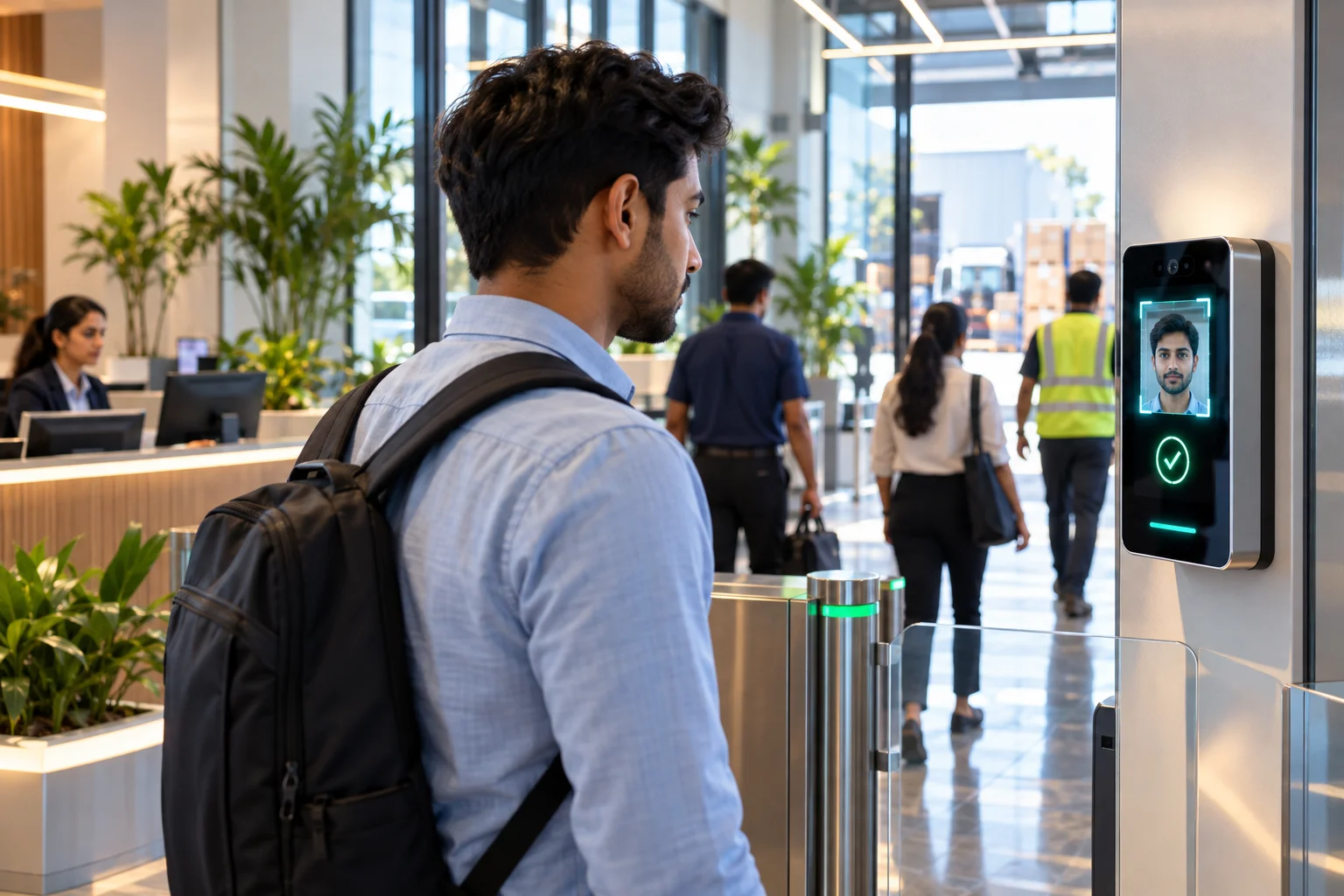
Biometric attendance payroll technology genuinely improves the accuracy and integrity of raw time data, addressing a real problem around identity verification that older attendance methods could not solve as reliably. It does not, by itself, guarantee an accurate final payslip, since that outcome depends on the reconciliation and calculation steps that turn captured attendance data into correctly calculated pay. Businesses that pair strong attendance technology with a disciplined, accountable reconciliation process get the full benefit of the technology investment, while those that treat the technology as a complete solution on its own often discover the gap only once it has already produced a payroll error.
Biometric attendance payroll technology will likely keep improving, with faster devices, better connectivity, and smarter anomaly detection built directly into the hardware and software over time. None of that progress removes the fundamental need for a disciplined reconciliation step between captured attendance data and the payroll calculation that ultimately determines what an employee is paid. Businesses that invest as seriously in that reconciliation discipline as they do in the attendance hardware itself are the ones that actually realize the payroll accuracy the technology was meant to deliver in the first place.
In the payroll runs we handle, the most common delay is a missed punch that is only found after the run has started. We recommend a cut-off date for exceptions, so that corrections are made before pay is calculated. Our related piece on real-time payroll against year-end accounting looks at how timing affects payroll accuracy, and mobile payslip apps against compliant payroll reporting covers what employees see at the end of the chain.
Conclusion
Biometric attendance payroll technology fixes identity, not interpretation. Accurate pay still depends on reconciliation, clear ownership and a fair dispute process. Build those around the hardware and the technology pays off.
This article is general information, not professional advice. Payroll, labour and privacy rules change and differ by country and state, so confirm current requirements with a qualified adviser before acting.
References
- Employees' Provident Fund Organisation (EPFO)
- Employees' State Insurance Corporation (ESIC)
- Digital Personal Data Protection Act, 2023: Digital India
Talk to Livida
If your business wants a closer look at how well your current attendance and payroll systems are reconciling with each other, Livida's team can review the process and flag where the gaps actually are. Our payroll and accounting teams also support ESI return filing and payroll tax compliance in India.
- Contact page: Talk to our team
- Email: info@livida.in
- Phone: +91 94860 33194